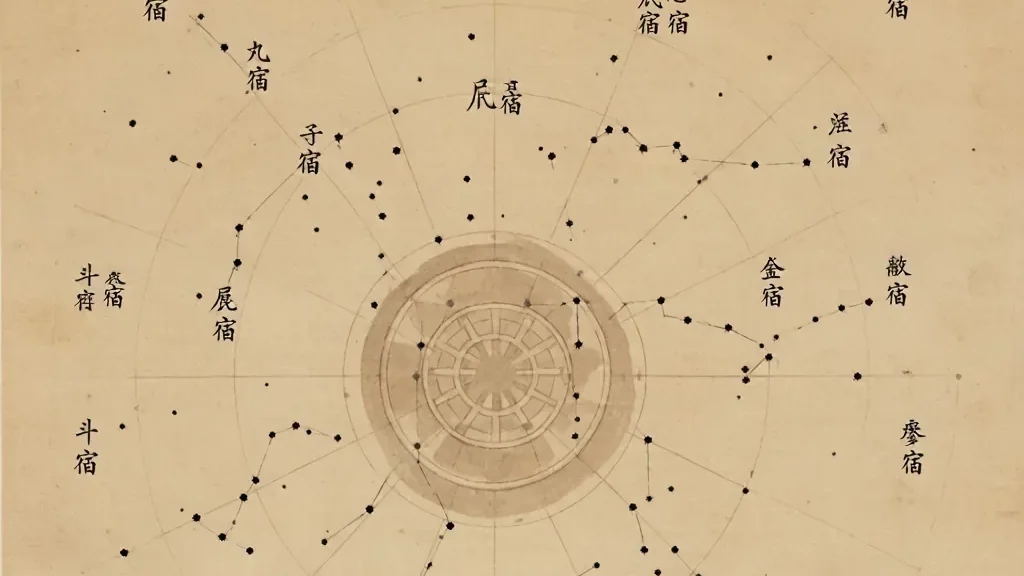
Long before the zodiac constellations of the West were codified, Chinese astronomers had already divided the sky into a wholly different grid. Instead of focusing on the sun's annual circuit through the ecliptic, they built their primary star map around the moon's daily journey. The result is the er shi ba xiu (二十八宿, èr shí bā xiù) — the "Twenty-Eight Lunar Mansions" — a system of 28 asterisms that ring the celestial equator like a beaded belt. For more than three thousand years, these mansions were the fundamental coordinates of Chinese astronomy, astrology, and calendrical science.
What Are the Twenty-Eight Lunar Mansions?
The moon takes roughly 27.3 days to complete one full orbit around the Earth. Chinese astronomers divided this path into 28 unequal segments, each anchored by a recognizable group of stars. The moon "lodges" in one mansion each night — hence the word xiu (宿), which means "to stay overnight" or "lodging." Unlike the Western zodiac, which follows the ecliptic and is tied to the sun, the mansions bracket the celestial equator and the moon's orbital plane, making them a lunar rather than solar coordinate system.
Each mansion has a poetic name, often drawn from the objects or creatures its stars were thought to resemble. The first mansion, for instance, is "Horn" (角, jiǎo) — the bright star Spica in the constellation Virgo — named because the Chinese saw it as the horn of the Azure Dragon. "Neck" (亢, kàng) follows as the dragon's throat, then "Base" (氐, dǐ) as its chest, and so on around the circle. The names are not merely decorative: they encode the position within the larger celestial animal that the group of seven mansions collectively forms.
The system is older than any surviving written record of the Western zodiac. Evidence on Shang dynasty oracle bones (甲骨, jiǎ gǔ) shows that individual mansion names were already in use by the 13th century BCE for divination about wind, rain, and military campaigns. A full list of 28 appears in early Han texts such as the Huainanzi (淮南子, c. 139 BCE), and the system was already the backbone of the official calendar by the Warring States period.
The Four Celestial Symbols
The 28 mansions are not a flat list; they are organized into four groups of seven, each quarter of the sky governed by one of the Four Celestial Symbols (四象, sì xiàng). The eastern quarter, occupied by the Azure Dragon (青龙, qīng lóng), contains mansions 1–7: Horn, Neck, Base, Room, Heart, Tail, and Winnowing Basket. These correspond in Western terms to parts of Virgo, Libra, Scorpius, and Sagittarius.
The northern quarter belongs to the Black Tortoise (玄武, xuán wǔ) — a turtle entwined with a snake — and holds mansions 8–14: Dipper, Ox, Girl, Void, Roof, House, and Wall. Here the "Dipper" is the Northern Dipper (part of Ursa Major), and "Ox" is the star Altair. The western quarter is the White Tiger (白虎, bái hǔ), mansions 15–21: Legs, Bond, Stomach, Hairy Head, Net, Turtle Beak, and Three Stars. The southern quarter is the Vermilion Bird (朱雀, zhū què), mansions 22–28: Well, Ghost, Willow, Star, Extended Net, Wings, and Chariot.
Each symbol is associated with a cardinal direction, a season, one of the Five Elements (五行, wǔ xíng), and a moral quality. The dragon is wood and spring; the tiger is metal and autumn; the bird is fire and summer; the tortoise is water and winter. Earth, the fifth element, remains at the centre and is not assigned a symbol. This fourfold division of the sky is one of the most persistent and elegant structures in Chinese cosmology, linking the stars directly to the cycles of nature and the moral order of the state.
The Mansions in the Calendar
The mansions were not merely a stargazing aid — they were the computational foundation of the Chinese calendar. Because the moon revisits the same mansion after roughly 27–28 days, astronomers could track the lunar month by observing which mansion the moon occupied at sunset. The mansions also served as reference points for the sun's position: at any given date, the sun rises and sets within a specific mansion, and the conjunction of the sun and a particular mansion marked the start of a new solar month.
The taichu ling (太初历, "Grand Inception Calendar") of 104 BCE, one of the great calendrical reforms of the Han dynasty, made the mansions integral to its calculations. The length of a solar year was determined by timing the sun's return to a specific mansion, and the intercalary month — the extra lunar month needed to keep the calendar in sync with the seasons — was inserted when the sun and moon met in a mansion that signaled a seasonal excess. This system remained in use, with refinements, through the Qing dynasty.
In daily life, the mansions also functioned as a shorthand for time and direction. A traveler might say "the moon is in the Net mansion" instead of giving an hour; a farmer would plant when the moon entered the Root mansion and harvest when it entered the Chariot. Each of the 28 mansions was further associated with a specific animal — Rat (Horn), Ox (Neck), Tiger (Base), and so on — creating a cycle that was used for fortune-telling and personal horoscopes.
Cultural and Astrological Significance
No other culture has maintained a lunar mansion system for so long with such consistency. The Twenty-Eight Mansions appear in literature, art, and everyday divination from the Han dynasty to the present. In the classic novel Journey to the West (西游记, xī yóu jì), the protagonists encounter star deities who are the living embodiments of the mansions. The astrological practice of suiming (宿命, "mansion fate") assigns each person a birth mansion based on the moon's position on the day of their birth, and this mansion is thought to influence character and fortune throughout life.
In traditional architecture, the layout of temples, tombs, and even entire cities was sometimes aligned with the mansion system. The Forbidden City in Beijing, for example, was positioned with reference to the Pole Star, which sits at the centre of the mansion's celestial wheel. The four gates of the imperial city were named after the four symbols — the Meridian Gate (Wumen) faces the Vermilion Bird, and the northern gate faces the Black Tortoise.
The mansions also survive in modern Chinese astronomical terminology. When Chinese astronomers name a newly discovered asteroid or describe the location of a comet, they still use the traditional mansion names alongside modern equatorial coordinates. The system is thus not a museum piece but a living vocabulary — a 3,300-year-old star chart that still lets its users speak the sky in the language of dragons, birds, tigers, and turtles.
The Mansions and Modern Astronomy
Remarkably, the Twenty-Eight Mansions also serve as a valuable resource for modern historians of science. Because the mansion boundaries are defined by specific — and often very faint — stars, scholars can determine the epoch at which the boundaries were drawn by matching them against precession-corrected star positions. This analysis suggests that the system's core was fixed sometime between 800 and 600 BCE, during the Spring and Autumn period, when Chinese observers systematically mapped the sky for calendrical purposes.
The mansions also reveal the independent path of Chinese astronomy. Unlike the Greek tradition, which divided the sky into constellations based on mythological figures, the Chinese tradition divided it metrically, using the moon's motion as its natural ruler. This gave Chinese astronomy a practical, computational character from its very origins: the sky was not a story to be told but a clock to be read. And at the heart of that clock was the quiet, nightly progress of the moon through its 28 lodgings — each one a room in the great mansion of the heavens.