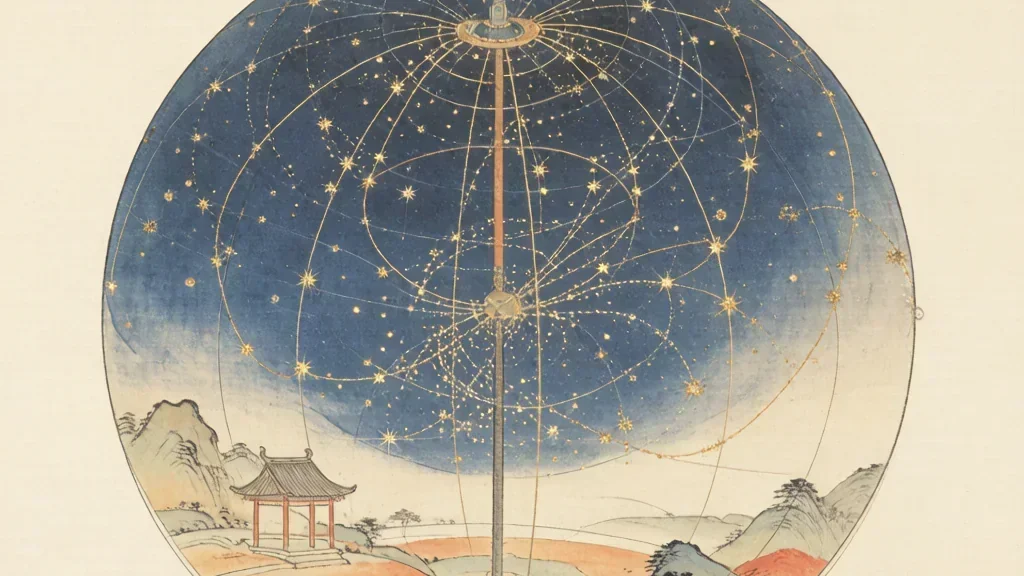
Before the telescope, before the Copernican revolution, and long before the modern understanding of gravity and orbits, Chinese thinkers debated the fundamental shape of the universe. Was the sky a domed canopy covering a flat, square Earth? Or was it a complete sphere enclosing a small, yolk-like world at its centre? The two great competing models — Gaitian (盖天说, gài tiān shuō, "canopy-heaven") and Huntian (浑天说, hún tiān shuō, "rounded-heaven") — framed Chinese cosmological discussion for more than a thousand years. Their debate was not merely philosophical: it influenced the design of instruments, the calculation of the calendar, and the self-image of the imperial state.
The Gaitian Theory: The Sky as Canopy
The Gaitian theory is the older of the two models, with roots in the Western Zhou dynasty (西周, Xī Zhōu, c. 1046–771 BCE). Its central image is captured in the famous phrase "the sky is round and the earth is square" (天圆地方, tiān yuán dì fāng). Under this model, the heavens form a hemispherical dome — like an overturned bowl or a circular umbrella — that covers a flat, four-cornered Earth. The dome rotates constantly, driven by a celestial wind or a cosmic axle, carrying the sun, moon, and stars around a central pivot.
The theory is described in the Zhoubi Suanjing (周髀算经, "Arithmetical Classic of the Gnomon and the Circular Paths of Heaven"), one of the oldest Chinese mathematical texts, probably compiled during the 1st century BCE but incorporating much earlier material. The Zhoubi uses the Gaitian model as the framework for its calculations of solar shadows and the seasons. It describes how the sun moves in concentric circles centered on the North Pole: its summer path is a smaller circle near the centre (making the days long and the sun high), and its winter path is a larger circle that takes it farther from the pole (making the days short and the sun low).
Although the Gaitian model seems primitive to modern eyes, it was not naive. It correctly predicted the increasing length of daylight from winter to summer and the variation in the sun's noon altitude. It also explained why the Pole Star remains fixed while all other stars wheel around it. However, it struggled with several phenomena: if the sky is a dome, why do some stars near the celestial equator rise and set, while stars near the pole never set? And why does the visible half of the sky change with the seasons while the Earth remains flat? These questions eventually opened the door to the rival Huntian theory.
The Huntian Theory: The Sky as Sphere
The Huntian theory emerged during the Warring States period (战国, Zhàn Guó, 475–221 BCE) and was fully articulated in the writings of the Han dynasty astronomer Zhang Heng (张衡, Zhāng Héng, 78–139 CE). In place of the flat canopy, Huntian proposed that the heavens were a complete sphere — the "celestial sphere" (浑天, hún tiān) — that rotated daily around a tilted axis. The Earth sat not at the absolute centre of the sphere but slightly below it, floating like the yolk of an egg. The water that surrounded the Earth in the lower half of the sphere explained why the stars appeared to rise from the eastern horizon and set in the west: they simply rotated out of the water's concealing grip.
Zhang Heng defended the Huntian model in his treatise Huntian Yi Zhu (浑天仪注, "Commentary on the Armillary Sphere"). He argued that the spherical model explained three observations that the canopy model could not. First, at the spring and autumn equinoxes, day and night are equal in length everywhere, which follows naturally from a spherical geometry but is hard to derive from a dome. Second, the same constellation appears at different altitudes at different seasons, which a sphere predicts and a canopy does not. Third, the moon and planets move in inclined orbits that can be modeled as rings on the sphere's surface.
The armillary sphere (浑天仪, hún tiān yí) — the physical embodiment of the Huntian theory — became the standard instrument of Chinese observatories for the next 1,500 years. By demonstrating that a spherical model could be built and made to turn in measurable agreement with the sky, Zhang Heng turned a philosophical debate into an engineering triumph.
The Third Model: Xuan Ye
A third, more radical model deserves mention. The Xuan Ye (宣夜说, xuān yè shuō, "Heavenly and Nightly" theory) held that the sky was infinite empty space in which the stars floated freely, with no solid celestial sphere at all. This theory was first recorded in the Jinshu (晋书, "Book of Jin") based on earlier Han dynasty sources: "The heavens are empty and void of substance. The sun, the moon, and the stars float in the empty space, their motion governed by the qi (气)."
The Xuan Ye theory is remarkable because it anticipates — in a qualitative way — the concept of an infinite universe filled with discrete celestial bodies. It did not, however, develop a mathematical framework to match its philosophical vision, and it never became influential enough to challenge the Huntian model's practical dominance. Nevertheless, it shows that Chinese cosmological speculation went beyond the two "standard" models and that the idea of a finite, solid firmament was not universally accepted.
The Debate over Earth's Shape
A critical question in the Gaitian-Huntian debate was the shape of the Earth. The Gaitian model required a flat Earth; the Huntian model was more ambiguous. Zhang Heng's egg analogy has sometimes been interpreted as implying a round Earth, but the dominant Han-dynasty view was that the Earth was flat — specifically, a flat disc or a square plate — floating in the cosmic waters within the celestial sphere. The idea that the Earth itself was a sphere did not gain traction in China until the arrival of Jesuit missionaries in the 17th century.
Yet some later Chinese thinkers pushed the boundaries. The Tang dynasty Buddhist monk and astronomer Yixing (一行, Yī Xíng, 683–727 CE) conducted a famous experiment in which he measured the lengths of gnomon shadows at multiple locations along a north-south line. He discovered that the shadow length changed faster per unit distance in the north than in the south — an effect that is exactly what one would predict on a spherical Earth, though Yixing himself did not draw that conclusion. The Song dynasty polymath Shen Kuo (沈括, Shěn Kuò, 1031–1095 CE) speculated that the Earth might float in space and that the "celestial sphere" was merely an optical effect of the atmosphere. These glimpses of a spherical Earth were not, however, developed into a comprehensive alternative model.
Legacy of the Cosmic Models
The Gaitian and Huntian models are fascinating not only for what they got right and wrong but for what they reveal about Chinese scientific thinking. Both models were geocentric, but they were not geocentric in the Ptolemaic sense: Chinese astronomy did not develop epicycles or deferents to explain planetary motion. Instead, it focused on the equatorial coordinates of the sky (the moon's path and the mansions) rather than the ecliptic coordinates that dominated Western astronomy. This equatorial bias, reinforced by the Huntian model's emphasis on the celestial equator and the pole, gave Chinese astronomy its distinctive character: practical, computational, and oriented toward the orderly rhythm of the seasons.
Even after the Gaitian model was officially superseded, its imagery persisted. The phrase "round sky, square earth" remained a cultural cliche for the natural order, and the square-earth symbolism was built into the architecture of the Ming and Qing imperial altars. The Temple of Heaven in Beijing, with its circular upper temple and square lower courtyard, deliberately reenacts the Gaitian cosmology — a nostalgic echo of the flat-canopy universe that once governed Chinese thinking about the heavens.