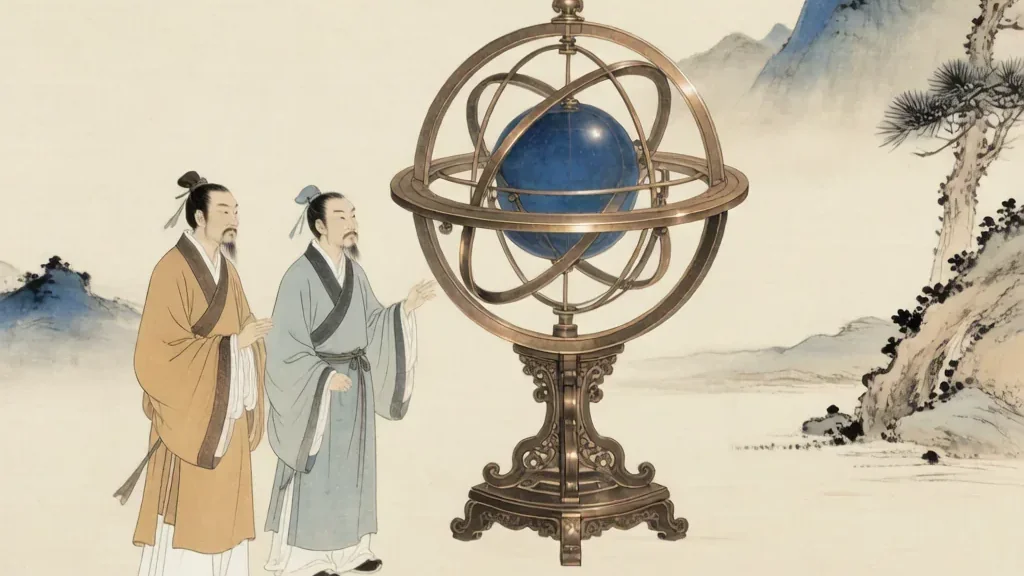
More than eighteen hundred years before the first mechanical clocks of medieval Europe, a Han dynasty scholar sat in the Imperial Observatory and watched a bronze globe turn by itself, ringed by slowly rotating metal circles, keeping perfect pace with the stars overhead. This was the hun tian yi (浑天仪, hún tiān yí) — the "armillary sphere" — and its maker, Zhang Heng, is one of the most remarkable scientific minds the ancient world produced. The instrument was not merely decorative; it was a working model of the sky, a clock, and a teaching engine all in one.
What Is an Armillary Sphere?
An armillary sphere is a skeleton model of the heavens built from interlocking rings. Each ring stands for one of the great circles that astronomers use to map the sky: the celestial equator, the ecliptic (the sun's yearly path), the meridian, and the horizon. The rings pivot around a central point — in Zhang Heng's "Huntian" theory, the Earth sits small at the centre while the sphere of stars rotates around it like a giant shell. By turning the rings and reading their graduated scales, a skilled observer could locate any star, show the sun's seasonal position, and demonstrate how day and night, solstices, and equinoxes all arise from one geometry.
The word hun (浑) means "whole" or "rounded," and tian (天) means "heaven." So the name literally announces the cosmological claim: the sky is a complete, spherical shell. This was a bold step away from the older flat-cover image of the heavens and toward the rounded, three-dimensional model that modern astronomy also uses.
Zhang Heng: The Man Behind the Machine
Zhang Heng (张衡, Zhāng Héng, 78–139 CE) lived under the Eastern Han dynasty and served as the Imperial Astronomer (太史令, tài shǐ lìng), the official responsible for the calendar, the portents, and the timekeeping instruments. He was no narrow technician. He wrote fu-rhapsodies (赋, fù) ranked among the finest literature of his age, calculated pi more accurately than his predecessors, improved the calendar, and mapped the stars. His most celebrated invention besides the armillary sphere is the houfeng didong yi (候风地动仪) — a bronze seismoscope shaped like a wine urn with dragon heads around its rim; when an earthquake struck, a single dragon would drop a bronze ball from its mouth, pointing to the direction of the quake hundreds of kilometres away.
Zhang Heng's career shows the classical Chinese ideal of the scholar-official who was at once poet and engineer. He believed that understanding the heavens was a moral duty because the harmony of the cosmos was mirrored in the order of the state, and disorder in one foretold disorder in the other.
The Water-Powered Celestial Globe
Zhang Heng's great innovation was to make the sphere run on its own. He coupled an armillary sphere to a "clepsydra" (漏壶, lòu hú), a constant-flow water clock. As water drained at a fixed rate from one vessel to another, its steady fall turned a train of gears that rotated the bronze celestial globe once every twenty-four hours — exactly matching the apparent daily rotation of the stars. A pointer attached to the globe thus always showed the current sky, so an astronomer indoors could announce the hour and name the stars rising at the horizon without stepping outside.
Later accounts say he also built a companion globe in a darkened room, linked to the armillary by the same gears, so that a visitor could watch a star rise on the inner globe at the very moment it rose in the real sky. This is essentially a planetarium, and it is the earliest known example of such a device. The gear ratios and the use of water as a power source make the machine a direct ancestor of the mechanical clock.
The Huntian Cosmology It Served
The armillary sphere embodied the "Huntian" (浑天说, hún tiān shuō) theory — the "rounded-heaven" model — which held that the sky is a sphere enclosing the Earth like the yolk inside an egg, with the Earth small and suspended within. This model was debated against the older "Gaitian" (盖天说, "canopy-heaven") flat-cover theory and eventually won because it predicted celestial motions far better. The instrument was therefore an argument as much as a tool: it let astronomers physically demonstrate that a spherical sky explained eclipses, the changing length of days, and the behavior of the planets.
Zhang Heng wrote a treatise, the "Huntian Yi Zhu" (浑天仪注), explaining the instrument and its underlying cosmology. Although the original bronze was lost, later dynasties rebuilt his design, and Tang and Song astronomers refined it with more rings and better escapements.
Scientific and Cultural Significance
The armillary sphere matters because it turned cosmology into something you could build and test. Instead of describing the heavens only in poetry or philosophy, Zhang Heng made a mathematical machine that embodied a predictive model — the essence of modern science. Its water-and-gear drive is a milestone in horology, and the idea of a self-turning globe survived into the great brass armillaries of the Ming and Qing observatories that still stand in Beijing today.
Culturally, the instrument expressed a deep Chinese conviction that human order and cosmic order are one. The astronomer was a servant of both the court and the heavens, and a well-run calendar was proof of a well-run state. Zhang Heng became a patron figure for inventors, and the hun tian yi remains the emblem of Chinese observational astronomy — a bronze argument that the sky is round, measurable, and knowable.
Zhang Heng and the Spirit of Han Science
Zhang Heng (张衡, Zhāng Héng, 78–139 CE) was not merely the inventor of the armillary sphere — he was a polymath whose work in astronomy, mathematics, and mechanical engineering made him the most celebrated scientist of the Han dynasty. His armillary sphere, powered by a water wheel, rotated in synchronization with the actual heavens, allowing observers to predict celestial movements with remarkable accuracy. He also created the first seismoscope (地动仪, dì dòng yí), which could detect earthquakes hundreds of miles away, and he correctly argued that the moon shines by reflected sunlight — a full millennium before Galileo. The Hun-tian (浑天, 'celestial sphere') theory he championed held that the heavens envelop the earth like an eggshell around the yolk, a view that remained foundational to Chinese astronomy through the Ming dynasty. The armillary sphere he perfected became the emblem of Chinese astronomy itself, and his dual identity — court astronomer and inventor of dazzling bronze machines — embodies the practical, observation-driven spirit of Han science.