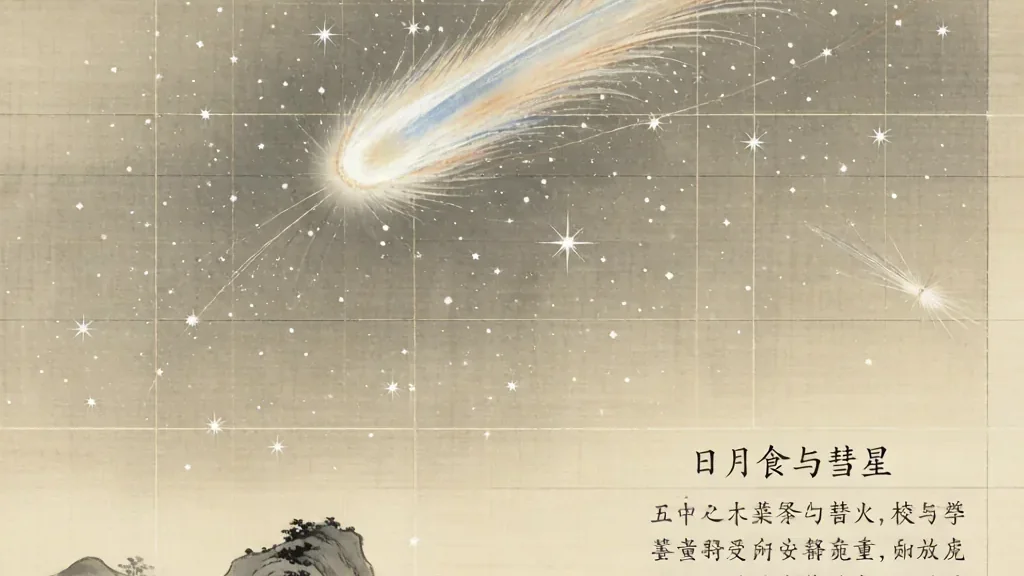
When a modern astronomer wants to study the behavior of a comet over two thousand years, or to verify a hypothesis about the gradual slowing of the Earth's rotation, the best place to look is not a European observatory. It is the dynastic histories of China. For more than three millennia, Chinese court astronomers recorded every striking celestial event they witnessed — solar and lunar eclipses, comets, meteors, sunspots, novas, and planetary conjunctions — and preserved those records in the official annals of each dynasty. The result is the longest continuous archive of astronomical observations in human history, a resource that modern science still mines for data.
Solar Eclipses: The Celestial Omen
In Chinese cosmology, a solar eclipse was the most portentous event in the sky. The sun was yang (阳) — the principle of light, the emperor, and the male force. When darkness consumed it, the cosmos itself seemed to falter. The traditional belief held that a celestial dragon or a sky dog was swallowing the sun, and the proper ritual response was for the court to gather in the courtyard, beat drums, and shoot arrows toward the sky to frighten the creature into releasing its prey.
Yet the same court that performed these rituals also undertook rigorous scientific prediction. The Spring and Autumn Annals (春秋, Chūn Qiū) — the chronicle of the state of Lu covering 722–481 BCE — records 37 solar eclipses. Modern astronomers, using computer models that account for the gradual slowing of the Earth's rotation, have confirmed that 33 of these 37 actually occurred and were visible in northern China. This is an astonishing hit rate for a text compiled 2,500 years ago. The annals record not just the fact of the eclipse but often its magnitude ("the sun was eaten to half") and its direction of travel.
The tradition continued without interruption through all subsequent dynasties. The Hanshu (汉书, "Book of Han") includes a detailed table of eclipses from 206 BCE to 5 CE. The Jinshu (晋书, "Book of Jin") contains the first known Chinese theoretical discussion of eclipse prediction using trigonometry. By the Tang dynasty, the imperial astronomers were publishing tables that gave the time of each eclipse to within an hour — performance that rivaled or exceeded contemporary Islamic and Indian astronomy.
Lunar Eclipses: A Different Sort of Sign
Lunar eclipses were treated somewhat differently. The moon was yin (阴) — associated with the empress, the earth, and the receptive forces. A lunar eclipse was therefore an omen concerning the women of the court or the harvest. The earliest reliable Chinese lunar eclipse record comes from the Shang oracle bones (c. 1200 BCE), which asked the ancestors whether the eclipse would bring disaster in the form of "rain and millet failure."
Because lunar eclipses are visible over an entire hemisphere and do not depend on the observer's location, they were far easier to predict than solar eclipses. By the Han dynasty, the Chinese calendar could predict lunar eclipses to within a few hours. The astronomers recognized that lunar eclipses could only occur at full moon, when the sun, Earth, and moon are aligned — a geometrical insight that was not yet fully developed in European astronomy at the same period. The Xin Tangshu (新唐书, "New Book of Tang") records that the Tang court "could announce the coming of a lunar eclipse to the palace with certainty three months in advance."
The records are so dense that modern astronomers have used them to measure the rate at which the Earth's rotation is slowing due to tidal friction. The difference between the predicted and observed times of ancient Chinese lunar eclipses reveals that the day has lengthened by roughly 1.7 milliseconds per century — a subtle datum that only a civilization with two thousand years of obsessive record-keeping could provide.
Comets: The Broom Stars of Heaven
Chinese astronomers called comets "broom stars" (彗星, huì xīng) because their tails swept across the sky like a straw broom sweeping a floor. A comet was almost always read as a warning: heaven was sweeping away the old to make room for the new, and the appearance of a broom star often preceded a change of ruler, a rebellion, or a war. The Hanshu explicitly advises: "When a broom star appears in the east, the general will be killed; when it appears in the south, the barbarians will invade; when it appears in the west, the heir apparent will be deposed; when it appears in the north, the empress will die."
Despite this ominous interpretation, the observational record is scrupulously factual. The Shiji (史记, "Records of the Grand Historian") by Sima Qian contains the earliest continuous listing of comets, beginning in the 4th century BCE. The most famous Chinese comet record is that of Halley's Comet. The Shiji records its appearance in 240 BCE: "The star appeared in the east; it was visible in the morning." Every subsequent return — in 163 BCE, 87 BCE, 12 BCE, and so on — was noted in the annals of the ruling dynasty, producing an unbroken chain of observations from 240 BCE to 1910 CE. No other civilization has anything approaching this record.
Modern astronomers have used the Chinese records to reconstruct the orbit of Halley's Comet with extraordinary precision. The data have also been used to study non-gravitational effects — the subtle changes in a comet's orbit caused by the jetting of gas and dust from its nucleus — since the historical positions can be compared with the predictions of purely gravitational theories.
Novas, Sunspots, and Other Phenomena
The Chinese annals also record phenomena that were invisible to the naked eye in Europe because they were too far south or too brief. The "guest stars" (客星, kè xīng) — novas and supernovas — were carefully dated and positioned. The most famous is the "guest star" of 1054 CE, recorded by Song dynasty astronomers in the constellation Taurus. This star exploded as a supernova, and its remnant is now known as the Crab Nebula (M1). The Chinese record allows modern astronomers to pinpoint the exact date of the explosion — July 4, 1054 — and to confirm that it was visible in daylight for 23 days.
Sunspots were also recorded. The Hanshu reports that in 28 BCE, "a black spot appeared in the sun; it vanished after three days." This is one of the earliest verifiable sunspot records in world history, predating Galileo's telescopic observations of sunspots by 1,600 years. By the Song dynasty, sunspots were being recorded as routine meteorological data, with information on their size, shape, and duration.
The Chinese astronomical archive — covering eclipses, comets, meteors, novas, sunspots, and planetary conjunctions — is thus a treasure house for historians of science. It reflects a civilization that, for reasons both political and intellectual, chose to watch the sky with unmatched patience and to write down everything it saw.