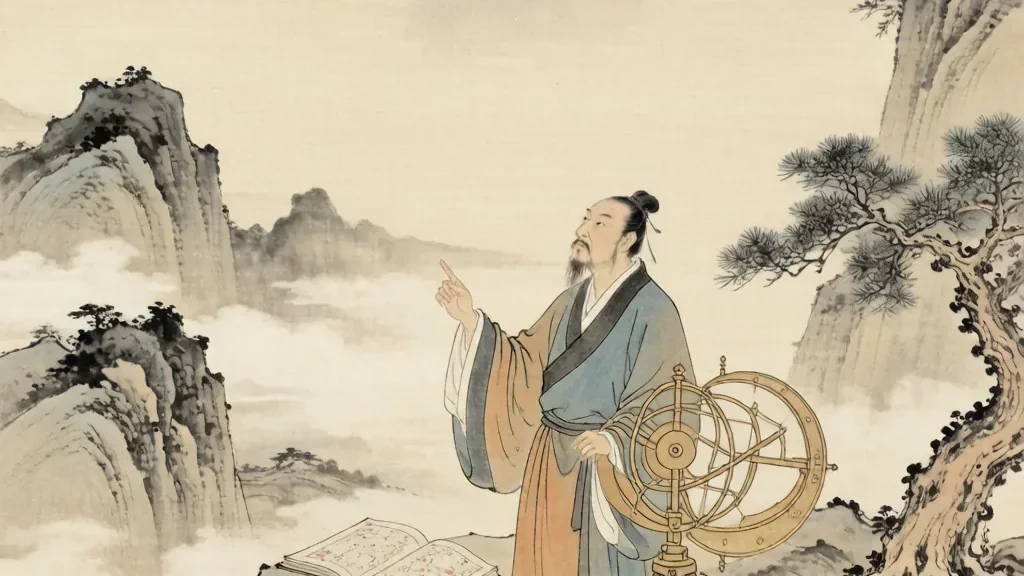
In traditional China, astronomy was never a purely academic pursuit. It was a branch of government. The emperor, as the Son of Heaven (天子, tiān zǐ), was responsible for maintaining the cosmic order — and that order could not be maintained without a reliable calendar, and a reliable calendar could not be compiled without meticulous observation of the sky. This principle is summed up in the phrase Guanxiang Shoushi (观象授时, guān xiàng shòu shí): "Observe the celestial phenomena to confer the seasons." It is one of the oldest and most enduring concepts in Chinese science, linking the throne, the stars, and the ploughed field in a single chain of cosmic responsibility.
The Mandate of the Sky Watchers
The earliest Chinese historical records already show a state obsessed with timekeeping. The Yaodian (尧典, "Canon of Yao") — part of the Book of Documents (尚书, shàng shū), a collection dating from the Zhou dynasty — describes how the mythical Emperor Yao commanded his astronomers to "calculate and delineate the movements of the sun, the moon, and the stars, and so respectfully confer the seasons upon the people." This passage, composed perhaps as early as the 7th century BCE, articulates the core idea: time is not a natural given that individuals can manage for themselves; it is a civilizational gift that the ruler must provide through scientific observation.
The practical consequence was an official astronomical bureau whose chief, the Imperial Astronomer (太史令, tài shǐ lìng), was one of the highest-ranking scholars in the court. The bureau's duties were laid down in detail: measure the length of the solar shadow at the solstices, record the rising and setting of the "determinative stars" (中星, zhōng xīng) that marked each season, predict lunar phases, and note any unusual celestial event — eclipses, comets, planetary conjunctions, sunspots — that might carry an omen for the dynasty. These observations were written into the court's "veritable records" (实录, shí lù) and later incorporated into the official dynastic histories.
Because the astronomical bureau's work was so politically sensitive, the instruments and methods were state secrets. Private astronomy was periodically banned on pain of death, especially after the fall of a dynasty, to prevent rebels from using celestial portents to claim the Mandate of Heaven. Only the state could speak for the stars.
Key Instruments and Methods
The central observational tool of Guanxiang Shoushi was the gnomon (圭表, guī biǎo) — a vertical pole whose shadow was measured on a horizontal scale. By tracking the length of the noon shadow throughout the year, the astronomer could determine the summer solstice (shortest shadow), the winter solstice (longest shadow), and the equinoxes (mid-length shadow). The distance between successive winter solstices gave the length of the solar year — the foundation of the calendar.
The armillary sphere (浑天仪, hún tiān yí), as perfected by Zhang Heng (张衡), added a third dimension. Where the gnomon gave a one-dimensional shadow length, the armillary sphere allowed the astronomer to measure the equatorial and ecliptic coordinates of any star or planet. With the addition of a sighting tube (窥管, kuī guǎn) — a movable tube aligned along the sphere's axis — the observer could pinpoint a celestial object's position with an accuracy of about one-sixth of a degree, which remained state-of-the-art worldwide until the invention of the telescope.
Water clocks (漏壶, lòu hú) provided the necessary time standard. The inflow clepsydra — a vessel that received a steady stream of water and marked the rising level against graduated lines — could measure intervals to within minutes over a full day. By combining the armillary sphere, the gnomon, and the clepsydra, Chinese astronomers could record the exact moment of a solstice or an eclipse with an accuracy that rivaled or exceeded contemporary European and Islamic observatories.
Recording Eclipses and Omens
No celestial event was more important to the Guanxiang Shoushi tradition than the solar eclipse. A solar eclipse was the visible moment when the cosmic order seemed to break: the sun — the symbol of the emperor himself — was devoured by a shadow. The traditional explanation was that a dragon or a celestial dog was swallowing the sun, and the proper response was for the court to beat drums, shoot arrows, and perform rituals to drive the creature away. But the astronomical bureau also had a more scientific duty: to predict the eclipse in advance.
Successfully predicting a solar eclipse was one of the greatest achievements a calendar could demonstrate. The Spring and Autumn Annals (春秋, chūn qiū) records 37 solar eclipses between 722 and 481 BCE, and modern astronomers have verified that all but a handful actually occurred. This record of accurate prediction, compiled at a time when no other civilization in the world was systematically recording eclipses, testifies to the observational skill of China's court astronomers. Conversely, a failure to predict an eclipse was a major political embarrassment — a sign that the calendar was out of order and, by extension, that the dynasty was losing its virtue.
Comets also carried heavy political weight. The appearance of a "broom star" (彗星, huì xīng) — a comet — was usually interpreted as a warning from heaven about impending disorder. The most famous example is Comet Halley, which was recorded in Chinese annals as early as 240 BCE — the earliest unambiguous observation of that comet anywhere in the world. Halley's comet returns every 75–76 years, and Chinese records contain continuous observations of every return from 240 BCE to 1910 CE, a unique resource for modern astronomers studying the comet's orbital evolution.
Cultural and Political Significance
Guanxiang Shoushi was far more than a technical procedure. It was a ritual performance of imperial authority. Each year, the emperor would issue the official calendar to his ministers and to the tributary states of Korea, Vietnam, and the Ryukyu Islands. Receiving the Chinese calendar was an act of political submission — an acknowledgment that the recipient's time was governed by the Chinese emperor. The calendar was thus an instrument of soft power as much as a tool for agriculture.
The phrase Guanxiang Shoushi also survived as a slogan of the Northern Song dynasty's (960–1127) great astronomical reform. The scholar-official Su Song (苏颂, Sū Sòng) used it to justify his building of the world's first known astronomical clock tower — a 12-meter-tall machine that combined an armillary sphere, a celestial globe, and a water-driven escapement mechanism, all housed in a pagoda-like structure in the capital Kaifeng. The tower was the ultimate expression of the principle: observe the stars, drive the mechanism, and announce the hours to the whole city.
Today, Guanxiang Shoushi is remembered as the guiding concept behind China's long and continuous tradition of observational astronomy. It explains why Chinese records are the world's richest repository of pre-telescopic data — 2,500 years of sunspots, comets, eclipses, and novas — and why the very idea of a "calendar" in Chinese culture is inseparable from the authority of the state.