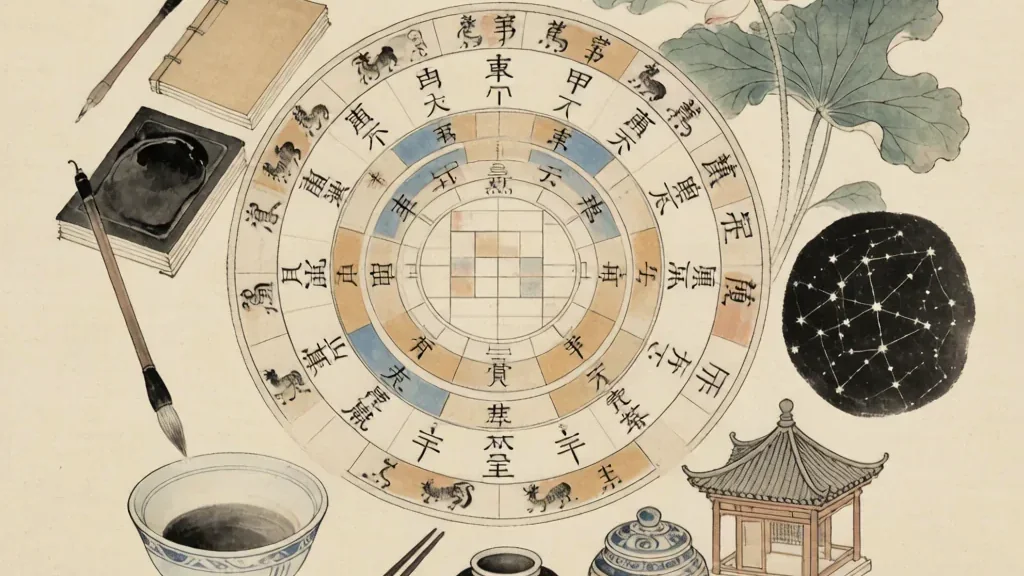
Of all the inventions Chinese civilization gave the world, none touches everyday life more intimately than its calendar. The nong li (农历, nóng lì) — the "peasant's calendar" — is a lunisolar timekeeping system that coordinates the cycles of the moon, the sun, and the stars into a single, elegant framework. At its heart is the gan zhi (干支, gān zhī) or "sexagenary cycle," a sixty-term repeating sequence that has named years, months, days, and even hours continuously for more than three thousand years — the longest unbroken chronological system on Earth.
The Lunisolar Principle
The challenge of any calendar is reconciling the moon's 29.5-day cycle with the sun's 365.25-day year. A purely lunar calendar — twelve months of 29 or 30 days — totals only 354 days, falling 11 days short of the solar year. Over three years the gap grows to a full month, and festivals meant for spring drift into summer. The Chinese solution was the intercalary month (闰月, rùn yuè): roughly every three years, an extra thirteenth month is inserted to bring the lunar and solar years back into alignment.
This intercalation was not guesswork. By the Spring and Autumn period (春秋, Chūn Qiū, 771–476 BCE), Chinese astronomers had developed the 19-year Metonic cycle — known in China as the "zhang" (章) cycle — in which 7 intercalary months are distributed across 19 years to synchronize the sun and moon. The Taichu Calendar (太初历) of 104 BCE, commissioned by Emperor Wu of Han, formalized this system and introduced precise rules for determining the length of each month based on the true new moon rather than a fixed alternation.
Because the calendar had to govern agriculture — telling the farmer when to plant, when to irrigate, when to harvest — it was also tied to the solar year through the 24 Solar Terms (节气, jié qì). Each term marks a specific point on the ecliptic, the sun's apparent path through the stars. "Start of Spring" (立春, lì chūn) falls around February 4, "Insects Awaken" (惊蛰, jīng zhé) around March 5, "Grain Rain" (谷雨, gǔ yǔ) around April 20, and so on. These terms are so reliable that Chinese farmers still consult them today, and the modern calendar publishes both the lunar date and the solar term side by side.
The Heavenly Stems and Earthly Branches
The sexagenary cycle is built from two parallel sequences. The first is the Ten Heavenly Stems (天干, tiān gān): Jia (甲), Yi (乙), Bing (丙), Ding (丁), Wu (戊), Ji (己), Geng (庚), Xin (辛), Ren (壬), Gui (癸). These are associated with the Five Elements (wood, fire, earth, metal, water) in their yin and yang aspects — the first Stem of each element is yang, the second yin. The second sequence is the Twelve Earthly Branches (地支, dì zhī): Zi (子, Rat), Chou (丑, Ox), Yin (寅, Tiger), Mao (卯, Rabbit), Chen (辰, Dragon), Si (巳, Snake), Wu (午, Horse), Wei (未, Goat), Shen (申, Monkey), You (酉, Rooster), Xu (戌, Dog), Hai (亥, Pig).
By pairing the first Stem with the first Branch, the second Stem with the second Branch, and so on, one generates a sequence of exactly 60 unique combinations before the cycle resets. The first term is Jia-Zi (甲子, Wood Rat), the second is Yi-Chou (乙丑, Wood Ox), and the cycle runs through to Gui-Hai (癸亥, Water Pig). Because 10 and 12 have a least common multiple of 60, every possible Stem-Branch pair appears exactly once in the cycle. This ingenious device — simple enough to memorize, precise enough for astronomical record-keeping — has been used continuously since at least the Shang dynasty, making it the world's oldest operational time-notation system.
The sexagenary cycle is applied at multiple scales. Year names repeat every 60 years, so a person born in a Jia-Zi year will turn 60 (a full cycle) in the next Jia-Zi year — a major longevity milestone celebrated as a "return to the beginning" (还历, huán lì). Days have been recorded in the sexagenary cycle without interruption since at least 720 BCE, allowing historians to correlate events in Chinese annals with absolute dates in the Western calendar with extraordinary precision.
History of Chinese Calendar Reform
No civilization reformed its calendar as often or as thoroughly as China. Over the course of two millennia, more than 50 official calendars were issued by imperial decree, each claiming to be more accurate than its predecessor. The first great reform was the Zhuanxu Calendar (颛顼历) of the Warring States period, which set the length of the tropical year at 365.25 days — identical to the value used in the Julian calendar. The Taichu Calendar of 104 BCE improved the year length to 365.3852 days and adopted the 19-year intercalation cycle.
The Tang and Song dynasties saw an explosion of calendrical precision. The Dayan Calendar (大衍历) of 729 CE, compiled by the Buddhist monk Yixing (一行, Yī Xíng), used trigonometric interpolation to predict solar and lunar motions and computed the year length to within two minutes of the modern value. Yixing also led the first large-scale survey of the length of a degree of latitude, sending teams across China to measure shadow lengths at the summer solstice. The Shoushi Calendar (授时历) of 1281 CE, developed under Kublai Khan by Guo Shoujing (郭守敬, Guō Shǒu Jìng), set the tropical year at 365.2425 days — exactly the same value used in the Gregorian calendar, which was not promulgated in Europe until 1582.
The current traditional calendar, known as the Shixian Calendar (时宪历), was compiled by Jesuit astronomers at the Qing court in 1645 and incorporates Western astronomical methods while preserving the indigenous lunisolar framework. It remains the authoritative calendar for determining the dates of Chinese New Year and all other traditional festivals.
The Calendar in Daily Life
The Chinese calendar is not a fossil. It governs the timing of the most important events in the lives of hundreds of millions of people. Chinese New Year (春节, chūn jié) always falls on the second new moon after the winter solstice, which places it between January 21 and February 20. The Mid-Autumn Festival (中秋节, zhōng qiū jié) is the full moon of the eighth lunar month. The Dragon Boat Festival (端午节, duān wǔ jié) is the fifth day of the fifth lunar month. None of these dates can be derived from the Gregorian calendar alone.
Beyond festivals, the sexagenary cycle is used in Chinese astrology to determine the "Four Pillars of Destiny" (四柱, sì zhù) — the Stem-Branch pairs for the year, month, day, and hour of a person's birth. These eight characters (八字, bā zì) form the basis of all traditional Chinese fortune-telling. The practice is so widespread that even today, many Chinese parents consult an astrologer before choosing a baby's name or a wedding date.
The calendar also survives in architecture and feng shui (风水, fēng shuǐ). The orientation of a house, the placement of a door, and the timing of a ground-breaking ceremony are all coordinated with the Stem-Branch cycle and the Solar Terms. The lunisolar calendar thus remains a living system — the most durable scientific and cultural framework in Chinese history, pulsing quietly beneath the digital clocks and smartphones of the modern world.