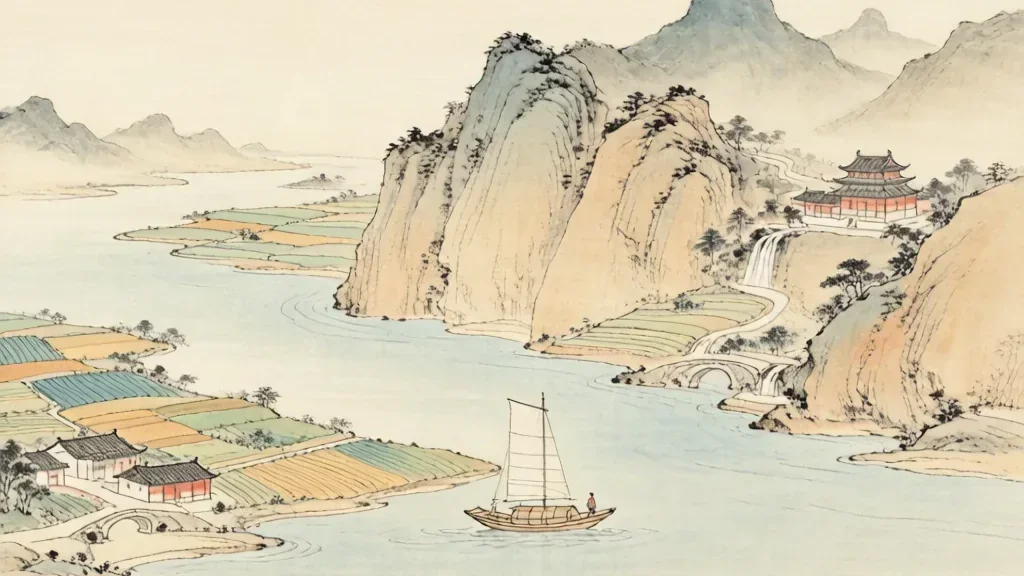
The Yangtze River (长江) — whose name literally means "Long River" — flows for 6,300 kilometers from the glaciers of the Tibetan Plateau to the East China Sea near Shanghai. It is the longest river in Asia, the third longest in the world after the Nile and the Amazon, and it has been the central artery of Chinese civilization for millennia. One-third of China's population lives within its vast drainage basin, and the river supports agriculture, transportation, industry, and culture on a scale that is difficult to comprehend. To call the Yangtze China's lifeblood is no exaggeration — it is the single most important geographical feature in the nation's history.
The Yangtze has many names along its course. In its upper reaches, near its source in Qinghai Province, it is known as the Tongtian River (通天河), or "River Passing Through Heaven." Further downstream, it becomes the Jinsha River (金沙江), or "River of Golden Sand," named for the gold that was once panned from its waters. Only after reaching Yibin in Sichuan Province does it take the name "Chang Jiang" — the Long River — that it carries to the sea. Each of these names tells a story about the river's character and the people who have lived along its banks.
The Three Gorges: Nature's Masterpiece
No discussion of the Yangtze would be complete without the Three Gorges (三峡) — Qutang, Wu, and Xiling — a stretch of the river where it cuts through the mountains of Chongqing and Hubei provinces. For 200 kilometers, the river narrows dramatically, squeezed between towering limestone cliffs that rise hundreds of meters on either side. The effect is breathtaking: sheer walls of stone, lush with vegetation, plunging into churning green water, with mist and cloud perpetually clinging to the peaks.
The Qutang Gorge (瞿塘峡) is the shortest but most dramatic of the three, only 8 kilometers long but so narrow that the sky appears as a thin ribbon overhead. The Wu Gorge (巫峡), 45 kilometers in length, is the most serene and beautiful, its twelve famous peaks often shrouded in mist and associated with the legend of the Goddess Peak (神女峰), a rock formation said to be a young woman waiting eternally for her husband's return. The Xiling Gorge (西陵峡), the longest at 66 kilometers, was historically the most dangerous, its treacherous rapids and hidden rocks claiming countless ships over the centuries. These gorges have inspired Chinese poets for over two thousand years. The Tang Dynasty master Li Bai (李白) captured their essence in his famous quatrain: "In the morning I depart Baidi City amid colorful clouds; a thousand li to Jiangling I arrive in a single day."
Ancient Civilizations Along the River
The Yangtze River basin is one of the cradles of Chinese civilization, with archaeological evidence of human settlement dating back over two million years. The Sanxingdui (三星堆) site in Sichuan Province, discovered in 1929, revealed a sophisticated Bronze Age culture that existed contemporaneously with the Shang Dynasty in the Yellow River valley, challenging the long-held assumption that Chinese civilization originated solely in the north. The site yielded extraordinary bronze masks with exaggerated features, gold foil ornaments, and a towering bronze "spirit tree" — artifacts unlike anything found elsewhere in China, suggesting a distinct and highly developed culture that flourished along the upper Yangtze.
Further downstream, the Liangzhu Culture (良渚文化) near modern-day Hangzhou left behind evidence of a sophisticated Neolithic society that mastered hydraulic engineering. Around 3300–2300 BCE, the Liangzhu people constructed an elaborate system of dams, reservoirs, and canals — one of the earliest known water management systems in the world — demonstrating that the Yangtze delta has been a center of technological innovation for over five thousand years. The river was also the birthplace of Qu Yuan (屈原), the great poet of the Warring States period whose tragic suicide by drowning in the Miluo River (a Yangtze tributary) is commemorated every year during the Dragon Boat Festival.
The Three Gorges Dam: Modern Engineering on an Ancient River
The Yangtze's modern chapter is dominated by the Three Gorges Dam (三峡大坝), the world's largest hydroelectric power station. Completed in 2012 after nearly two decades of construction, the dam stands 181 meters tall and stretches 2,335 meters across the river. Its 34 turbines generate a staggering 22,500 megawatts of electricity — enough to power millions of homes — and the reservoir behind it extends for 660 kilometers upstream.
The dam has been both celebrated and controversial. Proponents point to its flood control benefits (the Yangtze has historically experienced devastating floods that killed hundreds of thousands), its clean energy production, and its improvement of navigation on the upper river. Critics note the displacement of over 1.3 million people, the submergence of numerous archaeological and cultural sites, and the environmental impact on the river's ecosystem, including the critically endangered Yangtze River dolphin (白鱀豚), which is now believed to be functionally extinct. The dam stands as a monument to China's ambition and a reminder of the difficult choices involved in managing one of the world's greatest rivers.
Poetry and the River
Throughout Chinese literary history, the Yangtze has served as a powerful symbol — of the passage of time, of the vastness of the empire, of joy and sorrow alike. The Song Dynasty poet Su Shi (苏轼) wrote his most famous work, the "Ode to the Red Cliff," while exiled to a post along the Yangtze. In it, he gazes upon the river and reflects: "The Great River flows eastward, its waves washing away the heroes of a thousand ages." The river becomes a metaphor for time itself, its ceaseless flow erasing all human glory.
The Tang poet Du Fu (杜甫), often considered China's greatest poet, spent his later years living in a thatched cottage near the Yangtze and wrote many of his most moving verses about the river and the people who depended on it. His poetry captures both the river's beauty and its danger, the way it gives life and the way it can take it away — a duality that has defined humanity's relationship with the Yangtze since the first settlements appeared on its banks.
The River's Many Names
The Yangtze is less a single name than a sequence of them along its course. Near the glaciers of the Tibetan Plateau it begins as the Tuotuo and then the Tongtian River, the River Passing Through Heaven, suggesting its high, otherworldly source. As it swings north and east through deep gorges it becomes the Jinsha, the River of Golden Sand, named for the gold once panned from its beds and feared for its treacherous currents. Only at Yibin in Sichuan does it receive the name Chang Jiang, the Long River, which it keeps to the sea. Each name marks a change in landscape and in the people who lived beside it, a layered identity unusual for a single great river.
The Grand Canal and the Yangtze
The Yangtze's influence reached far beyond its banks through the Grand Canal, the immense artificial waterway linking Hangzhou on the river to Beijing in the north. Completed in its main form during the Sui dynasty, the canal let grain and tax goods from the rich Yangtze delta be shipped to the northern capital, binding south and north into one fiscal system. At the canal's junction with the Yangtze, cities such as Yangzhou grew rich as transshipment hubs. The canal turned the river from a regional artery into the linchpin of a continental empire, a feat of engineering that let a centralized state feed its capital from the southern harvest for over a thousand years. The waterway made the river the economic hinge of a unified empire.
Transport and Trade on the River
Today the Yangtze is China's commercial bloodstream. Oceangoing vessels reach as far upstream as Wuhan, and a dense fleet of barges carries coal, steel, grain, and containers between the interior and the port of Shanghai. The Three Gorges Dam added a series of locks that let large ships bypass the once-impassable rapids, cutting travel time and cost. River ports handle a substantial share of the nation's inland freight, and whole industries cluster along the banks to use cheap water transport. For centuries the river was a barrier to be crossed; now it is a highway to be ridden, the means by which the interior joins the global market. What was once a line on a map is now a moving highway of national commerce.
The Yangtze Delta Today
Where the river meets the sea, the Yangtze Delta forms one of the most dynamic regions on earth. Centered on Shanghai and stretching across Jiangsu and Zhejiang, it pairs the country's largest port with dense networks of manufacturing, finance, and research. The same fertile silt that built the ancient Liangzhu wetlands now underlies megacities and high-speed rail lines. Yet the delta also guards critical wetlands for migratory birds and struggles with the pollution of a heavily used river. Balancing growth with the health of the water is the delta's defining challenge, as the Long River that once fed civilizations now sustains, and is strained by, the weight of modern China. Its future will test whether prosperity and a clean river can be kept together.
❓ Frequently Asked Questions
📝 Chinese Vocabulary
- 长江 (Cháng Jiāng) — The Yangtze River, literally "Long River." Asia's longest river at 6,300 kilometers.
- 三峡 (Sān Xiá) — The Three Gorges: Qutang, Wu, and Xiling, a 200-kilometer stretch where the river cuts through towering mountains.
- 三峡大坝 (Sān Xiá Dà Bà) — The Three Gorges Dam, the world's largest hydroelectric power station, completed in 2012.
- 白鱀豚 (Bái Jì Tún) — The Yangtze River dolphin, a critically endangered (possibly extinct) freshwater dolphin species unique to the Yangtze.
- 大江东去,浪淘尽,千古风流人物 — "The Great River flows eastward, its waves washing away the heroes of a thousand ages." Famous lines from Su Shi's "Ode to the Red Cliff."
🎉 Fun Facts
- The Yangtze River discharges about 30,000 cubic meters of water per second into the East China Sea — enough to fill 12 Olympic-sized swimming pools every second.
- The river is home to the Chinese sturgeon (中华鲟), a "living fossil" that has existed for over 140 million years and can grow up to 5 meters in length and weigh up to 500 kilograms.
- The Yangtze's annual flooding historically deposited rich silt that created some of China's most fertile farmland, but catastrophic floods in 1931, 1954, and 1998 each killed tens of thousands and displaced millions.
- The Yangtze is traditionally taken as the boundary between North and South China, and locals say the dialect, cuisine, and climate all shift once you cross it.
- The river's source region on the Tibetan Plateau is so remote that it was not scientifically surveyed until expeditions in the 1970s.
- Before the first bridge at Wuhan opened in 1957, ferries were the only way to cross the Yangtze between the city's two halves.