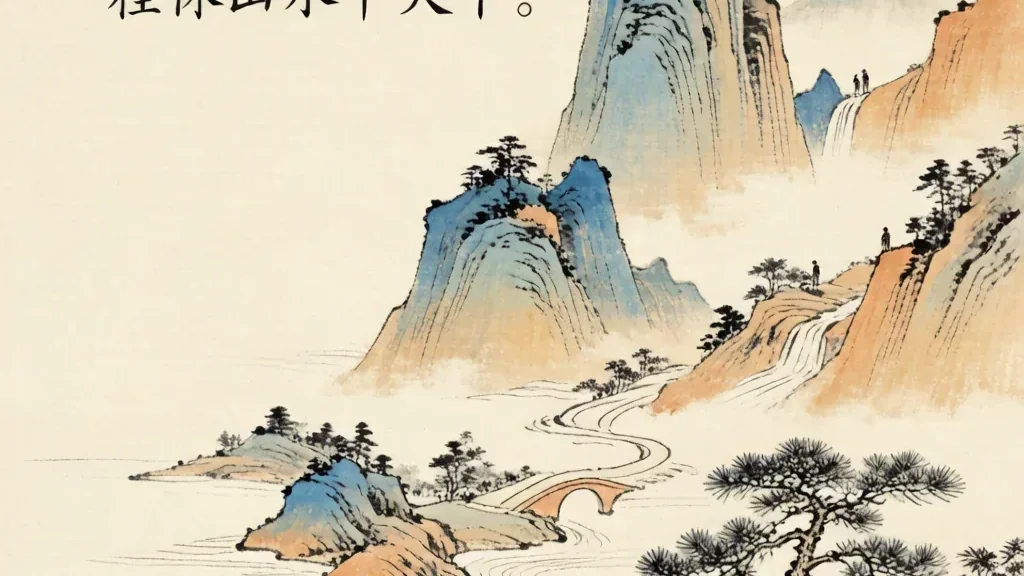
The Chinese phrase "桂林山水甲天下" — "Guilin's scenery is the best under heaven" — has been repeated so often for so many centuries that it has become almost cliché. And yet, one glimpse of the Li River winding through a forest of emerald karst peaks is enough to understand why no one has ever seriously challenged the claim. Guilin (桂林), a city of 5 million people in the Guangxi Zhuang Autonomous Region, sits at the heart of one of the most extraordinary landscapes on Earth — a surreal dreamscape of limestone towers, hidden caves, and winding waterways that has inspired Chinese poets, painters, and philosophers for over two thousand years.
Guilin's name means "Forest of Sweet Osmanthus," a reference to the fragrant osmanthus trees that fill the city with their perfume each autumn. But it is not the osmanthus that draws millions of visitors annually — it is the karst topography (喀斯特地貌), a geological phenomenon in which soluble limestone bedrock has been sculpted by water over hundreds of millions of years into the fantastical peaks that define the region. The result is a landscape that seems more like an artist's imagination than a product of geological processes — which may explain why Guilin has been the subject of Chinese painting and poetry for longer than almost any other place in the country.
The Li River: A Journey Through a Painting
The Li River (漓江) is the liquid thread that ties Guilin's scenery together. Flowing 437 kilometers from the Mao'er Mountains to the West River, its most celebrated stretch is the 83-kilometer cruise from Guilin to Yangshuo (阳朔). This journey — typically lasting four to five hours on a bamboo raft or tourist boat — takes travelers through a landscape so iconic that it appears on the back of China's 20-yuan banknote.
Along the way, the river winds past countless named peaks, each with its own legend. Elephant Trunk Hill (象鼻山), Guilin's symbol, is a natural arch that resembles an elephant drinking from the river. Mural Hill (九马画山), a massive cliff face, is said to contain the outlines of nine horses visible only to the most perceptive observers — and, according to local lore, anyone who can spot all nine is destined for greatness. Yellow Cloth Shoal (黄布倒影) produces the mirror-like reflections that appear on the 20-yuan note, with bamboo groves and water buffalo completing the timeless rural scene.
The riverbanks are dotted with villages where life has changed little for centuries. Fishermen still use cormorants (鸬鹚) to catch fish, a traditional technique in which trained birds dive into the water with rings around their necks (preventing them from swallowing large fish) and return their catch to their masters. The sight of a bamboo raft poled by a fisherman in a conical hat, with cormorants perched on the bow, against a backdrop of mist-shrouded peaks, is the quintessential image of Guilin — and of traditional China itself.
Reed Flute Cave and the Underground World
Guilin's beauty extends far below the surface. The same karst processes that created the above-ground peaks have carved out a vast network of caves filled with stalactites, stalagmites, and underground rivers. The most famous of these is Reed Flute Cave (芦笛岩), a 240-meter-long cavern named for the reeds that grow at its entrance, which were traditionally used to make flutes. Inside, colored lights illuminate formations with names like "Crystal Palace," "Dragon Pagoda," and "Virgin Forest" — a sometimes kitschy but undeniably spectacular presentation that attracts millions of visitors each year.
What makes Reed Flute Cave particularly remarkable is its documented history of human visitation. Over 70 ink inscriptions have been found on its walls, the oldest dating back to 792 CE during the Tang Dynasty. These ancient graffiti — some poetic, some simply recording a visit — prove that the cave has been a tourist attraction for over 1,200 years. Other notable caves in the region include Seven Star Cave (七星岩), Crown Cave (冠岩), and Silver Cave (银子岩), each with its own distinctive features and accompanying folklore.
Yangshuo: The End of the Journey
At the end of the Li River cruise lies Yangshuo (阳朔), a small county town that has become a legendary destination for backpackers, rock climbers, and travelers seeking a slower pace. Surrounded on all sides by karst peaks, Yangshuo offers a more intimate experience of the Guilin landscape. Visitors can cycle through rice paddies, float down the Yulong River (遇龙河) on bamboo rafts, or climb the region's limestone cliffs, which offer some of the best rock climbing in Asia.
The area around Yangshuo is home to several ethnic minority groups, including the Zhuang (壮族), Yao (瑶族), and Miao (苗族) peoples. Their traditional villages, festivals, and handicrafts add a rich cultural dimension to the natural beauty. The Zhuang people, in particular, are known for their embroidered clothing, silver jewelry, and the San Yue San (三月三) festival — the "Third Day of the Third Month" — a spring celebration featuring folk songs, bamboo dancing, and the preparation of five-colored glutinous rice.
Guilin in Chinese Art and Culture
Guilin's landscape has been a central subject of Chinese art for centuries. The misty karst peaks, winding rivers, and solitary fishermen of the region provided the perfect visual vocabulary for the Shanshui (山水) school of ink painting, which sought to capture not the literal appearance of nature but its essential spirit. The Southern Song painter Mi Fu (米芾), famous for his misty, atmospheric landscapes created with horizontal dots of ink, was directly inspired by the fog-shrouded peaks of southern China's karst regions.
Poets, too, have been moved to their finest work by Guilin's scenery. The Tang Dynasty poet Han Yu (韩愈) wrote of the Li River: "The river forms a green silk ribbon, the mountains are like jade hairpins" — a description so perfect that it is still quoted by every guide and appears in every travel brochure. The Southern Song poet Wang Zhenggong (王正功) is credited with coining the phrase "Guilin's scenery is the best under heaven" in a poem from 1201 CE, and the line has been Guilin's unofficial slogan ever since.
The landscape has also been immortalized in more modern media. Guilin's peaks appear on the 20-yuan banknote, making it one of the most viewed landscapes in the world. The region has served as a backdrop for numerous Chinese films, and its image is used to represent "China" in countless international contexts — from travel posters to corporate logos. In a very real sense, when the world pictures China, it often pictures Guilin.
The People and Festivals of the Karst
The Guilin region is far more than scenery. It is home to the Zhuang, the largest ethnic minority in Guangxi, as well as Yao and Miao communities whose villages dot the karst valleys. Their cultures add a human dimension to the peaks: the Zhuang are famed for embroidery and silverwork, and for the San Yue San festival on the third day of the third lunar month, when singers gather to trade folk songs in the open air. The legend of Liu Sanjie, a Zhuang maiden whose voice was said to move the mountains, has become a symbol of this musical heritage and is staged in light shows along the Li River. To know Guilin is to know both the stone and the songs of the people who have always lived among it.
Guilin Rice Noodles and Local Flavor
No visit to Guilin is complete without a bowl of Guilin rice noodles, known locally as mifen. Served at dawn in humble street stalls and bustling restaurants alike, the dish pairs springy rice noodles with a savory broth, braised meat, crushed peanuts, pickled bamboo, and a spoonful of chili, eaten standing or seated among neighbors. The recipe varies by shop, and locals debate the best version with the seriousness of connoisseurs. More than a breakfast, the noodles are a daily ritual that ties the city to its Guangxi roots, distinct from the wheat noodles of the north. Alongside the lake-and-peak tourism, this humble bowl is one of the most reliable ways to taste the region's character, proof that Guilin's culture is as nourishing as its views are famous.
A Landscape Under Protection
Guilin's fame is also a burden. Millions of visitors each year, riverside construction, and wastewater once threatened the very clarity that made the landscape legendary. In response, authorities have tightened rules on building near the Li River, moved or closed polluting factories, and run cleanup campaigns to keep the water and air clear for the painted reflections that define the scene. Cruise boats are managed and routes limited to protect the banks, and the karst hills themselves are guarded as a geologically fragile formation shaped over hundreds of millions of years. The challenge is to let people see the beauty without loving it away. Guilin's future depends on holding the line between access and preservation, so that the emerald peaks remain for the next generation of poets and travelers.
Climate and the Living Karst
Guilin's surreal forms are the work of a warm, wet climate as much as of rock. The region's plentiful rainfall, soaked from the summer monsoon, keeps the limestone constantly dissolving, slowly sharpening the pinnacles and deepening the caves. The same humidity feeds the mist that so often wraps the peaks at dawn, the soft veil that painters have loved for centuries and that gives the landscape its dreamlike quality. Seasons bring change: spring and early summer mists are thickest, while autumn offers the clearest light. This living karst is never finished; water still carves it grain by grain. The climate that made Guilin also sustains its rice, its osmanthus perfume, and the green that gives the hills their name, binding weather, water, and stone into a single continuing process.
❓ Frequently Asked Questions
📝 Chinese Vocabulary
- 桂林山水甲天下 (Guì Lín Shān Shuǐ Jiǎ Tiān Xià) — "Guilin's scenery is the best under heaven." The most famous phrase associated with Guilin, coined in 1201 CE.
- 喀斯特地貌 (Kā Sī Tè Dì Mào) — Karst topography, the distinctive limestone landscape created by the dissolution of soluble rocks over millions of years.
- 漓江 (Lí Jiāng) — The Li River, the scenic waterway that flows through Guilin's karst peaks, immortalized in painting, poetry, and on the 20-yuan banknote.
- 象鼻山 (Xiàng Bí Shān) — Elephant Trunk Hill, Guilin's most recognizable landmark, a natural arch resembling an elephant drinking from the river.
- 鸬鹚 (Lú Cí) — Cormorants, the birds traditionally used by Li River fishermen to catch fish, a practice dating back over a thousand years.
🎉 Fun Facts
- The karst peaks of Guilin appear on the 20-yuan banknote, making it one of the most reproduced landscapes in human history — seen by over a billion people every day.
- Reed Flute Cave has been open to tourists for over 1,200 years, with the earliest visitor inscription inside the cave dating to 792 CE during the Tang Dynasty.
- The Li River cormorant fishermen use a technique that dates back at least 1,300 years. The birds are trained from chicks and develop lifelong bonds with their human partners — some fishermen work with the same birds for over a decade.
- Guilin's karst peaks are so iconic that they appear not only on the 20-yuan note but also on numerous stamps, posters, and airline publicity as a stand-in for China itself.
- The nearby Yulong River, a quiet tributary of the Li, is famous for bamboo-raft drifting and has made the Yangshuo area one of Asia's most popular rock-climbing destinations.
- Guilin's Solitary Beauty Peak rises alone in the old city center and once anchored the ancient prefectural capital, with stone steps and carved inscriptions climbed by scholars for centuries.