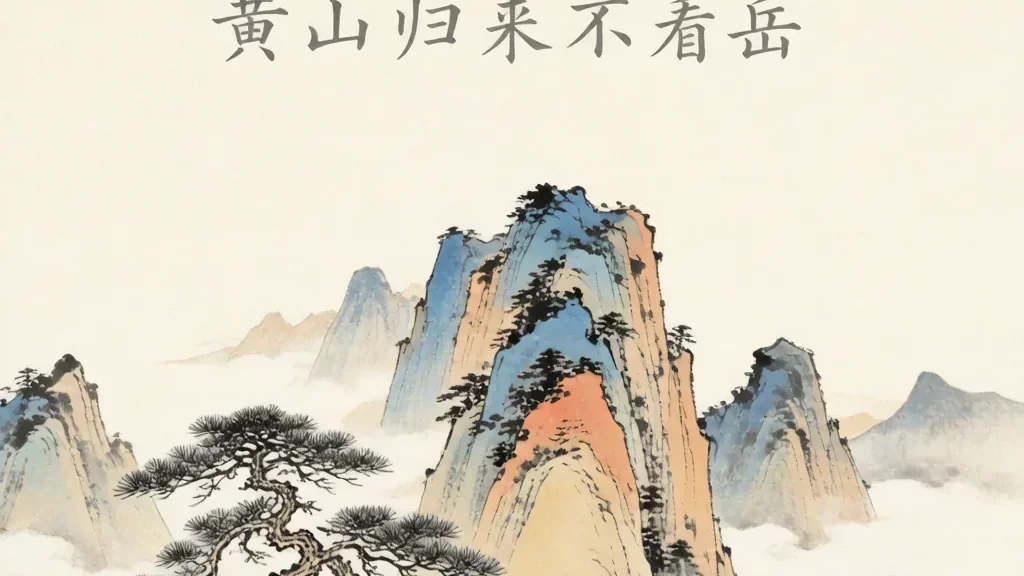
Huangshan, literally the Yellow Mountain, is a granite massif in southern Anhui Province in eastern China and one of the most celebrated scenic landscapes in the Chinese cultural imagination. Designated a UNESCO World Heritage Site in 1990 and a World Geopark, the range is renowned for what travellers and painters describe as its four great wonders: the strangely shaped pines that cling to bare rock, the fantastically eroded granite peaks, the rolling seas of cloud that fill the valleys at dawn, and the warm mineral springs at its foot. For more than a thousand years the mountain has been a destination for poets, monks, imperial pilgrims, and landscape painters, and its silhouette of soaring summits became the visual grammar of the Chinese ink-wash tradition. To stand on its high ridges at sunrise is to understand why the Ming dynasty explorer Xu Xiake declared that after seeing Huangshan he no longer cared to look at the Five Sacred Mountains themselves.
A Mountain of Granite Born from an Ancient Sea
The physical Huangshan is the product of deep geological time. Roughly one hundred forty million years ago, during the Mesozoic era, magma intruded into the crust beneath what is now Anhui and cooled slowly into a massive body of granite. Later, tectonic uplift raised this intrusive rock high above the surrounding land, while weathering and erosion over tens of millions of years stripped away the softer covering stone and sculpted the resistant granite into the sharp, vertical pillars that define the skyline today. The famous pinnacles, such as the Celestial Capital Peak and Lotus Peak, are essentially the exposed bones of that ancient pluton.
What makes the granite of Huangshan unusual is its jointing. The rock is split by two principal sets of vertical fractures and one horizontal fracture, a pattern that allows water and frost to pry blocks loose along clean planes. Freeze-thaw cycling widens these joints, and the result is a landscape of isolated turrets, knife-edge ridges, and rounded boulders balanced improbably on slender necks of stone. Geologists classify the area as a classic example of a glacially unmodified, subtropical granite峰林, and the exposed outcrops make the mountain a natural open-air laboratory for studying intrusive rock forms.
The soil that does exist is thin and acidic, clinging to ledges and hollows where windblown dust has accumulated. This poverty of earth is precisely why the vegetation is so striking: plants must anchor in cracks only a few centimetres wide, and the famous Huangshan pine has evolved to survive on almost nothing but mist, rain, and the minerals leached from the rock itself.
The Four Great Wonders of the Range
Huangshan’s reputation rests on four features that locals and guidebooks have distilled into a fixed canon. The first is the奇松, the wonderful pines, gnarled trees that grow horizontally out from cliff faces, their trunks bending toward the light and their roots probing deep into fissures. The second is the怪石, the strange rocks, natural sculptures that resemble animals, figures, and objects when viewed from particular vantage points. The third is the云海, the sea of clouds, which forms when moist air condenses over the peaks and the valleys fill with a level white ocean broken only by the tops of the mountains. The fourth is the温泉, the hot springs, which have flowed at a steady temperature near the western steps for centuries.
These four wonders are not independent curiosities but a single ecological and meteorological system. The abundant moisture that feeds the pines is the same humidity that produces the cloud sea; the weathering that creates the strange rocks is the same fracture network that gives the pines their precarious ledges. Visitors who climb in winter or early spring are most likely to see all four at once, because cold air pools in the valleys while the peaks remain clear, producing the dramatic inversion layer that turns the range into an archipelago of islands above a flowing mist.
Together the four wonders supply the aesthetic vocabulary that Chinese travellers use to judge the mountain. A good day on Huangshan is measured not by distance covered but by whether the clouds boiled up from the ravines, whether a particular pine caught the first gold light, and whether a boulder resolved itself into the shape of a monkey or a fairy maiden.
The Huangshan Pine and Its Living Architecture
The Huangshan pine, known to botanists as Pinus taiwanensis though long associated specifically with this mountain, is the signature organism of the range. Unlike the straight, timber pines of the lowlands, these trees grow矮 and broad, often sending a single limb horizontally outward for many metres to reach sunlight beyond the shade of the cliff. The Guest-Greeting Pine, a specimen near the Jade Screen Peak, has become the single most reproduced image of Huangshan: its longest branch extends toward the path as if welcoming visitors, and it appears on everything from postage stamps to restaurant murals.
These pines owe their form to hardship. Wind prunes every bud that points into the prevailing gusts, leaving only those that grow along the lee of the rock. Nutrients are scarce, so the tree invests in a wide, shallow root system that smears itself across the stone surface and dives into any crack it can find. The result is a plant that is technically a tree yet behaves like a bonsai grown by the mountain itself, each specimen a record of decades of wind direction, frost, and the slow chemistry of weathering granite.
Because the pines are slow growing and long lived, individual famous trees have acquired names, ages, and biographies. Some are estimated to be centuries old, and park authorities protect them as living monuments, fencing off the root zones and limiting foot traffic nearby. The Guest-Greeting Pine in particular is monitored for health, since its image is so tied to the identity of the place that its decline would feel like a national loss.
Peaks, Ridges, and the High Circuit
Huangshan’s summit area concentrates dozens of named peaks above seventeen hundred metres, but three dominate the experience. Lotus Peak, at about eighteen hundred sixty-four metres, is the highest point in the range and in all of Anhui. Bright Summit, at roughly eighteen hundred sixty metres, offers the most open panorama and is a favourite spot for watching the sunrise because its flat top holds the viewer above the cloud layer. Celestial Capital Peak, near eighteen hundred twenty-nine metres, is the steepest and most exposed of the trio, with iron chains bolted into the rock to help climbers on its final scramble.
The modern visitor ascends by a network of stone steps, built over centuries by monks and maintained by the park, that link the peaks into a circuit. Cable cars now reach two of the high saddles, sparing most travellers the full day of ascent on foot, but the ridge walks between summits remain strenuous and exposed. The West Sea Canyon, a deep ravine on the northwestern side, has been opened with suspended walkways that let hikers look straight down thousands of feet into a labyrinth of slender peaks.
What surprises many first-time visitors is how the mountain changes character with altitude. The forested lower slopes, with their streams and temples, give way to a treeless world of rock and wind, and then, above the cloud line, to a silent expanse of pinnacles fading into haze. The transition in a single morning of walking compresses several climate zones into a few vertical kilometres.
Cloud Seas, Sunrises, and the Light of the Mountain
The云海, or sea of clouds, is the spectacle most visitors travel to see, and its reliability is what sets Huangshan apart from merely tall hills. Because the range sits where moist air from the Yangtze delta meets cool air rising off the granite, clouds form frequently and settle into the valleys rather than shrouding the peaks. On a good morning the viewer stands on Bright Summit with the tops of neighbouring peaks emerging like islands from a calm white plain that extends to the horizon.
Sunrise and sunset are the two daily performances. In winter the sun rises late and the air is cold and clear, giving the best chance of a red dawn over the cloud sea; in summer the short nights and frequent thunderstorms make the light more variable but the vegetation lusher. Photographers speak of the magic light that follows a passing storm, when the wet granite darkens and the low sun turns the mist rose and gold.
The mountain’s weather is famously changeable, and local advice holds that one should not be disappointed by a grey morning, because the clouds that hide the view at nine o’clock may be the very clouds that become a sea by noon. Part of the Huangshan experience is learning to read the mist as a feature rather than an obstacle, a lesson that the painters of the literati tradition absorbed centuries ago.
Huangshan in Chinese Painting and Poetry
No single landscape is more responsible for the look of Chinese mountain painting than Huangshan. From the Ming and Qing dynasties onward, artists such as Mei Qing, Shi Tao, and the monks of the Huangshan school climbed the peaks and translated their vertical drama into ink and wash. The characteristic composition of a tall scroll, with a few bare trees on a ledge and a waterfall of mist between dark ridges, is directly borrowed from what these painters saw on the mountain. The loose, wet brushwork suited to suggesting cloud and vapor found its perfect subject in Huangshan’s weather.
Poets, too, made the mountain a recurring motif. The Tang dynasty poet Li Bai is traditionally said to have wandered here, and later writers composed verse on the hot springs, the pines, and the loneliness of the high ridges. The mountain entered the language as a shorthand for sublime withdrawal, the place a scholar might retire to when weary of court politics. The very act of naming the rocks, turns, and springs contributed to a literary map of the mountain that pilgrims still follow.
In the modern period Huangshan became a subject for photographers and a symbol used in tourism and diplomacy, its silhouette standing in for Chinese landscape beauty as a whole. Yet the older painterly relationship persists: many visitors arrive already knowing the mountain from scrolls and then find the real place uncannily familiar, as though the art had been a preview rather than an interpretation.
Temples, Hospices, and the Culture of Pilgrimage
Long before mass tourism, Huangshan was a sacred mountain with a scattering of Daoist and Buddhist sites. Hermits and monks built small temples and meditation huts on the slopes, and the hot springs were associated with healing and longevity. The labor of cutting steps and erecting railings fell to these religious communities and to later local officials, who recognized the mountain as a source of regional prestige. Remnants of old shrines sit beside the modern paths, and place names still recall the immortals said to have practicedalchemy among the rocks.
The practical culture of the mountain was carried by the bearers and innkeepers who served the pilgrimage route. For centuries, porters carried everything from temple offerings to the materials for mountaintop lodges on their backs up thousands of stone steps, and a network of simple hospices fed and sheltered travellers. Some of these hospices have become the modern hotels at the summits, but the logic of the place, a vertical world reached only by climbing, has changed less than one might expect.
Today the mountain manages this heritage with a UNESCO-mandated balance between access and preservation. Visitor numbers are capped on peak days, and the high lodges are supplied by a combination of cable car and the continuing labor of porters, so that the experience of arriving at a stone inn above the clouds still echoes the pilgrimage of earlier centuries.
The Hot Springs and the Foot of the Mountain
At the southwestern base of the mountain, near the Tangkou entrance, the Huangshan hot springs emerge at a temperature of around forty-two degrees Celsius and have been used for bathing since at least the Tang dynasty, when they were favored by the imperial court. The water is slightly sulphurous and rich in dissolved minerals, and the pools sit among bamboo and streamside rocks, a gentle counterpoint to the harsh grandeur above. Travellers traditionally soothe their legs here after descending from the peaks.
The spring area also anchors the cultural fringe of the mountain: teahouses, stone bridges, and the small museums that explain the geology and the paintings. The nearby town of Tunxi, now part of Huangshan City, preserves a stretch of old street with timber shops selling ink, tea, and the local Maofeng green tea, whose best leaves are picked on the lower slopes. The transition from hot spring to summit is thus a passage from cultivated comfort to elemental rock.
Because the springs flow year round at a near-constant temperature, they also serve as a microclimate refuge for plants and small animals that cannot survive the cold winds higher up. This makes the foot of the mountain biologically richer than the exposed summit, and a good place to observe the broader forest community of which the famous pines are only the most extreme members.
UNESCO Recognition and the Modern Park
Huangshan was inscribed on the UNESCO World Heritage List in 1990, cited for both its scenic beauty and its value as a model of granite landscape evolution, and it was later admitted to the Global Geoparks Network. The inscription formalized a management regime meant to protect the granite, the pines, and the viewshed from the pressures of growing visitor numbers. The park now operates under carrying-capacity limits, waste-removal systems, and reforestation of the lower slopes.
Modern infrastructure includes two cableways, a network of paved and railed paths, and summit hotels that let visitors watch sunrise without camping. Critics note that this development changes the solitary character the mountain once offered, yet the administration argues that concentrated infrastructure protects the surrounding rock by confining foot traffic to fixed corridors. The compromise is visible everywhere: a glass-floored viewing platform here, a roped-off pine there.
The mountain’s fame has also spread through its appearance in film and its adoption as a backdrop for national identity. Still, the core experience remains what it was for Xu Xiake: a vertical world of stone, pine, and cloud that rewards the effort of the climb with a perspective available almost nowhere else in China.
Visiting Huangshan: Seasons and Practical Wisdom
The best times to visit are widely held to be spring and autumn, when the weather is stable and the cloud seas frequent, though each season offers something distinct. Winter brings snow that caps the pines and clarifies the air, producing the iconic image of white-clad summits, but the paths can be icy and some facilities close. Summer is green and warm but prone to afternoon storms and the heaviest crowds.
Practical wisdom for the mountain centers on the weather and the legs. Visitors are advised to begin the ascent early, carry layers because the summit is far colder than the base, and reserve summit lodging in advance during holidays. The classic route takes two days, sleeping at a summit hotel to catch sunrise, but fit walkers can complete a circuit in a long day using the cable cars. The West Sea Canyon is best attempted in good weather, as its exposed walkways are unpleasant in wind and rain.
Above all, Huangshan rewards patience with the climate. The mountain that hides itself in mist for an hour may unveil a sea of clouds the next, and the travellers who plan for the possibility rather than demand a fixed view tend to leave with the deepest impression of why this granite massif has dominated Chinese ideas of natural beauty for a millennium.
❓ Frequently Asked Questions
Q: What is special about Huangshan (Yellow Mountain)?
A: Huangshan (黄山) is renowned for its 'Four Wonders': oddly-shaped granite peaks (奇松), ancient pine trees growing from sheer cliffs (怪石), seas of clouds (云海), and hot springs (温泉). It is one of China's most iconic landscapes and a UNESCO World Heritage Site.
Q: How did Huangshan get its name?
A: Huangshan means 'Yellow Mountain.' According to legend, the Yellow Emperor (黄帝, Huángdì) came to these mountains to cultivate immortality and refine elixirs. The mountain was renamed from 'Yi Mountain' (黟山) to 'Yellow Mountain' in 747 CE to honor this legend.
Q: What is the famous Welcoming Pine?
A: The Welcoming Pine (迎客松, Yíngkè Sōng) is a famous pine tree on Huangshan that grows from a cliff face, with one branch extending outward as if welcoming visitors. It is over 800 years old and appears in countless Chinese paintings and photographs.
Q: When is the best time to visit Huangshan?
A: Each season offers a different experience: spring for blooming flowers, summer for escaping heat but with more rain, autumn for the best chance of clear skies and colorful foliage, and winter for spectacular snow-covered peaks and rime ice formations.
Q: Where exactly is Huangshan located?
A: Huangshan lies in southern Anhui Province in eastern China, near the city of Huangshan, formerly Tunxi, and is reachable by rail and air from major eastern cities.
Q: What are the four great wonders of Huangshan?
A: They are the wonderfully shaped pines, the strangely eroded rocks, the sea of clouds that fills the valleys, and the hot springs at the foot of the mountain.
Q: How high is the tallest peak?
A: Lotus Peak is the highest at about eighteen hundred sixty-four metres, followed closely by Bright Summit and Celestial Capital Peak, both above eighteen hundred metres.
Q: When is the best time to see the cloud sea?
A: Winter and early spring offer the most reliable cloud seas, because cold air pools in the valleys while the peaks stay clear, though spring and autumn are also excellent.
Q: Can ordinary visitors reach the summit without climbing all the steps?
A: Yes, two cable cars reach high saddles on the mountain, and paved railed paths link the peaks, though the ridge walks remain strenuous and exposed.
Q: Why is Huangshan important in Chinese art?
A: From the Ming and Qing dynasties, painters of the Huangshan school translated its vertical peaks and mists into ink scrolls, giving Chinese landscape painting one of its defining images.