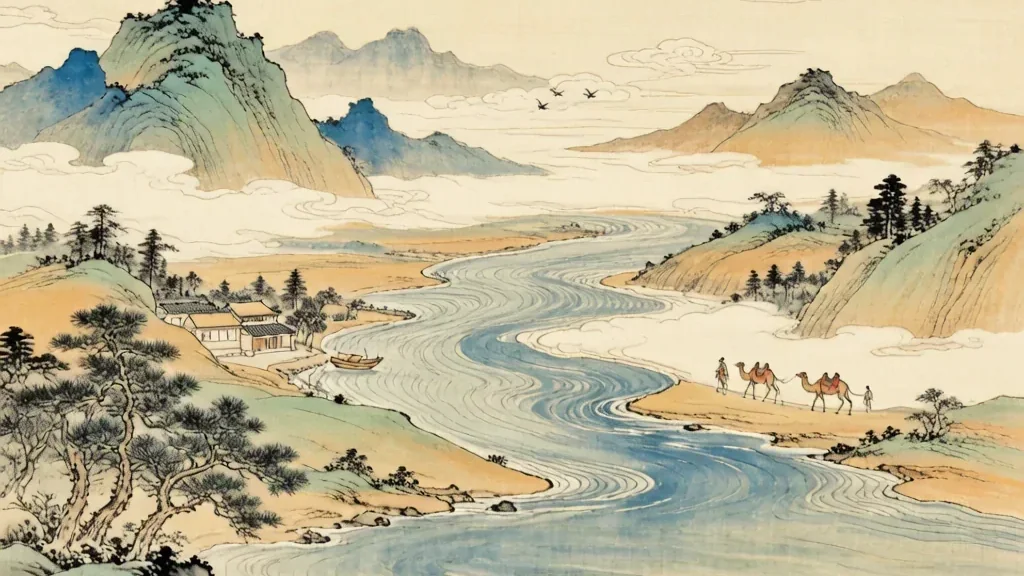
The Yellow River (黄河), known affectionately as China's "Mother River (母亲河)," flows for 5,464 kilometers from the Bayan Har Mountains of Qinghai Province to the Bohai Sea. It is the second-longest river in China and the sixth-longest in the world, but its true significance cannot be measured in kilometers alone. The Yellow River basin is the birthplace of Chinese civilization — the fertile loess plains along its middle and lower reaches nurtured the earliest Chinese dynasties, giving rise to writing, bronze metallurgy, and the philosophical traditions that would shape East Asia for millennia. Without the Yellow River, China as we know it would not exist.
The river's distinctive yellow-brown color comes from the enormous quantities of loess (黄土) — fine, wind-blown silt — that it carries from the Loess Plateau in northern China. This sediment load, the highest of any river in the world, has earned the Yellow River the nickname "China's Sorrow (中国之忧患)" because of its tendency to flood catastrophically. Over recorded history, the river has changed its course dramatically at least 26 times, its mouth shifting by hundreds of kilometers, and its floods have killed millions. The river gives life, but it also demands respect — a duality that has deeply shaped the Chinese worldview.
The Birth of Civilization: Xia, Shang, and Zhou
The Yellow River valley is where Chinese history begins. According to traditional accounts, the Xia Dynasty (夏朝) — China's first dynasty, founded around 2070 BCE by Yu the Great (大禹) — emerged along the Yellow River. Yu was not a conqueror but an engineer, a man who earned his throne by taming the river's floods. The story of Yu the Great, who spent thirteen years controlling the waters, passing his own home three times without entering because he could not rest while the people suffered, established a fundamental Chinese ideal: legitimate rule comes from service to the people and harmony with nature.
The Shang Dynasty (商朝), which followed the Xia around 1600 BCE, left the first indisputable archaeological evidence of Chinese civilization. The Shang capital at Anyang (安阳) yielded oracle bones — turtle shells and ox scapulae used for divination — that bear the earliest known examples of Chinese writing. These inscriptions reveal a sophisticated society with a complex bureaucracy, ancestor worship, and the use of bronze for ritual vessels and weapons. The Shang also practiced human sacrifice on a large scale, a dark aspect of their culture that reminds us of how far Chinese civilization has evolved.
The Zhou Dynasty (周朝), which overthrew the Shang around 1046 BCE, introduced the concept of the Mandate of Heaven (天命) — the idea that rulers govern by divine approval, which can be withdrawn if they become corrupt or incompetent. This revolutionary political philosophy, born in the Yellow River heartland, would legitimize dynastic change in China for the next three thousand years. The Zhou period also saw the flourishing of classical Chinese philosophy — Confucius (孔子), Laozi (老子), and the Hundred Schools of Thought all emerged from the intellectual ferment of the Yellow River civilization.
Loess and the Shaping of a Landscape
The Loess Plateau (黄土高原) through which the Yellow River flows is one of the most distinctive landscapes on Earth. Loess — fine-grained, yellowish silt deposited by wind over millions of years — covers an area of approximately 640,000 square kilometers, in places reaching depths of over 300 meters. This porous, easily eroded soil is both a blessing and a curse. Its fertility made early agriculture possible, supporting the rise of civilization, but its susceptibility to erosion has created one of the most severe environmental challenges in human history.
For centuries, the Loess Plateau was ravaged by deforestation and overgrazing, turning vast areas into a barren, eroded wasteland. The Yellow River carried away an estimated 1.6 billion tons of sediment annually, choking its lower reaches and raising the riverbed above the surrounding countryside — a phenomenon known as a "suspended river (地上河)" that made catastrophic flooding inevitable. In recent decades, however, China has undertaken one of the world's most ambitious ecological restoration projects on the Loess Plateau, planting billions of trees, terracing slopes, and restricting grazing. The results have been remarkable: the plateau is greening, erosion has decreased dramatically, and the Yellow River carries significantly less sediment than it did a generation ago.
Hukou Waterfall: The Yellow River's Roar
At Hukou Waterfall (壶口瀑布) on the border of Shaanxi and Shanxi provinces, the Yellow River performs one of nature's most dramatic spectacles. Here, the river — which can be 300 meters wide upstream — is suddenly constricted to a narrow gorge only 20 to 30 meters across, plunging 20 meters with a thunderous roar. The waterfall's name means "Kettle Mouth," a reference to the way the water appears to pour into a giant teapot. It is the largest waterfall on the Yellow River and the second-largest in China.
Hukou is more than a natural wonder; it is a national symbol. The waterfall's raw power — the churning yellow water, the perpetual mist, the deafening sound — has been compared to the indomitable spirit of the Chinese people. The famous wartime song "Defend the Yellow River (保卫黄河)," composed during the Second Sino-Japanese War, captures this association: "The wind is howling, the horses are neighing, the Yellow River is roaring!" For many Chinese, visiting Hukou is a pilgrimage to the heart of their civilization, a chance to feel the pulse of the mother river at its most powerful.
The Yellow River in Culture and Legend
Beyond its historical and geographical significance, the Yellow River occupies a sacred place in Chinese mythology. According to legend, the river god Hebo (河伯) controlled its waters, and ancient texts describe elaborate rituals performed to appease him. The most famous legend associated with the river is that of the Dragon Gate (龙门), a narrow passage in the middle reaches of the Yellow River where, it was said, carp that could leap the falls would transform into dragons. This legend gave rise to the Chinese expression "鲤鱼跳龙门" (the carp leaps over the Dragon Gate), a metaphor for a student who passes the imperial examinations or anyone who achieves success through perseverance.
Poets, too, have been drawn to the Yellow River. The Tang Dynasty poet Wang Zhihuan (王之涣) captured its vastness in his famous lines: "The Yellow River flows far into the white clouds; a lonely fortress stands amid ten thousand mountains." His contemporary Li Bai (李白) wrote with characteristic bravado: "Have you not seen the Yellow River's waters coming from heaven, rushing to the sea never to return?" — lines that are still memorized by every Chinese schoolchild.
The River's Course and Provinces
The Yellow River begins as a trickle on the northern slope of the Bayan Har Mountains in Qinghai and travels roughly 5,464 kilometers before reaching the Bohai Sea. Along the way it passes through nine provincial-level regions: Qinghai, Sichuan, Gansu, Ningxia, Inner Mongolia, Shaanxi, Shanxi, Henan, and Shandong. Its upper course tumbles through deep gorges on the Tibetan Plateau, the middle course cuts a dramatic valley between the two flanks of the Loess Plateau, and the lower course spreads across the flat North China Plain. Because the plain offers so little slope, the river moves slowly and drops much of its sediment, raising its bed over time. This long, winding path across very different landscapes helps explain why the Yellow River has meant so many things to the people who live along it, from a source of fertile silt to a recurring threat of flood.
Flood Control Through the Ages
For more than three thousand years, controlling the Yellow River has been a central task of Chinese government. Early states organized large labor forces to build earthen levees, and the legendary story of Yu the Great taming the floods became a model of worthy rule. Under the Han, Tang, and later dynasties, special river commissions were created to repair banks and dredge channels, because a single breach could drown villages and ruin harvests. The river's tendency to shift course made the work endless: when the bed rose above the plain, engineers had to choose between raising the levees higher or guiding the water to a new channel. In the nineteenth century a particularly catastrophic change sent the river's lower course far to the south for decades. These long struggles shaped Chinese ideas about the duties of the state and humanity's uneasy partnership with nature.
Dams and Modern Management
In the twentieth and twenty-first centuries, China turned to large dams to bring the Yellow River under control. The Sanmenxia Dam, built in the 1960s, was the first major effort but suffered from rapid siltation. Later projects learned from it: the Longyangxia Dam stores water on the upper river for power and irrigation, while the Xiaolangdi Dam near the middle reach is used to regulate floods and to flush accumulated sediment from the channel. Together these structures have greatly reduced the worst flooding and supply water for cities and farms across the north. Yet heavy withdrawal for industry and agriculture has sometimes left the lower river dry before it reaches the sea. Balancing the needs of people with the health of the river remains the central challenge of modern Yellow River management.
Wildlife Along the River
Although the Yellow River is best known for its sediment, it sustains a surprising variety of life. The river and its tributaries are home to fish such as the Yellow River carp, a species long valued in northern cooking, as well as several smaller minnows adapted to the silty water. In the wetlands of the upper plateau and the marshy lower delta, migratory birds including cranes, geese, and egrets rest and breed along ancient flyways. The estuary's mixing of fresh and salt water supports shrimp and crabs that feed larger animals. Centuries of water extraction, dam building, and pollution have reduced this biodiversity in places, and conservation projects now protect key wetlands. Even so, the river remains a living corridor of habitat stretching from the high Tibetan grasslands to the coastal Bohai Sea.
❓ Frequently Asked Questions
📝 Chinese Vocabulary
- 黄河 (Huáng Hé) — The Yellow River, China's second-longest river and the cradle of Chinese civilization, often called the "Mother River."
- 黄土 (Huáng Tǔ) — Loess, the fine, wind-blown yellow silt that gives the river its distinctive color and created the fertile plains of northern China.
- 大禹 (Dà Yǔ) — Yu the Great, the legendary founder of the Xia Dynasty who earned his throne by taming the Yellow River's floods.
- 壶口瀑布 (Hú Kǒu Pù Bù) — Hukou Waterfall, the largest waterfall on the Yellow River, where the river plunges into a narrow gorge.
- 鲤鱼跳龙门 (Lǐ Yú Tiào Lóng Mén) — "The carp leaps over the Dragon Gate," a metaphor for achieving success through hard work, derived from a Yellow River legend.
🎉 Fun Facts
- The Yellow River carries so much sediment that in some places the riverbed has risen 10 meters above the surrounding countryside, held in place only by artificial levees — making it literally a river flowing above the land.
- The Loess Plateau is the largest deposit of loess in the world, and its distinctive yellow soil is so fertile that ancient Chinese farmers could grow crops simply by scattering seeds on the ground.
- The Yellow River has changed its course so dramatically over history that its mouth has shifted by as much as 800 kilometers — from north of the Shandong Peninsula to south of it — in a single catastrophic flood.
- The Yellow River basin is considered one of the birthplaces of Chinese astronomy, because early dynasties used observations of its flood cycle to help regulate the farming calendar.
- The river's waters were once linked into the Grand Canal system, which moved grain from the northern plains toward the imperial capital.
- The river supports a distinct freshwater ecosystem, including the Yellow River carp, a fish long prized in the cooking of northern China.