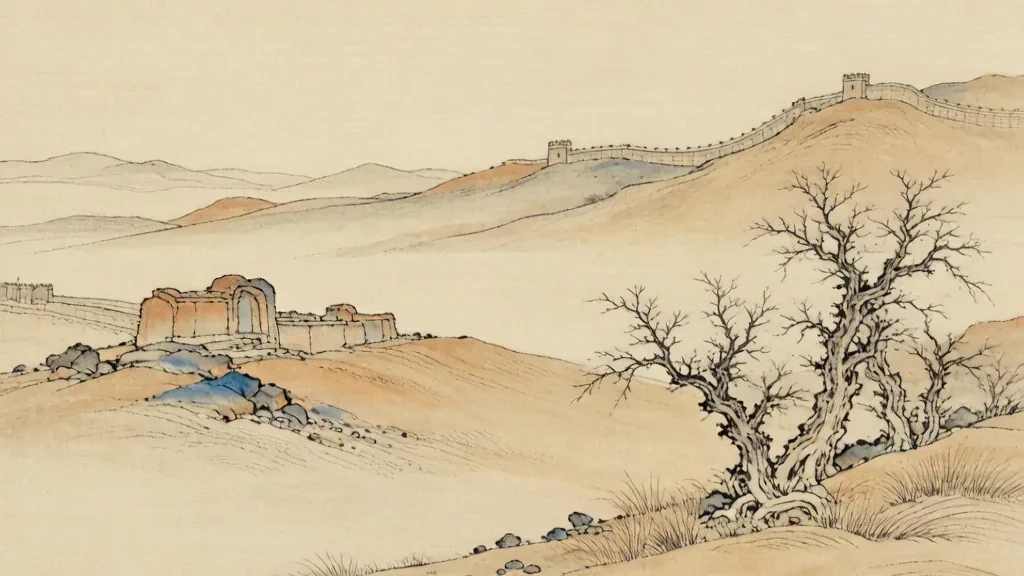
Stretching across the borderlands of northern China and southern Mongolia lies a desert that is not the sea of dunes many imagine, but a vast, stark expanse of gravel, rock, and hardy scrub. The Gobi — 戈壁 (Gēbì) — is one of the largest deserts in Asia, a cold desert where winter brings frost and where the horizon is often a line of distant, broken hills. For centuries it separated and connected the empires of the steppe and the sown, a gravel threshold at the edge of civilizations.
A Cold Desert of Gravel, Not Sand
The word "Gobi" in Mongolian conveys a stony, waterless expanse, and that is the reality: unlike the sandy Taklamakan, much of the Gobi is covered not by dunes but by bare rock and gravel pavement, with sparse grasses and low shrubs clinging to life between them. It is a "cold desert," meaning its aridity comes with sharp temperature swings, including freezing winters, rather than only desert heat.
The Gobi sprawls across southern Mongolia and into China's Inner Mongolia and beyond, a region of basins and low ranges rather than a single uniform plain. Its dryness stems from its position deep in the interior, far from any ocean and shielded by mountains that block moist air. What rain falls is sparse and erratic, and surface water is rare and precious.
Where Two Worlds Meet
The Gobi has always been a frontier zone. To its south lay the settled, farming civilization of China; to its north ranged the nomadic peoples of the Mongolian steppe. The desert was a barrier that limited invasion and a corridor that, where oases and hardy routes allowed, permitted movement of herds, armies, and goods. It was the meeting line between two ways of life.
This position made the Gobi a stage for grand history. Steppe empires rose beyond it, and Chinese dynasties built walls and sent expeditions toward it. The desert's very emptiness was a kind of defense, but also an invitation: those who could cross it connected the grasslands to the riches of the south. The Gobi was the edge of empires in both senses — the limit of their reach and the seam where they touched.
Life in a Harsh Land
Despite its severity, the Gobi supports life adapted to scarcity. Herders of the steppe keep sheep, goats, camels, and horses, moving with the sparse pasture and the seasons. The Bactrian camel, with its two humps, is the quintessential animal of the region, able to endure cold, drought, and long journeys without water, and it remains a symbol of survival on the gravel plain.
Wildlife, too, persists. The Gobi is home to rare and remarkable animals, including the wild ass and the elusive snow leopard in the bordering mountains, and famously the Gobi bear, a critically endangered creature found almost nowhere else. The desert's isolation has preserved a fragile ecology that scientists value precisely because so little of it has been altered.
Fossils, Dinosaurs, and the Ancient Past
The Gobi is one of the world's great repositories of dinosaur fossils. Its dry, eroding sediments have yielded nests of fossilized eggs, complete skeletons, and species unknown elsewhere, making it a magnet for paleontologists. The same aridity that limits life today helped preserve the remains of creatures that lived tens of millions of years ago.
These discoveries connect the Gobi to a deep time far older than the Silk Road or the steppe empires. To walk its surface is to walk over a cemetery of dinosaurs, where the wind uncovers bone as readily as it uncovers ruin. The desert is, in this sense, a library written in stone.
The Gobi and the Silk Road
Like the Taklamakan to the west, the Gobi lay across the northern reaches of the Silk Road, and caravans crossed it along routes where wells and oases permitted. The southern edge of the desert bordered the Hexi Corridor, the green thread that linked China to Central Asia, so the Gobi formed a northern wall to that corridor. Trade and tribute moved through the desert's margins, and its dangers were legendary among travelers.
The Gobi thus played a quiet but essential role in the geography of exchange. It was the testing ground that the northern route had to survive, and its oases were the punctuation marks in a long, lonely sentence of travel. Where the desert relented, towns appeared; where it did not, only the wind moved.
The Gobi in Modern Times
Today the Gobi spans an international border, shared by Mongolia and China, and its margins are changing. Mining extracts coal, copper, and other minerals from the desert's depths, bringing both development and environmental concern. Dust from the Gobi's dry surface, lifted by spring winds, can travel thousands of kilometers eastward, a reminder of how the desert's condition affects regions far away.
Yet the Gobi retains its character as a place of scale and silence, where the human footprint is still small against the gravel and the sky. For those who cross it, the desert offers the same lessons it offered the caravans and the khans: that the land at the edge of empires is its own kind of empire, ruled by wind, cold, and the patient endurance of life.
Dust Storms and the Distant Reach of the Gobi
Because the Gobi's surface is loose gravel and fine sediment with little plant cover, strong spring winds can lift enormous clouds of dust into the air. These storms, known in Chinese as sand-dust storms, darken the sky and can sweep eastward across northern China, the Yellow Sea, and sometimes reach the Korean peninsula and Japan. The dust carries minerals that can fertilize distant soils, but it also harms air quality and disrupts travel and health. In recent decades such storms have grown more noticeable as desert margins expand and dry seasons intensify. The Gobi's condition is therefore not a local matter: what the wind picks up on a remote plateau can fall as far away as city streets on the Pacific rim, binding the desert to the wider atmospheric system of East Asia.
Resources Beneath the Gravel
Beneath the Gobi's quiet surface lie deposits that have drawn miners for generations. The desert and its margins hold coal, copper, gold, and other minerals, and Mongolia's side in particular has become a major source of the copper and coal that feed Asian industry. Modern roads, railways, and mining towns have appeared where once only caravans passed, bringing jobs and infrastructure but also pressure on a fragile, slow-recovering ecology. Dust from open pits and the demand for water in an arid land are constant tensions. The Gobi thus stands at a crossroads between its ancient identity as an empty frontier and its modern role as a storehouse of the materials behind regional growth, a transformation that touches both the steppe and the cities that depend on what the desert yields.
❓ Frequently Asked Questions
📝 Chinese Vocabulary
戈壁 — : the Gobi, a stony, waterless desert.
沙漠 — : desert, though the Gobi is more gravel than sand.
骆驼 — : camel, the beast of the desert, especially the two-humped Bactrian.
草原 — : grassland, the steppe bordering the desert.
风沙 — : wind-blown sand, the dust that travels from the Gobi.
沙尘暴 — : Sand-dust storm, the spring storms that lift Gobi dust eastward across Asia.
雅丹 — : Yardang, the wind-carved rock ridges found across the desert's dry basins.
蒙古 — : Mongolia, the nation that shares the Gobi with China.
🎉 Fun Facts
- The Gobi is a cold desert of gravel and rock, not sand, and its winters can bring frost despite its aridity.
- It is one of the world's richest sites for dinosaur fossils, including nests of fossilized eggs.
- Dust from the Gobi can be carried by spring winds thousands of kilometers eastward across China.
- Temperatures in the Gobi can swing by more than 60 degrees Celsius between the heat of summer and the deep cold of winter, a range that few places on Earth match.
- The Gobi bear, known locally as Mazaalai, is one of the rarest bears on Earth, surviving only in a tiny pocket of the desert and found nowhere else.
- The red sandstone Flaming Cliffs of the Gobi gave the world its first discovered dinosaur eggs in the 1920s, a find that made the desert legendary among paleontologists.