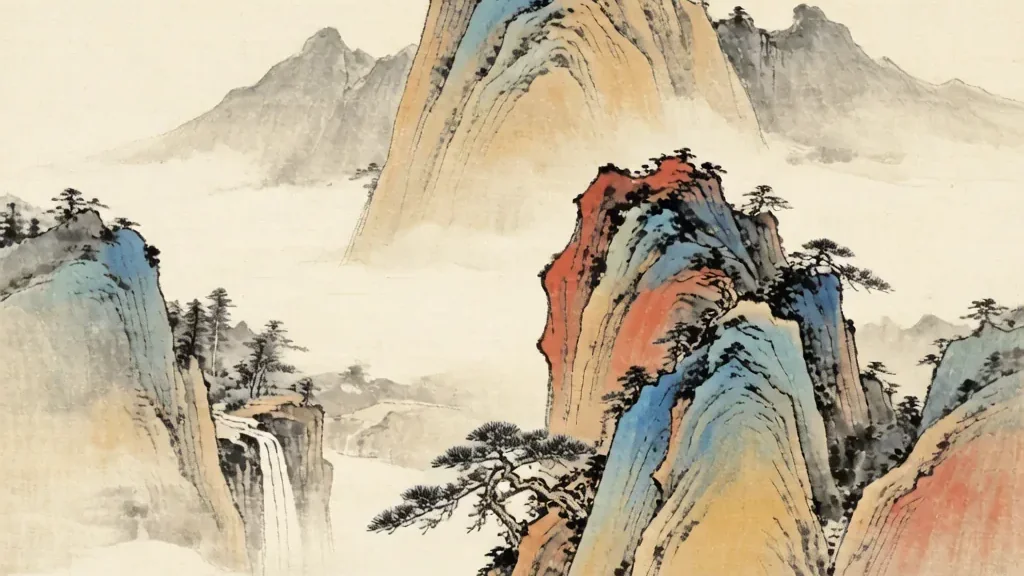
Few concepts capture the spiritual and geographical imagination of China quite like the Five Great Mountains, known in Chinese as 五岳 (Wǔ Yuè). These five peaks — Mount Tai, Mount Hua, Mount Heng (North), Mount Heng (South), and Mount Song — are not merely geological formations. They are living temples, pilgrimage routes, and cultural monuments that have shaped Chinese civilization for over three thousand years. Emperors climbed them to perform sacred rites. Poets immortalized them in verse. Daoist masters sought enlightenment in their mist-shrouded heights. To understand these mountains is to understand a profound layer of China's spiritual DNA.
The term "Wu Yue" first appeared during the Zhou Dynasty (1046–256 BCE), when rulers began formalizing the worship of mountains as intermediaries between Heaven and Earth. Each mountain was assigned a cardinal direction — East, West, North, South, and Center — creating a cosmic mandala that mirrored the structure of the Chinese empire itself. Over centuries, Daoism and Buddhism wove themselves into the fabric of these peaks, adding temples, monasteries, and legends to their already formidable presence.
Mount Tai (泰山) — The Eastern Great Mountain
Rising 1,545 meters above Shandong Province, Mount Tai (泰山) is the undisputed leader of the Five Great Mountains. Known as the "Eastern Mountain," it has been a place of imperial worship since the time of the legendary sage-kings. The phrase "稳如泰山" (steady as Mount Tai) reflects its cultural status as a symbol of stability and grandeur. Seventy-two emperors are said to have performed the Fengshan (封禅) ceremony here — a grand ritual in which the ruler reported his achievements to Heaven and Earth, thereby legitimizing his mandate to rule.
Mount Tai's most famous ascent begins at the Red Gate (红门), climbing 6,660 stone steps past ancient steles, inscribed cliffs, and Taoist temples. The South Heavenly Gate (南天门) marks the final approach to the summit, Jade Emperor Peak (玉皇顶), where visitors watch the sunrise burst over a sea of clouds — a sight that has moved pilgrims to tears for centuries. The mountain is also home to the Dai Temple (岱庙), a sprawling complex at the foot of the mountain where emperors prepared for their sacred ascent. Confucius himself climbed Mount Tai, and a stone inscription records his famous words: "登泰山而小天下" — "Climbing Mount Tai makes the world seem small."
Mount Hua (华山) — The Western Great Mountain
If Mount Tai represents solemn majesty, Mount Hua (华山) represents raw, heart-stopping adventure. Located in Shaanxi Province, its five granite peaks rise like lotus petals from the earth, earning it the nickname "The Western Mountain." Mount Hua is famous — some would say infamous — for having some of the most dangerous hiking trails in the world. The Plank Walk in the Sky (长空栈道) consists of wooden planks bolted into a sheer vertical cliff face, with nothing but chains and a harness between you and a 2,000-meter drop.
Despite its terrifying reputation, Mount Hua has been a sacred Daoist site for over two millennia. The mountain is believed to be the dwelling place of the God of the West (西岳大帝), and numerous Daoist temples cling to its precipitous slopes. The Jade Spring Temple (玉泉院) at the mountain's base has welcomed pilgrims since the Song Dynasty. Legend holds that the Daoist immortal Chen Tuan (陈抟) lived and meditated in the caves of Mount Hua, perfecting the art of inner alchemy and sleeping meditation. The mountain's five peaks — East, West, South, North, and Center — each offer distinct views and challenges, but the South Peak (南峰) at 2,154 meters is the highest, providing an unparalleled panorama of the Qinling mountain range.
Mount Heng North (恒山) — The Northern Great Mountain
The Northern Mount Heng, located in Shanxi Province, reaches 2,016 meters and is known as the "Pillar of the North." Its most extraordinary feature is not the mountain itself but what hangs from its cliffs: the Hanging Temple (悬空寺). Built into a sheer rock face over 1,500 years ago, this remarkable structure appears to float in midair, supported by wooden beams wedged into crevices in the rock. The temple uniquely combines Buddhist, Daoist, and Confucian elements, with halls dedicated to the founders of all three traditions standing side by side.
Mount Heng was historically a critical defensive position, guarding the northern frontier against nomadic incursions. Its strategic importance is reflected in its name — "Heng (恒)" means "permanent" or "enduring," suggesting an unshakeable barrier. The mountain is also home to the Golden Dragon Gorge (金龙峡) and numerous ancient pines twisted into fantastical shapes by centuries of wind. In Daoist cosmology, the Northern Mountain corresponds to the element of Water and the Black Tortoise of the Four Symbols, reinforcing its role as guardian of the northern frontier.
Mount Heng South (衡山) — The Southern Great Mountain
Not to be confused with its northern namesake, Mount Heng South (衡山) rises 1,300 meters in Hunan Province and is renowned for its lush, almost tropical beauty. Known as the "Mountain of Longevity (寿岳)," it is associated with the Star of Longevity (寿星) in Chinese mythology. The mountain's 72 peaks are draped in dense forests, bamboo groves, and year-round mist, creating an atmosphere of serene mystery that has attracted hermits and poets for centuries.
The Grand Temple of Mount Heng (南岳大庙) at the mountain's foot is the largest temple complex in southern China, featuring nine courtyards that blend Daoist and Buddhist architecture. The mountain's highest point, Zhurong Peak (祝融峰), is named after the legendary god of fire, and the view from its summit — looking down upon a sea of clouds pierced by distant peaks — is one of the most photographed scenes in Chinese landscape art. Unlike the stark granite of Mount Hua, Mount Heng South feels gentle and nurturing, a fitting representative of the warm, life-giving south.
Mount Song (嵩山) — The Central Great Mountain
The fifth and final of the Great Mountains, Mount Song (嵩山) in Henan Province, holds the most central position — both geographically and spiritually. Rising 1,512 meters, it is best known as the home of the Shaolin Temple (少林寺), the birthplace of Chan (Zen) Buddhism and Shaolin Kung Fu. Founded in 495 CE, the temple became legendary for its warrior monks, who combined intense martial training with deep Buddhist meditation.
Beyond Shaolin, Mount Song is home to the Songyang Academy (嵩阳书院), one of China's four great ancient academies of classical learning, and the Zhongyue Temple (中岳庙), the largest Daoist temple complex in the Central Plains. The mountain's geological structure is equally remarkable — it preserves rock formations spanning three billion years, making it a UNESCO Global Geopark. In the cosmology of the Five Mountains, Mount Song sits at the center, corresponding to the element of Earth and the color yellow, the most sacred of the five traditional Chinese colors. It is, quite literally, the axis around which the Chinese world turns.
Origins of the Five Mountains Cult
The formal worship of the Five Great Mountains began during the Zhou dynasty, when rulers cast mountains as intermediaries between Heaven and Earth. Each peak was assigned a cardinal direction, forming a cosmic pattern that mirrored the ordered Chinese realm. Over time emperors travelled to the mountains to perform sacrifices that confirmed their mandate to rule. The cult blended early nature worship with the political symbolism of the unified state, so that reverence for the peaks became an expression of loyalty to the dynasty. This fusion of geography and governance is why the Wuyue have remained central to Chinese ceremonial life for more than three thousand years.
The Five Elements and Directions
Each of the Five Mountains corresponds to one of the five directions and one of the five elements in traditional Chinese cosmology. The East (Mount Tai) links to wood, the South (Mount Heng South) to fire, the West (Mount Hua) to metal, the North (Mount Heng North) to water, and the Center (Mount Song) to earth. These pairings connected the landscape to the cycles thought to govern health, seasons, and the state. Daoist and Buddhist temples built on the slopes reinforced the mountains as sacred axes of the world. Understanding this mapping helps explain why climbing all five was considered a complete spiritual pilgrimage rather than merely a tour of scenic peaks.
Pilgrimage and Modern Tourism
Visiting all five sacred mountains has long been a goal for pilgrims, poets, and painters, and today it draws large numbers of domestic and international tourists. Improved roads, cable cars, and high-speed rail have made even the remotest peaks accessible, while temples and inscribed cliffs remain active sites of worship. Mount Tai alone receives millions of visitors a year, many climbing before dawn to watch the sunrise. Local authorities balance access with preservation through visitor caps and restored paths. The Wuyue thus survive as living cultural landscapes, where ancient ritual and modern leisure meet on the same stone steps climbed by emperors.
❓ Frequently Asked Questions
📝 Chinese Vocabulary
- 五岳 (Wǔ Yuè) — The Five Great Mountains, a collective term for China's five sacred Daoist peaks.
- 封禅 (Fēng Shàn) — The imperial ceremony performed at Mount Tai to legitimize the emperor's rule before Heaven and Earth.
- 悬空寺 (Xuán Kōng Sì) — The Hanging Temple, a 1,500-year-old temple built into a cliff face on Mount Heng North.
- 少林寺 (Shào Lín Sì) — Shaolin Temple, the birthplace of Chan Buddhism and Kung Fu, located on Mount Song.
- 登泰山而小天下 — "Climbing Mount Tai makes the world seem small," a famous saying attributed to Confucius.
🎉 Fun Facts
- The tradition of climbing Mount Tai is so ancient that archaeological evidence suggests ritual activity on the mountain dating back to the Neolithic period, over 5,000 years ago.
- Mount Hua's Plank Walk was originally built over 700 years ago by Daoist monks who wanted a path to the cave of a hermit — using only simple tools and their bare hands.
- All five mountains are UNESCO World Heritage Sites, either individually or as part of larger cultural landscape designations, recognizing their unique blend of natural beauty and human culture.
- Emperor Wu of Han is traditionally credited with formally establishing the worship of the Five Mountains and granting each a noble title.
- In traditional cosmology the Five Mountains map onto the five directions and the five elements: wood, fire, earth, metal, and water.
- Mount Song preserves rock layers spanning roughly three billion years, making it a favorite of geologists as well as pilgrims.