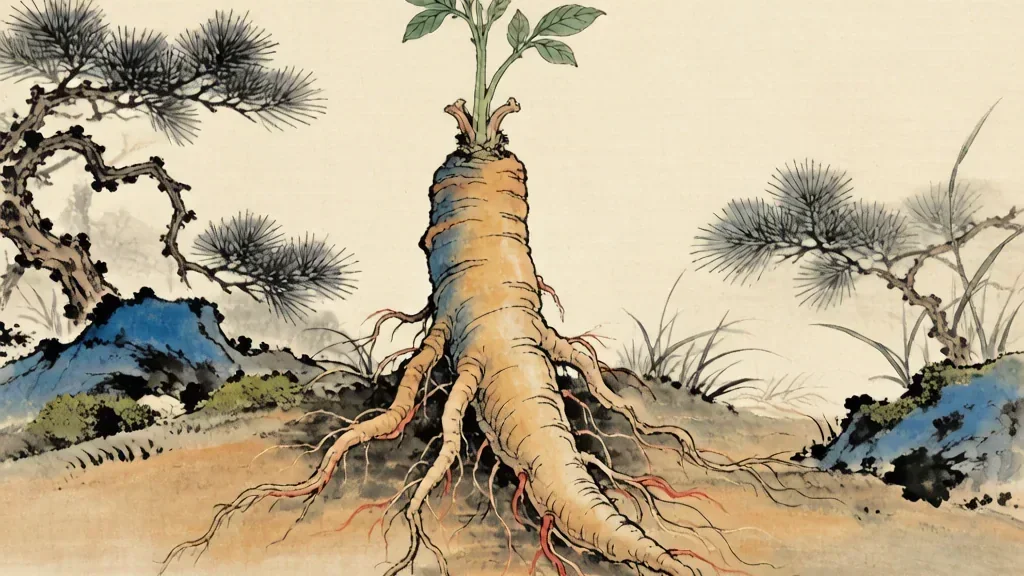
Deep in the shaded forests of northeastern China grows a root so revered that it has been called "the king of herbs" and "the root of life." This is ginseng — 人参 (), the "man root," named for the faint human shape of its forked body. For two millennia Chinese medicine has treasured ginseng as a tonic that restores energy, steadies the spirit, and lengthens life. More than a medicine, it became a cultural obsession: a wild root could cost more than its weight in silver, and searching for it was a near-mythic quest through the mountains.
The Root That Looks Like a Man
True ginseng is Panax ginseng, a slow-growing perennial of the Araliaceae family native to the cool, moist forests of Manchuria, Korea, and the Russian Far East. The Chinese name 人参 means "person root" ( = person, = a root category), because a well-formed root splits into limbs and a head that resemble a tiny human. The genus name Panax comes from the Greek for "panacea," reflecting the same universal-healer belief.
A wild ginseng takes decades to mature, and the older and more man-like the root, the higher its value. A single "old mountain root" might be aged fifty years or more, with a gnarled body and whisker-like rootlets. Such specimens were (and are) treated like treasures, wrapped in silk and presented to emperors. The human form was read as a sign that the plant concentrated life-force drawn from the forest itself.
A Tonic in Chinese Medicine
In the framework of traditional Chinese medicine, ginseng is a 补气 () herb — one that "tonifies qi," the vital energy thought to animate the body. It is prescribed for weakness, fatigue, poor appetite, and the wear of age or illness. Classic texts like The Divine Farmer's Materia Medica rank it among the supreme medicines, able to calm the spirit and brighten the eyes.
Ginseng is rarely used alone in heavy doses; it is blended into soups, teas, and complex formulas. The idea is balance: too much can cause agitation, so a skilled practitioner matches the root's warmth to the patient's constitution. This measured use reflects a core medical philosophy — that the best remedy strengthens the body's own resources rather than fighting symptoms head-on. Ginseng is thus less a drug than a steward of vitality.
The Hunt for Wild Ginseng
For centuries, "ginseng diggers" (采参人, ) ventured into the Changbai Mountains with rituals bordering on worship. Before digging, they would tie a red cord to the root to "bind" it so it could not escape (an old belief that ginseng could transform into a child and run), then dig carefully with a deer-horn spoon to avoid damaging it with iron.
The hunt produced a rich folklore of "ginseng children" — plant-spirits that appeared as glowing boys to guide or test the worthy. Finding a great root could lift a poor family from ruin, so the search carried both hope and danger, as diggers faced bears, cold, and rival claimants. The red-cord ritual survives in folk memory as a charming example of how seriously Chinese culture took this forest gift.
Ginseng and Longevity
Because ginseng restores depleted energy and was linked to the Daoist search for long life, it became a staple of the "immortality diet" imagined by alchemists and emperors. Tales tell of hermits who lived on ginseng and dew for a hundred years. While no root grants immortality, modern research confirms ginseng's active compounds — ginsenosides — can support stamina, immune function, and mental clarity, lending the folklore a kernel of truth.
The cultural link to longevity made ginseng a festive gift: a fine root or a box of ginseng tea for an elder's birthday signals respect and the wish for a long life. In this it joins the peach and the deer as a standard emblem of 寿 (longevity). To give ginseng is to give, symbolically, time itself — the most precious thing one person can offer another.
Cultivated Ginseng and the Modern Trade
Wild ginseng is now rare and protected, so most ginseng is cultivated, especially in Jilin province and Korea, where fields are shaded to mimic forest conditions. Cultivated roots are cheaper and milder but still valued. "Garden ginseng" (园参) and "forest-grown" (林下参) varieties bridge the gap between wild and farmed, the latter grown among trees to recover some of the wild character.
China's ginseng trade is global, with the root appearing in teas, candies, cosmetics, and energy drinks. Yet the romance remains with the wild mountain root, whose scarcity keeps its legend alive. The tension between the humble farm product and the mythic forest treasure is itself telling: ginseng shows how Chinese culture can hold a plant as both everyday tonic and sacred object at once.
How to Use Ginseng Wisely
Traditionally, a few thin slices of dried root are simmered with chicken to make a restorative soup, or steeped alone as a tea. Korean "red ginseng" is steamed and dried for a warmer, more concentrated effect. The cautious advice, echoed by both old texts and modern herbalists, is moderation: ginseng is a tonic for the depleted, not a stimulant to be overused by the already vigorous.
To meet ginseng is to meet a plant that has carried Chinese hopes for health and long life for two thousand years. Its human shape invited the earliest comparisons; its real chemistry earned the later trust. Between myth and medicine, the root of life remains exactly what its name promises — a little person of the forest, offering strength to those who know how to ask for it gently.
Ginseng in Folklore and the Mountain Spirit
The search for wild ginseng produced a rich folklore centered on the Changbai Mountains. Diggers believed the root could sense a person's intent and even transform into a glowing child to lead or test the worthy, which is why they bound it with a red cord before digging. Tales of 'ginseng children' blended gratitude, danger, and the peril of the forest, where bears and cold were as real a threat as rival claimants. These stories turned a humble plant into a near-sacred forest gift and gave the harvest a ritual seriousness found in few other crops. The folklore survives today in folk memory and regional festivals that honor the old diggers' craft.
Grades, Forms, and How Ginseng Is Sold
Ginseng reaches the market in several forms that signal age, processing, and price. Fresh roots are sold whole or sliced, while red ginseng is steamed and dried for a darker, more concentrated product. Wild roots, aged decades and shaped like a small person, command the highest prices and are often presented as gifts, whereas garden and forest-grown roots are more affordable daily tonics. In shops the root appears as tea, powder, candy, and liquor, and buyers judge quality by age, shape, and origin. Knowing these grades helps a customer tell a prized mountain treasure from an ordinary farm product, a distinction that has mattered in China for centuries.
❓ Frequently Asked Questions
📝 Chinese Vocabulary
人参 — : ginseng, "person root."
补气 — : to tonify or supplement vital energy (qi).
采参人 — : ginseng digger, a mountain harvester.
园参 — : garden (cultivated) ginseng.
林下参 — : forest-grown ginseng.
长白山 — : the Changbai Mountains, the main wild habitat of ginseng in northeastern China.
红参 — : red ginseng, the root steamed and dried for a warmer, more concentrated effect.
高丽参 — : Korean ginseng, a closely related and highly valued regional form of Panax ginseng.
🎉 Fun Facts
- Ginseng diggers once believed the root could turn into a child and run, so they bound it with a red cord before digging.
- A wild ginseng root can take fifty years or more to mature, and the oldest fetch prices higher than their weight in silver.
- The genus name Panax is Greek for "panacea," showing the West shared China's healer belief.
- Modern science has isolated ginsenosides, the compounds behind ginseng's energy and immunity effects.
- In imperial times a fine wild ginseng root was presented to the emperor as tribute from the northeast.
- A cultivated ginseng plant may take about six years before its root is ready to harvest.