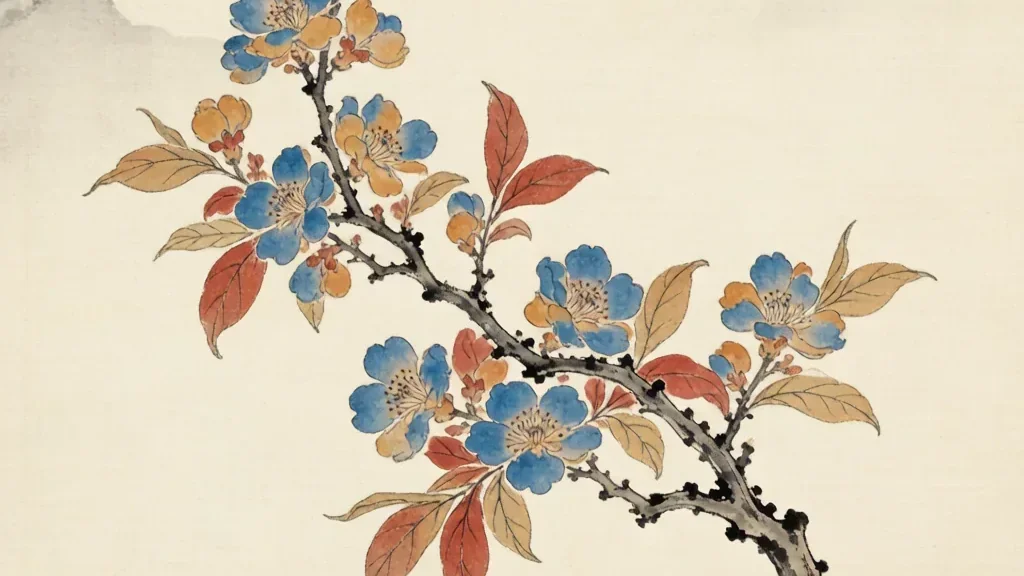
Before the rose, before the lotus, there was the peach blossom — 桃花 (). In Chinese culture the peach is a plant of astonishing range: its spring flowers stand for love and marriage, its fruit grants longevity to gods and immortals, and its wood drives away evil. Few plants carry so many contradictory blessings at once. To follow the peach through Chinese myth, medicine, and poetry is to trace a single tree from a bride's wedding gown to the staff of a conquering deity, from a lover's blush to the secret grove of a utopian paradise.
The Blossom of Love and Marriage
In spring the peach tree erupts in clouds of pink flowers, and from early times Chinese poets linked this flush to the cheeks of a bride. The Book of Songs contains the famous opening "The peach tree is young and elegant; its blossoms shine brightly" (桃之夭夭,灼灼其华), sung at weddings to wish the bride a happy household and many children. The peach blossom thus became the flower of marital joy and feminine beauty.
This association hardened into custom. Peach-blossom powder was used as a cosmetic; "peach-blossom fate" (桃花运, ) describes a run of romantic luck; and a "peach-blossom star" in fortune-telling signals attraction and love. To this day, a young woman compared to a peach blossom receives one of the oldest compliments in the Chinese language — a blessing of vitality, warmth, and flourishing life.
The Peach of Immortality
If the blossom means love, the fruit means endless life. Chinese mythology tells of the Queen Mother of the West (西王母, ), who tended a orchard of immortal peaches that ripen only once every three thousand years. To eat one was to gain eternal youth. When the peaches were stolen by the monkey deity Sun Wukong, the resulting uproar became one of the great episodes of the Journey to the West saga.
In art and birthday celebrations, the peach is the supreme symbol of longevity. An elderly person's birthday is marked by 寿桃 (), steamed buns shaped like peaches and colored pink, piled on a plate as a wish for long life. The God of Longevity himself often carries a peach. The fruit's fuzz and rosy skin made it a natural emblem of healthy old age, and its myth gave that folk belief cosmic backing.
Peach Wood Against Evil
The peach's power was not only benign; it was protective. For at least two thousand years, Chinese people believed peach wood (桃木, ) could repel demons. Door gods were sometimes painted on peach-wood plaques, and the earliest "talisman" (符) was inscribed on a peach slip. The custom of pasting spring couplets on New Year doors descends from peach-wood charms meant to block evil spirits from entering the home.
Legend explains the wood's potency through a story of two spirit-catching brothers, Shen Tu and Yu Lei, who hung demons on a peach tree. Their authority transferred to the tree itself. Even the whips used to drive out illness were made of peach twigs. Thus a single plant protected the bedroom, the doorway, and the body — blossom for courtship, fruit for life, wood for safety.
The Peach Blossom Spring
Perhaps the most beloved peach story is "The Peach Blossom Spring" (桃花源, ) by the Jin-dynasty writer Tao Yuanming. A fisherman follows a stream banked with blossoming peach trees and passes through a cave into a hidden valley where people live in peace, untouched by war or taxes. The tale became the enduring Chinese image of an earthly paradise lost the moment one tries to return to it.
The peach grove here is not merely pretty scenery; it is a threshold. The flowers mark the boundary between the ordinary world and a possible better one, a utopia accessible only by accident and innocence. For centuries afterward, "peach-blossom spring" meant any idyllic refuge, and poets used the image to criticize the turbulence of their own times by imagining a place without it.
Peach in Medicine and the Kitchen
Chinese medicine has used the peach for millennia. Peach kernels (桃仁, ) are a standard herb, prescribed to move blood and relieve constipation; peach leaves and flowers appear in remedies for skin and digestion. The fruit itself, eaten fresh or dried, is valued for hydration and gentle cleansing. None of this contradicts the mythology — rather, the mythology grew from the tree's real usefulness.
In the kitchen, peaches are eaten ripe in summer, preserved in syrup, or dried. Peach-blossom tea is drunk as a light, fragrant tisane said to aid the skin. The flower's brief, brilliant season made it a natural symbol of fleeting youth, so that eating or drinking peach was also, softly, a way of tasting time itself before it passed.
The Peach Across the Year
Across the Chinese calendar the peach appears again and again: pink blossoms at spring festivals, peach-wood charms at New Year, longevity peaches at birthdays, and immortal-peach imagery at the Mid-Autumn and Lantern seasons. A single family might encounter the tree in four different roles without ever naming the thread that connects them. That thread is blessing — the peach as a plant that gives beauty, life, and protection in equal measure.
To know the peach is to see how Chinese symbolism stacks meanings onto one living thing until it becomes a small theology. The same branches that blush for a bride also arm the door against ghosts and feed the immortals. Few trees have been asked to do so much, and fewer still have done it so gracefully for three thousand years.
The Peach Blossom in Women's Culture
Of all the flowers, the peach blossom has been most closely tied to women. The Book of Songs compared a bride to its brightness, and for two thousand years the same comparison blessed daughters leaving home. Women painted their cheeks with peach-blossom powder to borrow its flush, and poets measured a lover's beauty against its petals. Because the blossom opens before its leaves, it also stood for a youth that arrives suddenly and fades soon, a gentle warning folded into the praise. In folk song the peach blossom is the girl at the well, the girl by the wall, the girl who blooms and is gone. This long association gave the flower a gendered voice in Chinese poetry, one that could say I am young, I am desired, I will not last without a single direct word, only pink against a clear spring sky.
Peach Blossoms in Regional Spring Life
When the peach blooms, different regions greet it differently. In the water towns of the south, groves line the canals so that falling petals fleck the water and the boats move through pink. In the north, orchard villages open their rows to strollers who come to photograph the brief color before it drops. Sichuan and the lower Yangtze hold peach-blossom festivals that mix viewing with folk performance, and city parks float cut branches in basins for people with no orchard nearby. However it is done, the outing is a small rebellion against winter, a reason to be outside together. The peach blossom's season is short, sometimes barely two weeks, which is exactly why the custom matters: the flower teaches that some beauty must be met in person, now, or not at all.
❓ Frequently Asked Questions
📝 Chinese Vocabulary
桃花 — : peach blossom.
桃花运 — : peach-blossom luck; romantic fortune.
寿桃 — : longevity peach; birthday bun shaped like a peach.
桃木 — : peach wood, used to repel evil.
桃花源 — : Peach Blossom Spring; an earthly paradise.
蟠桃 — : Flat peach; also the immortal peach of the Queen Mother's heavenly banquet.
桃仁 — : Peach kernel, a medicinal herb used to move blood and relieve constipation.
桃红 — : Peach-red, the pink color of the blossom, used as a named color in Chinese.
🎉 Fun Facts
- The Queen Mother's immortal peaches were said to ripen only once every three thousand years.
- Spring Festival couplets on doors evolved from ancient peach-wood demon-repelling charms.
- "Peach-blossom fate" is still used in Chinese to describe a streak of romantic luck.
- Tao Yuanming's Peach Blossom Spring coined a phrase now used for any hidden, peaceful refuge.
- The phrase about peach and plum filling the world praises a teacher whose students have spread everywhere, using the trees' abundance as a measure of influence.
- In some regions a bride steps over a threshold of peach wood or carries a peach to bless the new household with protection and children.