← Back to Plants & Flora
🌿 Plants & Flora
Peony (牡丹) — King of Flowers
✍️ by xiaoyu luo
🗓️ Updated Jul 29, 2026
By Xiaoyu Land · 14 min read
The tree peony (牡丹, mǔdān, Paeonia suffruticosa) reigns supreme as the 'King of Flowers' (花王, Huā Wáng) in Chinese culture, a title it has held since the Tang Dynasty (618–907). Native to the mountainous regions of western China — particularly the Qinling Mountains of Shaanxi Province — the wild tree peony was first brought into cultivation during the Southern and Northern Dynasties period (420–589). Initially valued for its medicinal root bark (牡丹皮, mǔdān pí), which was used to cool the blood and reduce inflammation in Traditional Chinese Medicine, the peony's spectacular blooms soon captured the imagination of the imperial court. By the reign of Empress Wu Zetian (r. 690–705), the only female emperor in Chinese history, the peony had become the undisputed flower of the imperial gardens — and a legend was born that would cement its status in the Chinese imagination for the next 1,300 years.
Empress Wu Zetian and the Peony's Defiance
The most famous story about the Chinese peony involves Empress Wu Zetian and an imperial decree. One winter day, as the legend goes, the Empress wrote a poem commanding all the flowers in her garden to bloom overnight in her honor. The next morning, every flower had obeyed — except the peony, which stubbornly refused to bloom out of season. Enraged, Wu Zetian ordered all peonies banished from the capital of Chang'an (modern Xi'an) to the distant city of Luoyang. But the peonies thrived in Luoyang's climate, producing blooms even more magnificent than before. Whether or not this story has any historical basis, it captures the Chinese perception of the peony's character: proud, unbending, and magnificent. Luoyang did indeed become China's peony capital, and to this day the Luoyang Peony Festival (洛阳牡丹花会), held every April since 1983, is the largest peony exhibition in the world, drawing millions of visitors to admire over 1,200 varieties blooming across the city's parks and gardens.
The Peony in Tang Dynasty Culture
The Tang Dynasty represented the golden age of peony culture in China. The great poet Li Bai (701–762), summoned to the imperial court to compose verses in honor of the peonies blooming in the沉香亭 (Chénxiāng Tíng, Pavilion of Aloeswood), produced his famous 'Qing Ping Diao' (清平调) poems, comparing the beauty of the peony — and by extension, the imperial consort Yang Guifei — to clouds and flowers, the most ethereal of all earthly beauties. During the Tang period, a single prized peony plant could cost as much as a commoner's house, and the flower became so associated with wealth and status that the phrase 'wealth and honor' (富贵, fùguì) became practically synonymous with the peony itself. Peony-viewing parties among the Tang elite were elaborate affairs: guests would compose poems on the spot, painters would capture the blooms on silk, and musicians would perform new compositions dedicated to the flowers. The Tang capital of Chang'an was said to turn into a 'city of flowers' each spring, with entire neighborhoods transformed by cascades of peony blooms.
Cultivars, Art, and the National Flower Debate
Chinese horticulturists have developed over 1,000 named cultivars of tree peony over the centuries, classified into ten major color groups and multiple flower forms. The most famous varieties include 'Yao Huang' (姚黄, Yao's Yellow), a golden-yellow peony named after a Song Dynasty family that first cultivated it, and 'Wei Zi' (魏紫, Wei's Purple), a deep purple variety that was once so valuable it was used as currency. 'Er Qiao' (二乔), named after the two legendary beauties of the Three Kingdoms era, produces flowers that are half red and half pink on the same bloom. In Chinese painting, the peony is a perennial favorite — the Qing Dynasty painter Yun Shouping (1633–1690) revolutionized flower painting with his 'boneless' (没骨, mògǔ) technique that depicted peonies without ink outlines, using pure washes of color to create flowers of extraordinary delicacy. In modern China, a long-running public debate has considered whether the peony or the plum blossom should be designated the official national flower — with the peony representing China's glorious cultural heritage and the plum blossom symbolizing the nation's resilient spirit.
Peony Symbolism in Modern China and Beyond
Today, the peony continues to be one of China's most powerful cultural symbols. It appears on everything from fine porcelain to paper currency — the 1-yuan coin features a peony on its reverse side. The peony motif is ubiquitous in Chinese weddings, embroidered onto bridal gowns and featured in decorations, as it symbolizes a happy, prosperous marriage. In feng shui (风水), peony paintings are believed to attract romantic luck and are often recommended for the bedroom of single women seeking a partner. The city of Heze in Shandong Province has emerged as a rival to Luoyang in peony cultivation, producing over 80% of China's peony exports, which now reach florists and gardens worldwide. Chinese peony oil (牡丹籽油), pressed from the seeds, was approved as a new food resource by China's National Health Commission in 2011 and has since become a luxury health product, valued for its high content of alpha-linolenic acid. The peony's journey from a wild mountain flower to a global symbol of Chinese culture is a testament to its enduring beauty and the depth of meaning it has accumulated over fifteen centuries of cultivation and veneration.
❓ Frequently Asked Questions
Q: What does the peony symbolize in Chinese culture?
A: The peony (牡丹, mǔdān) symbolizes wealth, prosperity, honor, and beauty. Known as 'the king of flowers' (花王), it is one of the most beloved flowers in Chinese culture. Peonies are often called '富贵花' (fùguì huā) or 'flower of wealth and nobility.'
Q: What is the history of peony cultivation in China?
A: Peony cultivation in China dates back over 1,500 years to the Sui and Tang dynasties. During the Tang Dynasty (China's 'golden age'), peonies were cultivated in imperial gardens and became the most fashionable flower among the aristocracy. Empress Wu Zetian was a famous peony enthusiast.
Q: What is the legend of the peony?
A: One legend tells that Empress Wu Zetian ordered all flowers to bloom in winter. The peony alone refused, and she exiled it from the capital to Luoyang. But in Luoyang, the peony bloomed more beautifully than ever — making Luoyang the peony capital of China.
Q: Where is the best place to see peonies in China?
A: Luoyang in Henan Province is the peony capital of China, hosting the annual Luoyang Peony Festival in April. The city has been famous for peonies since the Tang Dynasty and now grows over 1,000 varieties. Heze in Shandong is another major peony cultivation center.
Q: Is the peony used in Chinese medicine?
A: Yes. The dried root bark of the tree peony, called mu dan pi, is a standard herb used to cool the blood and clear heat, and it appears in many classical formulas. The flower is also eaten candied or brewed into tea in some regions, though its main role remains symbolic rather than culinary.
Q: How do Chinese people display peonies at home?
A: During the spring blooming season families buy potted peonies or cut stems in a tall vase as a centerpiece, and paintings or porcelain peonies are kept on display year-round. For birthdays and weddings a peony image is chosen to wish the recipient wealth, honor, and a happy union.
Key Terms
牡丹 (mǔdān)
mǔ-dān · 'tree peony' · 花王 (huā wáng, king of flowers) · 国色天香 (guó sè tiān xiāng, national beauty and heavenly fragrance)
花王 (huā wáng)King of flowers, the traditional title given to the peony.
富贵 (fù guì)Wealth and honor, the pair of qualities the peony stands for.
国色天香 (guó sè tiān xiāng)National beauty and heavenly fragrance, a classical phrase for the peony.
牡丹皮 (mǔ dān pí)Peony root bark, a standard herb used to cool the blood and clear heat.
洛阳 (luò yáng)Luoyang, the city known as the peony capital of China.
姚黄 (yáo huáng)Yao's Yellow, a famous golden peony cultivar first raised by a Song dynasty family.
没骨 (mò gǔ)Boneless, a painting technique that builds the peony from color washes without ink outlines.
Fun Facts
- The world's oldest living peony tree, the 'Peony King' at the Jinci Temple in Taiyuan, Shanxi Province, is estimated to be over 400 years old, dating to the Ming Dynasty. It still produces over 200 blooms each spring.
- During the Tang Dynasty, peony mania reached such extremes that one official was recorded as having paid 100,000 copper coins — roughly the annual salary of a mid-ranking official — for a single peony plant.
- In 1994, the China Flower Association conducted a nationwide poll to select the national flower. The peony received 79% of the vote, but the plum blossom's supporters argued for dual designation, leading to a stalemate that has left China officially without a designated national flower to this day.
- Peony blooms are enormous, with some double cultivars carrying more than a hundred petals in a single flower head.
- The peony is a popular tattoo and embroidery motif in China because its rounded, full shape reads clearly even at a small size.
- In Chinese weddings the peony often appears on the bride's shoes or the bed hangings as a wish for a rich and harmonious marriage.
The Peony and the Boneless Brush
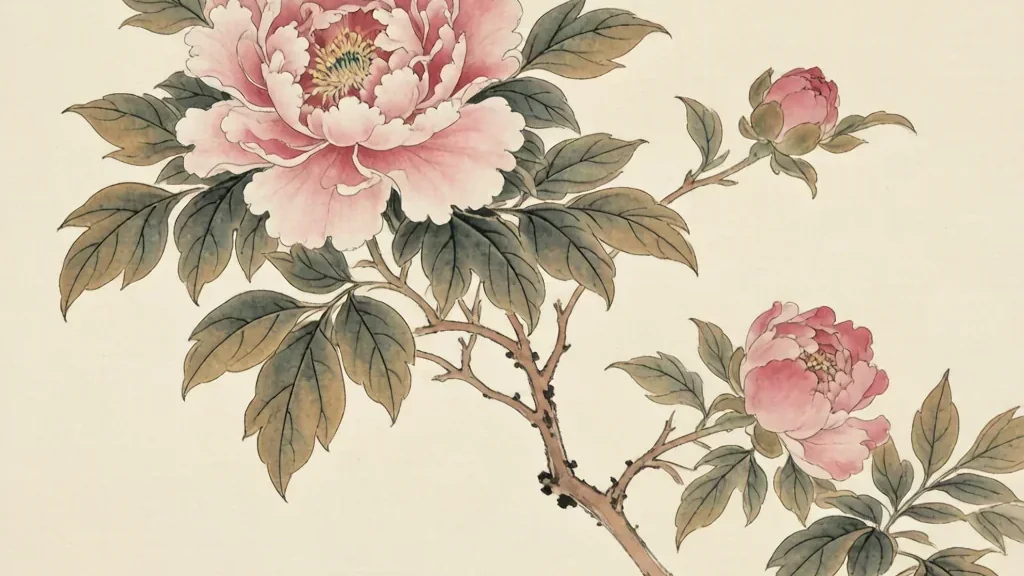
The peony pushed Chinese painters toward a new method. Because its petals are soft and layered, outlining them in hard ink can look stiff, so the Qing master Yun Shouping revived the boneless technique, building the flower from washes of color with no ink contour at all. The result let the peony seem to breathe, its edges dissolving into the paper like a real bloom in mist. Later painters of the Yangzhou school adopted the approach, and the boneless peony became a test of confidence: with no outline to hide behind, every tone had to be right the first time. The flower and the method suited each other perfectly, the peony's fullness answering the technique's softness. Today art students still learn the boneless peony as a foundation, making it one of the living links between a Tang emblem and a modern brush.
The Peony in Craft and Ornament
Outside painting, the peony became the most repeated motif in Chinese decorative art. Embroiderers set it on silk robes and wedding bed curtains, where its rounded form symbolized a full, fortunate life. Carvers cut it into jade, ivory, and lacquer; ceramic painters ringed plates and vases with peony scrolls; and architects carved it into the lintels of prosperous homes. The pattern traveled along the Silk Road and appears in Persian and Ottoman textiles that borrowed the Chinese bloom. What made the peony so useful was its symmetry and scale: a single round flower could fill a medallion, while a spray could run the length of a robe. In folk craft the peony usually pairs with a bird, the flower-and-bird combination that signals domestic happiness. Few plants have been rendered in as many materials as this one.
Peony Festivals in Modern China
The peony's public life did not end with the empire. Every April, Luoyang closes its streets to traffic and opens its parks, temples, and even factory lawns to rivers of peony blooms, drawing visitors from across Asia for the Luoyang Peony Festival. Heze in Shandong mounts a rival event built on its export business, shipping cut peonies to Europe and America in refrigerated containers so that Chinese flowers bloom in Western spring weddings. Cities as distant as Lanzhou and Chengdu now stage their own peony weeks. These festivals are both tourism and inheritance, a way for a plant cultivated for fifteen centuries to keep its place in ordinary life. The crowds that come to photograph a single perfect bloom are the latest link in an unbroken chain of looking that began with Tang courtiers.
The Peony as a Flower of Marriage
If the chrysanthemum blesses the elder, the peony blesses the bride. Its full, opulent bloom reads as abundance and harmony, so it appears on the embroidered panels of wedding dresses, on the red lacquer trousseau chest, and on the hanging pictures above the marital bed. A pair of peonies stands for a balanced couple, and a peony with a butterfly can wish the new household joy. In feng shui a peony picture in the bedroom is said to draw romantic luck, especially for those seeking a partner. The logic is simple: the flower that meant wealth and honor in the court became the flower of a rich and peaceful home. Thus the same bloom that impressed Tang emperors now quietly oversees the most ordinary and hopeful event in a Chinese family's calendar.