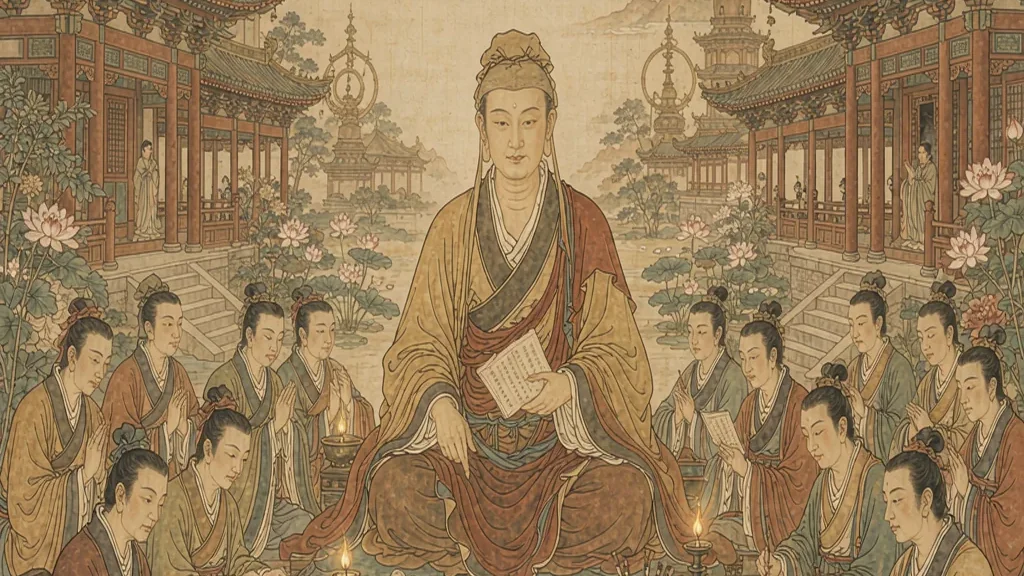
Kumarajiva, whose Chinese name was Jiumoluoshi, was the single most consequential translator in the history of Chinese Buddhism, whose renderings of Mahayana scriptures shaped the very language, doctrine, and devotional life of East Asian Buddhism for fifteen hundred years. Born around 344 in Kucha, a flourishing Buddhist kingdom of the Tarim Basin, he was trained in the Sarvastivada and then converted to the Madhyamaka philosophy of Nagarjuna before being brought to the Chinese capital of Chang'an in 401 under military compulsion. There, under the patronage of the Later Qin ruler Yao Xing, he led a translation academy that produced elegant, philosophically penetrating versions of the Lotus Sutra, the Diamond Sutra, the Heart Sutra, the Treatise on the Middle Way, and dozens of other foundational texts. His style favored clarity and readability over literal fidelity, and his choices of phrasing entered the permanent vocabulary of Chinese, Korean, and Japanese Buddhism.
Birth and Upbringing in Kucha
Kumarajiva was born around 344 in Kucha, a prosperous oasis city-state on the northern branch of the Silk Road in what is now Xinjiang. His father was a Kashmiri Brahmin who had renounced household life to become a Buddhist monk, and his mother was a sister of the Kucha royal family, giving the boy both Indian scholastic heritage and local aristocratic standing. He was ordained as a child prodigy and rapidly mastered the monastic curriculum of the Sarvastivada school that dominated the region.
At the age of about twelve he accompanied his mother on a journey to Kashmir, where he studied Abhidharma under renowned teachers and absorbed the rigorous scholastic method of the north Indian Buddhist universities. This early formation in the conservative Sarvastivada gave him the grammatical and doctrinal discipline that later made his translations technically reliable even as his mature thought turned toward Mahayana philosophy.
Conversion to Madhyamaka Thought
The decisive intellectual turn in Kumarajiva's life came when he encountered the teachings of Nagarjuna and Aryadeva, the founders of the Madhyamaka or Middle Way school, during his travels in the Kushan and Central Asian cultural sphere. He became convinced of the doctrine of emptiness, the claim that all phenomena lack inherent self-existence, and he devoted himself to the study of the Mulamadhyamakakarika and related treatises. This conversion reoriented his entire career from a Sarvastivada scholar to a champion of Mahayana philosophy.
His embrace of Madhyamaka placed him at odds with the dominant scholastic establishment of his homeland, yet it equipped him with precisely the framework that Chinese Buddhists most needed as they grappled with the paradoxical language of the Prajnaparamita literature. When he later translated Nagarjuna's treatises, he did so not as a neutral scribe but as a committed exponent who understood the dialectic of emptiness from within.
Imprisonment and the Road to Chang'an
Kumarajiva's reputation spread eastward, and the Former Qin ruler Fu Jian dispatched an army in 382 to bring him to China, reportedly saying that a single monk was worth more than a conquered territory. The expedition succeeded in extracting him, but the chaos of dynastic war delayed his arrival, and he spent years in confinement after the death of his patron. During this period of forced residence he deepened his Chinese fluency and endured personal hardship that later biographies portrayed as purifying his commitment.
In 401 the Later Qin emperor Yao Xing captured the city where Kumarajiva was held and brought him to the capital Chang'an with high honor. Yao Xing, a devout ruler, established him as the empire's premier religious authority and provided the resources for a state translation bureau. This transition from prisoner to imperial preceptor marks the beginning of his most productive decade and the true birth of mature Chinese Buddhist literature.
The Chang'an Translation Academy
At Chang'an, Kumarajiva presided over an unprecedented translation enterprise. Yao Xing housed him in a major monastery and assembled a team of hundreds of monk-scholars, scribes, and editors who worked under his direction. He would expound the Sanskrit text in oral lecture, discuss the meaning with his assistants, and then supervise the drafting and polishing of the Chinese, sometimes revising a single passage many times to achieve the right balance of accuracy and elegance.
The scale of this academy was extraordinary for its time. Participants included gifted disciples such as Sengzhao, who became a notable philosopher in his own right, and many others who later spread Kumarajiva's translations across China. The collaborative method, combining oral explanation with editorial refinement, produced texts that were both philosophically faithful and literarily graceful, setting a standard that later translators such as Xuanzang would both admire and deliberately revise.
Major Sutras and Shastras Translated
Kumarajiva's corpus includes some of the most beloved scriptures of East Asian Buddhism. His version of the Lotus Sutra became the definitive Chinese text for the Tiantai school and for popular devotion to the Bodhisattva ideal. His rendering of the Vimalakirti Sutra offered a sophisticated lay Buddhist model of nondual wisdom. He translated the Diamond Sutra and the shorter Heart Sutra, both central to Chan practice, and the Amitabha Sutra that underpins Pure Land devotion.
Equally important were his translations of the great Mahayana treatises: Nagarjuna's Middle Way and Twelve Gates treatises, and Aryadeva's Hundred Verse treatise, which together founded the Sanlun or Three Treatise exegesis in China. By rendering both the popular sutras and the difficult philosophical shastras, Kumarajiva supplied Chinese Buddhism with a complete literary and conceptual foundation in a single coherent idiom.
Translation Style and Lasting Influence
Kumarajiva deliberately chose a fluent, expressive style over rigid literalism. Where earlier translators produced awkward, Sanskrit-flavored Chinese that was hard to understand, he wrote in a polished literary language that captured the spirit of the original. He is famous for saying that a translator should convey the meaning like a cook who preserves the flavor while changing the form. This approach made his scriptures immediately accessible and spiritually moving to Chinese readers.
The cost of his freedom was occasional imprecision, and later literalist translators criticized him for smoothing over grammatical details. Yet his versions proved so poetically powerful that they eclipsed rival renderings and remained standard for centuries. Phrases from his Lotus and Heart sutras became embedded in Chinese religious speech, calligraphy, and liturgy, and his terminology for emptiness, suchness, and the Buddha nature shaped the vocabulary of every subsequent school.
Disciples and the Sanlun Legacy
Kumarajiva trained a generation of scholars who became the intellectual leaders of Chinese Buddhism. Among the "four sages" of his circle, Sengzhao stands out for his essays blending Madhyamaka dialectic with native Chinese phrasing, while Daosheng later advanced the radical doctrine of sudden enlightenment and the universal possession of Buddha nature. These disciples carried his Madhyamaka teachings into the formation of the Sanlun school and beyond.
The Sanlun tradition, based on the three treatises he translated, became a major vehicle for Nagarjuna's thought in China and was later systematized by masters such as Jizang. Even schools that critiqued Madhyamaka, such as the consciousness-only Weishi school, defined themselves in relation to the conceptual terrain Kumarajiva had laid out. His interpretive fingerprint is thus visible across the entire map of Chinese Buddhist doctrine.
Relationship with Emperor Yao Xing
The partnership between Kumarajiva and Yao Xing was one of the most consequential alliances of monastic and royal power in Chinese history. Yao Xing regarded the monk as a treasure of the state and a source of legitimation, while Kumarajiva relied on the emperor's patronage to fund his academy and protect his work. The ruler even pressed Kumarajiva to take a consort and produce heirs, an episode recorded in biographies that frames the tension between monastic vows and political expectation.
Despite such pressures, Kumarajiva maintained his role as teacher and translator until his death around 413. On his deathbed he is said to have declared that if his translations were faithful, his tongue would not decay after death; later tradition claimed that his preserved tongue relic confirmed his sincerity. The story, whatever its historicity, captures how completely his person had become merged with the authority of the translated word.
Doctrinal Contributions to Chinese Buddhism
Kumarajiva's chief doctrinal gift was the systematic introduction of emptiness philosophy in a form Chinese thinkers could wield. Before him, Prajnaparamita literature was known but often misunderstood through Daoist coloration. His clear translations of Nagarjuna equipped Chinese monks to engage the logic of non-self-existence rigorously, anchoring the later development of Chan, Tiantai, and Huayan in a properly Madhyamaka grounding while leaving room for the indigenous emphasis on innate enlightenment.
He also transmitted a sophisticated Bodhisattva ideal through the Lotus and Vimalakirti scriptures, shifting Chinese practice from arhat-centered goals toward the universal path of compassion and awakening for all beings. This reorientation helped Buddhism become a mass religion rather than a cloistered philosophy, embedding the Mahayana vision of universal salvation at the heart of Chinese religious culture.
Historical Reputation Through the Ages
Across the centuries, Kumarajiva has been remembered as the patron saint of Buddhist translation. Later catalogers ranked him beside Xuanzang and Amoghavajra among the three great Tang and pre-Tang translators, though he worked in the volatile Sixteen Kingdoms period rather than the high Tang. His life story, with its arc from Central Asian prince-scholar to imperial captive to beloved teacher, became a enduring narrative of how the Dharma survives political turmoil.
Modern scholars recognize that his achievement was as much cultural as religious. By creating a beautiful, consistent Buddhist Chinese, he made possible the flowering of Chinese Buddhist philosophy, art, and devotion. The fact that his renderings of the Heart and Lotus sutras are still chanted today is the clearest measure of a translator who, in choosing flavor over form, won the hearts of a civilization.
❓ Frequently Asked Questions
Who was Kumarajiva?
Kumarajiva was a Central Asian Buddhist monk and translator born around 344 in Kucha who led the Chang'an translation academy and produced the definitive Chinese versions of major Mahayana scriptures.
What are his most famous translations?
His best-known works include the Lotus Sutra, Diamond Sutra, Heart Sutra, Vimalakirti Sutra, and Nagarjuna's Middle Way and Twelve Gates treatises.
Why is his style important?
He chose fluent literary Chinese over literal rendering, making scriptures accessible and beautiful, and his phrases entered the permanent vocabulary of East Asian Buddhism.
How did he reach China?
The Former Qin ruler Fu Jian sent an army to fetch him, and after years of upheaval he was brought to Chang'an in 401 by Emperor Yao Xing.
What is the Sanlun school connection?
The three Madhyamaka treatises he translated became the basis of the Sanlun or Three Treatise school, later systematized by Jizang.
How did he influence later Buddhism?
His emptiness philosophy grounded Chan, Tiantai, and Huayan, while his sutras shaped Pure Land devotion and the universal Bodhisattva ideal in China.