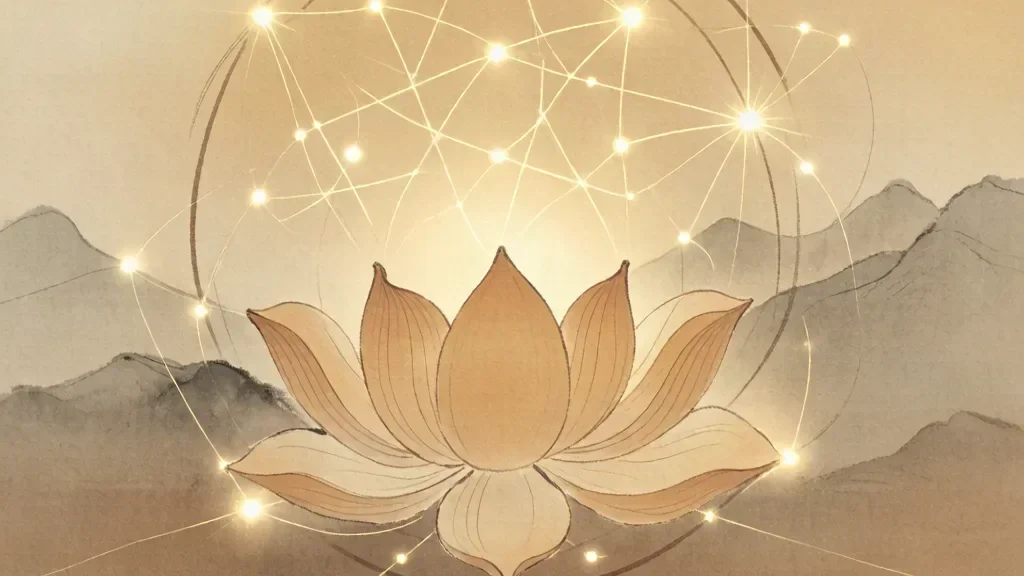
If the Heart Sutra is a single drop of wisdom and the Lotus Sutra is a flowering tree, the Avatamsaka Sutra is an entire universe — a vision of reality so vast, so intricate, and so endlessly interconnected that reading it is less an act of study than an act of cosmic travel. The Avatamsaka Sutra (华严经, huá yán jīng), or Flower Garland Sutra, presents a universe in which every atom contains all other atoms, every being reflects every other being, and the entirety of existence is a single, radiant web of awakening. This text gave rise to the Huayan school, one of the most philosophically sophisticated traditions in Chinese Buddhism.
The Ocean of Texts: Versions and Translations
The Avatamsaka Sutra is not a single text but a collection of texts that were assembled into a composite scripture. The full sutra exists in three Chinese translations: the 60-scroll version translated by Buddhabhadra (佛陀跋陀罗, 418–421 CE), the 80-scroll version translated by Siksananda (实叉难陀, 699 CE), and the 40-scroll version translated by Prajna (般若, 798 CE), which focuses on the final chapter, the Gandavyuha. The 80-scroll version is the most widely used.
The sutra's vastness — over 1,200 pages in English translation — reflects its content. It describes a cosmos of infinite worlds, each containing infinite Buddhas, each Buddha teaching infinite beings, each being performing infinite practices. The text multiplies infinities upon infinities, pushing language to its limits in an attempt to express the inexpressible scope of enlightened reality.
The Avatamsaka is traditionally considered the first teaching the Buddha gave after his enlightenment — a direct expression of his awakened vision before he adapted it for ordinary understanding. This claim, whether historical or theological, positions the Avatamsaka as the most fundamental and complete statement of Buddhist truth, from which all other teachings derive.
The Jewel Net of Indra: Perfect Interpenetration
The most famous image from the Avatamsaka Sutra is Indra's Net — a vast, infinite net strung with polished jewels at every node. Each jewel reflects every other jewel in the net, so that the entire net is present in each jewel, and each jewel is present in the entire net. This image captures the Huayan doctrine of "perfect interpenetration" (圆融, yuán róng): all phenomena are mutually containing and contained, without obstruction.
This teaching has two dimensions. First, every phenomenon contains all other phenomena: a single dust mote contains the entire universe, because each thing arises in dependence on everything else. Second, every phenomenon is present in every other phenomenon: my existence pervades yours, and yours pervades mine. The boundaries we perceive between self and other, inside and outside, large and small, are illusions. In reality, all things interpenetrate without obstruction.
The Huayan school developed this teaching into a sophisticated philosophical system with four realms (四法界): the realm of phenomena (事), the realm of principle (理), the realm of non-obstruction between principle and phenomena (理事无碍), and the realm of non-obstruction between all phenomena (事事无碍). The fourth realm is the ultimate Avatamsaka vision: a cosmos in which each individual thing is perfectly itself and perfectly everything else simultaneously.
The Sudhana Pilgrimage: The Gandavyuha Chapter
The final and longest chapter of the Avatamsaka Sutra, the Gandavyuha (入法界品), tells the story of the young pilgrim Sudhana, who journeys across India to visit 53 spiritual teachers. Each teacher — monks, laypeople, gods, goddesses, even prostitutes and murderers — teaches Sudhana a different aspect of the bodhisattva path. The pilgrimage is a literary masterpiece and a profound teaching about the universality of wisdom.
Sudhana's teachers include some of the most memorable characters in Buddhist literature: the bodhisattva Manjusri, who sends him on the journey; the wealthy merchant Megashri, who teaches that wealth can be used for the Dharma; the nun Simhavijrmbhita, who expounds the perfection of wisdom; and the bodhisattva Samantabhadra, who finally reveals the supreme practice of the bodhisattva vow.
The Gandavyuha chapter was enormously influential in Chinese Buddhist art. The 53 teachers became a common subject for paintings and sculptures, and pilgrimages to the sites associated with Sudhana's journey became a practice in Chinese Buddhism. The chapter's message — that wisdom can be found in any person and any situation — reinforced the Chinese Buddhist emphasis on the accessibility of enlightenment.
Huayan in China: From Dushun to Fazang
The Huayan school was systematized by a series of brilliant Chinese patriarchs. Dushun (杜顺, 557–640 CE) is considered the first patriarch, laying the foundation with his Meditation on the Dharmadhatu. Zhiyan (智俨, 602–668 CE) developed the doctrinal classification system. But the greatest Huayan thinker was Fazang (法藏, 643–712 CE), who synthesized the school's teachings into a comprehensive philosophical system and served as a teacher to Empress Wu Zetian.
Fazang's teaching method was famously creative. To illustrate the doctrine of interpenetration, he placed ten mirrors around a Buddha statue — one behind, one in front, one on each side, and the rest on the ceiling and floor. When a candle was lit, the statue was reflected in every mirror, and each reflection contained all the others. The empress, it is said, understood immediately.
Fazang also developed the Huayan classification of Buddhist teachings, placing the Avatamsaka Sutra at the very top — the perfect, complete teaching of the Buddha, from which all other scriptures were partial expressions. This ranking, while obviously partisan, reflected Huayan's ambition to encompass all of Buddhism within a single comprehensive vision.
Avatamsaka and Chinese Buddhist Culture
The Avatamsaka Sutra left a deep mark on Chinese Buddhist culture. Its vision of a perfectly interconnected universe inspired poets, painters, and architects. The structure of Chinese Buddhist temples — with multiple halls, courtyards, and pagodas arranged in a harmonious whole — reflects Huayan principles of unity and diversity. The emphasis on the mutual identity of all things influenced Chinese landscape painting, where mountains, water, and figures are depicted as part of a single, living organism.
In modern times, the Avatamsaka Sutra has attracted attention from physicists and systems theorists who see in its vision of interpenetration a prefiguration of quantum entanglement and ecological interdependence. While such comparisons are anachronistic, they testify to the enduring power of the sutra's central insight: that separation is an illusion, and that the universe is a single, radiant body of awakening.
Vairocana: The Radiant Cosmic Buddha
In the Avatamsaka cosmology the central figure is Vairocana, not a historical teacher but the cosmic Buddha who embodies the entire universe as a single body of awakening. Unlike Shakyamuni, who appears in a specific time and place, Vairocana sits at the center of the Lotus Treasury World and radiates outward in countless manifestations, each teaching beings according to their capacity. The sutra describes his body as coextensive with all reality: every mountain, river, and thought is a pore of Vairocana through which he teaches. This identification of the divine with the very fabric of the world gave Chinese Buddhists a vision of enlightenment not as escape from the world but as the full realization of its hidden glory. Vairocana later became the focus of devotion and monumental sculpture across East Asia, most famously in the colossal bronze Buddha enshrined at Tōdai-ji in Nara.
The Ten Mysterious Gates of Huayan
To make its dense philosophy teachable, the Huayan school distilled the doctrine of interpenetration into the Ten Mysterious Gates, a set of paired perspectives showing how all things simultaneously contain and pervade one another. Among them are the gate of the simultaneous completion of cause and effect, the gate by which the minute and the vast mutually enter, and the gate in which the obscured and the luminous reflect without obstruction. Each gate is not a separate doctrine but a different angle on the same truth: that reality is a seamless web in which every part already holds the whole. The framework was refined by the early patriarchs, especially Zhiyan, and used by later teachers as a mnemonic map for students approaching the sutra. Read together, the ten gates dissolve the ordinary habit of splitting the world into isolated objects and reveal a reality in which nothing stands alone.
The Avatamsaka in Practice
Beyond its philosophy, the Avatamsaka Sutra has long shaped Buddhist practice. Devotees copy and recite the scripture as a merit-making act, and whole Huayan assemblies were organized in imperial China to chant the text continuously over days or weeks, sometimes while circumambulating an image of Vairocana. The Samantabhadra vow, the bodhisattva's ten great resolves described at the end of the Gandavyuha, became a popular liturgical text in its own right, recited by monastics and laypeople alike as a daily pledge to benefit all beings. Visualizations based on Indra's Net and the Lotus Treasury World guided meditators to see their own minds as coextensive with the cosmos. In this way the sutra was never only a book to be studied; it was a lived program of devotion, chanting, and vow-making that turned its vision of universal interconnection into daily spiritual training.
❓ Frequently Asked Questions
📝 Chinese Vocabulary
华严经 — : The Avatamsaka or Flower Garland Sutra.
圆融 — : Perfect interpenetration; the hallmark Huayan doctrine.
四法界 — : The four realms of reality in Huayan philosophy.
入法界品 — : The Gandavyuha chapter; Sudhana's pilgrimage to 53 teachers.
法藏 — : Fazang; the third Huayan patriarch and its greatest systematizer.
毗卢遮那 — : Vairocana, the cosmic Buddha who embodies the entire universe in Huayan cosmology.
普贤菩萨 — : Samantabhadra, the bodhisattva whose ten great vows conclude the Gandavyuha chapter.
华藏世界 — : The Lotus Treasury World, the vast cosmic reality in which all Buddhas and worlds are arrayed.
🎉 Fun Facts
- The Avatamsaka Sutra describes a Buddha named Vairocana who is the cosmic embodiment of the entire universe — not a historical person but reality itself.
- The 53 teachers in Sudhana's pilgrimage represent all walks of life, reflecting the teaching that wisdom is universally accessible.
- The Huayan mirror-room demonstration — using ten mirrors to illustrate interpenetration — is one of the most famous teaching devices in Buddhist history.
- The sutra describes a Lotus Treasury World in which countless world-systems are arrayed like the petals of a lotus, and each of those worlds contains infinite further worlds.
- In East Asia the Gandavyuha chapter was so cherished that it was often copied, illustrated, and venerated as a scripture in its own right, apart from the full sutra.
- The Huayan vision reached Japan as the Kegon school, and the giant bronze Vairocana Buddha enshrined at Tōdai-ji in Nara was conceived as a visible image of the sutra's cosmic Buddha.