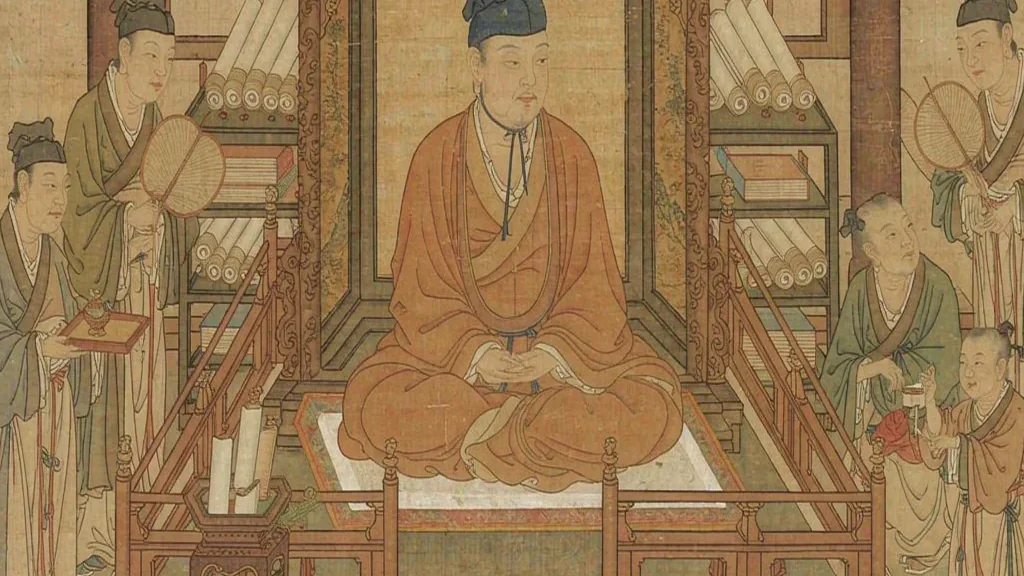
When Empress Wu Zetian — the only woman to rule China in her own name — wanted to understand the Buddhist doctrine of interpenetration, she turned not to a Chan master or a sutra reciter but to a Sogdian monk from a Central Asian merchant family who had entered the monastery at a young age and would become the greatest philosopher of the Huayan tradition. Fazang (法藏, fǎ zàng) was not only a brilliant thinker but also a political survivor, a master of metaphor, and a teacher so effective that he once demonstrated the interpenetration of all phenomena using a hall of mirrors and a golden lion.
The Sogdian Scholar in the Tang Capital
Fazang was born in 643 CE in Chang'an, the cosmopolitan capital of the Tang empire. His family was of Sogdian origin — Sogdiana, in modern Uzbekistan, was a network of city-states along the Silk Road, whose merchants dominated trade between China and Persia. His father was a diplomat who had served the Tang court, and the family was well-connected in imperial circles. But Fazang showed little interest in commerce or politics; at a young age, he was drawn to the study of the Avatamsaka Sutra, the vast and visionary text that would become his life's work.
He studied under the second Huayan patriarch, Zhiyan (智俨), and quickly surpassed his fellow students in both learning and insight. After Zhiyan's death, Fazang took on the leadership of the Huayan community and began the systematic exposition that would define the school. He enjoyed the patronage of Empress Wu, who found his philosophy of interpenetration appealing as a cosmic justification for her universal rule.
The Essay on the Golden Lion
Fazang's most famous work, On the Golden Lion (金狮子章, jīn shīzi zhāng), began as an impromptu teaching for Empress Wu. She had asked him to explain the Huayan doctrine of the four Dharma-realms, and Fazang, noticing a golden statue of a lion in the hall, used it as his teaching aid. The lion, he said, is made of gold — the gold is the substance, the lion shape is the appearance. They are not the same, nor are they different. The gold is the lion; the lion is the gold. This is the non-obstruction between principle and phenomena.
From this simple example, Fazang unfolded the entire Huayan system. Each part of the lion — the mane, the paws, the tail — contains the whole lion. Remove any part, and the "lion" disappears. This is non-obstruction between all phenomena. The lion is not a collection of independent parts; it is a whole in which each part expresses the totality. Similarly, every phenomenon in the universe expresses the entire universe. The golden lion was a perfect teaching device: concrete, visual, and immediately comprehensible to a non-specialist audience.
The Four Dharma-realms Systematized
Fazang's greatest philosophical achievement was his systematic formulation of the Four Dharma-realms (sì fǎ jiè). The first realm is that of individual phenomena — ordinary reality as we perceive it, with its distinctions and separations. The second is the realm of principle (lǐ) — the underlying empty nature that all phenomena share. The third is the realm of non-obstruction between principle and phenomena — the realization that emptiness and form interpenetrate without conflict.
The fourth realm, the supreme teaching of Huayan, is the realm of non-obstruction between all phenomena (shì shì wú ài). In this realm, each individual thing contains every other thing without obstruction. A speck of dust contains all the Buddhas of the ten directions. One moment contains all moments. This is not pantheism — Fazang was careful to maintain the distinctness of individual phenomena. The dust and the Buddhas remain distinct, yet they interpenetrate completely. This is the mystery of Huayan: the one and the many are perfectly realized in each other without confusion.
The Five Teachings and the Classification of Doctrines
Fazang developed a hierarchical classification of Buddhist teachings known as the "Five Teachings" (wǔ jiào). The first is the Hinayana teaching of the Agamas. The second is the elementary Mahayana teaching of the Consciousness-Only school. The third is the advanced Mahayana teaching of the Madhyamaka school. The fourth is the sudden teaching of Chan, which transcends gradual stages. The fifth and highest is the perfect teaching of Huayan, which reveals the complete interpenetration of all reality.
This classification was not merely a ranking of schools — it was a pedagogical map showing how the Buddha gradually led beings to the fullest truth. Each teaching was valid for its time and audience, but only Huayan expressed the complete, unqualified reality. Fazang was careful to include Chan and Tiantai within his scheme, positioning Huayan as the crown of Buddhist philosophy rather than a sectarian alternative. This inclusive strategy helped Huayan gain respect from rival traditions.
Fazang's Legacy
Fazang died in 712 CE, honored as the "National Teacher" and survived by a flourishing Huayan community. His works — particularly the Huayan Jing Tanxuan Ji (华严经探玄记, "Record of Investigating the Mystery of the Avatamsaka Sutra") — became the foundational texts of the school. His disciple Chengguan would carry the tradition to even greater heights in the following generation.
Fazang's influence extended beyond institutional Huayan. His ideas about interpenetration and mutual inclusion permeated Chinese Buddhist thought, influencing Chan masters, Neo-Confucian philosophers, and even Chinese landscape painters who sought to capture the "non-obstruction" of mountains, rivers, and mist on silk scrolls. In the modern era, Fazang's philosophy has been compared to Western systems like Leibniz's monadology and Whitehead's process philosophy, earning him a place in the global history of metaphysics.
The Ten Profound Gates
Fazang's 'ten profound gates' (十玄门) organize Huayan's vision into perspectives that reveal how the one and the many interpenetrate without obstruction. Each gate shows a different facet of relationship — such as the simultaneity of cause and effect, or the mutual containment of the whole and its parts — yet all point to the same truth of perfect interpenetration. The scheme gave later students a structured path through the Avatamsaka's sometimes overwhelming symbolism, turning poetic imagery into a rigorous metaphysical system that influenced the whole East Asian commentarial tradition. By naming the gates, Fazang made the school's insight teachable: a student could work through them one by one until the habit of seeing isolated things gave way to the vision of a single, mutually reflecting reality.
Dharma-Realm Conditioned Arising
At the heart of Fazang's thought lies the principle of dharma-realm conditioned arising (法界缘起): nothing exists independently, but each thing arises only in relation to all others, and each therefore contains the whole. This is why a single atom can be said to hold the entire cosmos. Fazang used this principle to explain how the Buddha's enlightenment and the suffering of ordinary beings share one reality. It remains the distinctive contribution of Huayan to Mahayana philosophy and a foundation for later Chinese Buddhist cosmology. The teaching also supplied a logic for compassion: if all things are woven together, then the fate of any being is bound to the fate of all, and to help one is to touch the whole.
Huayan at the Tang Court
Fazang enjoyed extraordinary imperial favor, especially under Empress Wu, who sponsored Huayan as a kind of state philosophy and reportedly received his personal instruction. He consecrated her great ordination platform and lent Buddhist legitimacy to her unprecedented rule as a woman. After her reign, Huayan remained influential among the elite even as it faced the 845 persecution. Its categories of interpenetration outlived the school's institutional independence, passing into the doctrine of Chan, Tiantai, and esoteric Buddhism at court. The spectacle of a cosmo-political theology at the Tang court shows how Huayan's abstract vision of total interconnection could be recruited to imagine the emperor as the still point around which the whole realm turned. Huayan's vision of interconnection could even be recruited to imagine the emperor as the still point of the realm.
❓ Frequently Asked Questions
📝 Chinese Vocabulary
法藏 — : Fazang; literally "Dharma Storehouse," the third Huayan patriarch.
金狮子章 — : the Essay on the Golden Lion; Fazang's teaching aid.
事事无碍 — : non-obstruction between phenomena; the highest Huayan teaching.
华严经探玄记 — : Fazang's great commentary on the Avatamsaka Sutra.
华严宗 — : the Huayan (Avatamsaka) school
十玄门 — : the ten profound gates of Huayan
法界缘起 — : dharma-realm conditioned arising
武则天 — : Empress Wu Zetian, Fazang's patron
🎉 Fun Facts
- Fazang's Sogdian heritage meant he grew up speaking a Eastern Iranian language as well as Chinese — he was one of many Central Asian immigrants who shaped Chinese Buddhism.
- He once organized a "Seven-Day Dharma Assembly" for Empress Wu at which he miraculously induced rain during a drought, greatly enhancing his reputation at court.
- Fazang's mirror demonstration of interpenetration is considered the earliest recorded use of an infinity mirror — an effect still used in art and science today.
- Fazang was born into a Sogdian merchant family, making him among the most cosmopolitan of Tang Buddhist thinkers.
- He is said to have used a gilded lion and a row of mirrors to demonstrate to Empress Wu how every phenomenon reflects the whole.
- Fazang systematized the 'ten profound gates,' a set of perspectives showing how the one and the many interpenetrate.