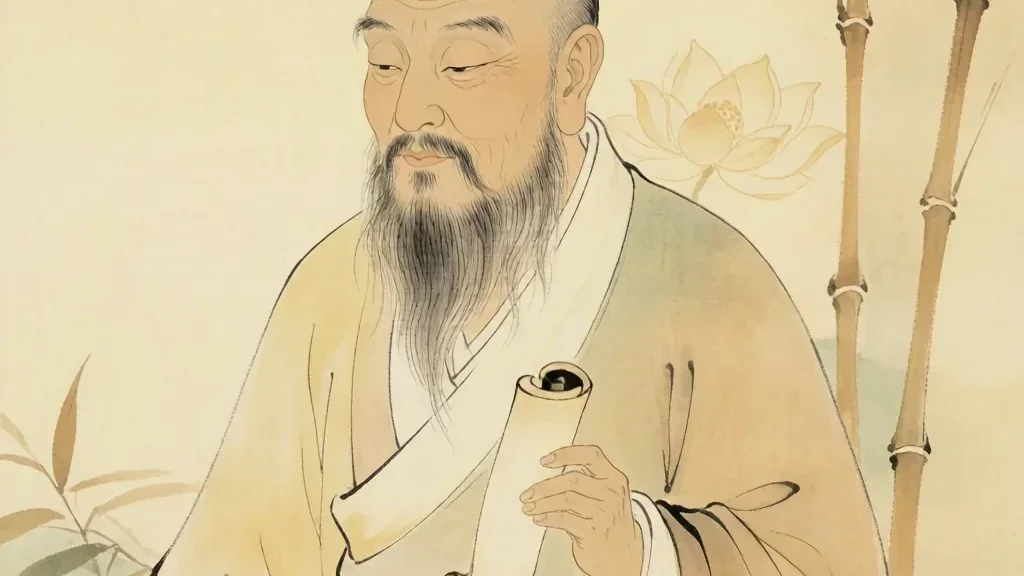
If Fazang was the architect of Huayan philosophy, Chengguan was its master builder — the commentator who took the system Fazang had outlined and expanded it into a cathedral of thought, brick by logical brick. Chengguan (澄观, chéng guān) lived to be over one hundred years old, served seven Tang emperors, and produced the most detailed and authoritative commentary ever written on the Avatamsaka Sutra. His life spanned almost the entire ninth century, and he witnessed both the glory of Tang Buddhism and the first tremors of the persecution that would nearly destroy it.
A Century of Scholarship: Chengguan's Long Life
Chengguan was born in 738 CE in Kuaiji (present-day Shaoxing, Zhejiang Province), a region known for its natural beauty and scholarly culture. He entered a monastery at a young age and began a program of study that would continue for over eighty years. He studied the Vinaya, the Madhyamaka treatises, the Yogacara texts, the Chan meditation methods, and the Tiantai classification system — mastering every major school of Chinese Buddhism before finally dedicating himself to the Huayan tradition.
His education was remarkably broad. Chengguan also studied Confucian classics, Taoist philosophy, traditional Chinese medicine, and even Sanskrit grammar. This breadth of learning would serve him well when he began his commentary on the Avatamsaka Sutra, a text that ranges over cosmology, ethics, meditation, and philosophy, requiring a commentator who could speak to all these dimensions. Chengguan was that rare scholar: a specialist who had mastered the general.
The Great Commentary on the Avatamsaka Sutra
Chengguan's magnum opus is the Avatamsaka Sutra Commentary (华严经疏, huá yán jīng shū) in sixty fascicles, along with its companion Sub-commentary (华严经随疏演义钞, huá yán jīng suí shū yǎn yì chāo) in ninety fascicles. Together, these works represent one of the largest commentary projects in the entire Buddhist canon. Chengguan did not merely explain the sutra line by line — he used the commentary as an opportunity to develop Huayan philosophy further, clarifying points that Fazang had left ambiguous and extending the system into new areas.
His commentary is notable for its precision and clarity. Chengguan had a gift for distilling complex philosophical arguments into memorable formulations. His explanation of the "ten mysteries" of Huayan — ten principles that describe the relationship between the one and the many, the part and the whole, the simultaneous and the sequential — remains the standard treatment of these topics. He also introduced new categories, such as the "ten bodies" of the Buddha, that enriched Huayan's already elaborate taxonomy.
The Teacher of Emperors
Like his predecessor Fazang, Chengguan enjoyed close relationships with the imperial court. He served as National Teacher under seven emperors, from Daizong to Wenzong, a span of over fifty years. His reputation for wisdom and integrity was such that even the notoriously anti-Buddhist Emperor Wenzong treated him with respect. Chengguan used his position at court to protect Buddhist institutions and to promote the study of the Avatamsaka Sutra among the aristocracy.
His relationship with Emperor Dezong (德宗, r. 779–805) was particularly close. Dezong invited Chengguan to the capital to give lectures on the Avatamsaka, and the emperor personally attended the lectures, a mark of extraordinary respect. Chengguan reportedly had the ability to make the sutra's cosmic visions accessible to lay audiences — he would describe the Buddha's radiant body, the jeweled trees of the Lotus Treasury World, the infinite realms interpenetrating without obstruction, and his listeners would feel as though they were witnessing the sutra's visions firsthand.
The Ten Bodies of the Buddha
One of Chengguan's most significant contributions to Huayan doctrine was his teaching on the "ten bodies" of the Buddha. Traditional Buddhism spoke of three bodies: the dharma-body (dharmakaya), the enjoyment-body (sambhogakaya), and the transformation-body (nirmanakaya). Chengguan expanded this to ten, incorporating the Buddha's manifestation as the ground of reality, as wisdom, as compassion, as the assembly of bodhisattvas, and as the entire universe itself.
The tenth body, the "body of the universal ground" (pǔ tí fǎ jiè shēn), is particularly striking: it identifies the Buddha with the totality of existence. The mountains are the Buddha's body; the rivers are his speech; the sun and moon are his eyes. This is not pantheism in the Western sense — it does not posit a divine substance underlying the world — but it does suggest that the world itself is a manifestation of awakening, that reality is the Buddha's body. In this vision, enlightenment is not escape from the world but the realization that the world is already the Buddha's perfect expression.
The Persecution and the Survival of Huayan
Chengguan died in 839 CE at the extraordinary age of 101. Six years later, Emperor Wuzong launched the Great Anti-Buddhist Persecution, which destroyed thousands of monasteries and forced hundreds of thousands of monks and nuns to return to lay life. Huayan was devastated: its monasteries were closed, its texts were scattered, and its institutional lineage was broken.
But Chengguan's commentaries survived. They were preserved in monasteries that managed to escape destruction, and they were copied by devoted monks who risked their lives to keep the teaching alive. When Huayan was revived during the Song dynasty, it was Chengguan's commentary — not Fazang's original expositions — that became the foundation of the restored tradition. Chengguan had built so thoroughly that even an emperor's persecution could not erase his work.
The Four Dharma-Realms
Chengguan's exposition of the four dharma-realms became a cornerstone of later Huayan study. The first, the realm of phenomena, sees things as distinct and separate. The second, the realm of principle, sees the single suchness underlying them all. The third, the non-obstruction of principle and phenomena, shows how the absolute and the relative mutually contain each other without conflict. The fourth, the non-obstruction of phenomena with phenomena, reveals that every single event perfectly interpenetrates every other. Together these stages map the movement from ordinary fragmented perception to the holistic vision of the Avatamsaka Sutra, in which the whole cosmos is present in every part. Chengguan presented the scheme as both an object of study and a path of realization, so that contemplating it gradually dissolved the habit of dividing the world into isolated things.
Scriptural and Meditative Synthesis
Though best known as a scholar, Chengguan insisted that Huayan learning must ripen into direct realization rather than remain dry exegesis. He taught that calm meditation and clear insight must stabilize the understanding of interpenetration, so the practitioner could actually taste the dharma-realm instead of only describing it. His emphasis on uniting 'teaching' and 'meditation' influenced later Tiantai and Chan approaches to combining doctrine with practice. In this way Chengguan offered a model later masters invoked to keep scholarship from hardening into abstraction, reminding students that the Avatamsaka's vision is finally a matter of awakened experience, not book knowledge. He warned that to debate the ten bodies of the Buddha without transforming one's own mind was like counting another's wealth.
Legacy in Korea and Japan
Chengguan's commentaries traveled abroad and shaped Buddhism far beyond Tang China. In Korea, Huayan (Hwaom) became a leading scholastic tradition, with masters such as Uisang building on his framework. In Japan the same corpus entered as Kegon, centered on the great Todaiji temple, where the cosmic Buddha Vairocana was visualized through his categories of the ten bodies and the dharma-realm. Even after Huayan faded in China as a separate school, its concepts survived inside the doctrine of other traditions, and Kegon remained influential in Japanese Buddhist philosophy and art well into the medieval period. A lasting echo of Chengguan's synthesis thus persisted for centuries as a quiet current within the broader Buddhist world. Korean and Japanese monks carried his commentaries home, where they shaped centuries of scholastic Buddhism.
❓ Frequently Asked Questions
📝 Chinese Vocabulary
澄观 — : Chengguan; literally "Clear Contemplation," the fourth Huayan patriarch.
华严经疏 — : the Avatamsaka Sutra Commentary; Chengguan's masterwork.
十身 — : the ten bodies of the Buddha; Chengguan's doctrinal innovation.
普提法界身 — : the body of the universal ground; the tenth and highest Buddha body.
华严宗 — : the Huayan (Avatamsaka) school of Chinese Buddhism
法界 — : the dharma-realm, the totality of reality
四法界 — : the four dharma-realms of Huayan analysis
清凉国师 — : National Preceptor Qingliang, Chengguan's honorific title
🎉 Fun Facts
- Chengguan is said to have been born with a white streak in his hair, which his followers interpreted as a sign of his extraordinary wisdom and longevity.
- He studied Sanskrit grammar in order to read the Avatamsaka Sutra in its original language — a rare accomplishment among Chinese monks of his time.
- At age 100, Chengguan was still lecturing on the Avatamsaka Sutra, and his voice was reportedly so clear that it could be heard throughout the largest monastery halls.
- Chengguan was the only Huayan master to serve as imperial preceptor under four Tang emperors, earning the title 'National Preceptor Qingliang.'
- His commentary tradition was carried to Korea and Japan, where Huayan (Kegon) became a major scholastic school.
- Chengguan reportedly synthesized the thought of both Fazang and the earlier exegete Zhiyan, bridging two generations of Huayan doctrine.