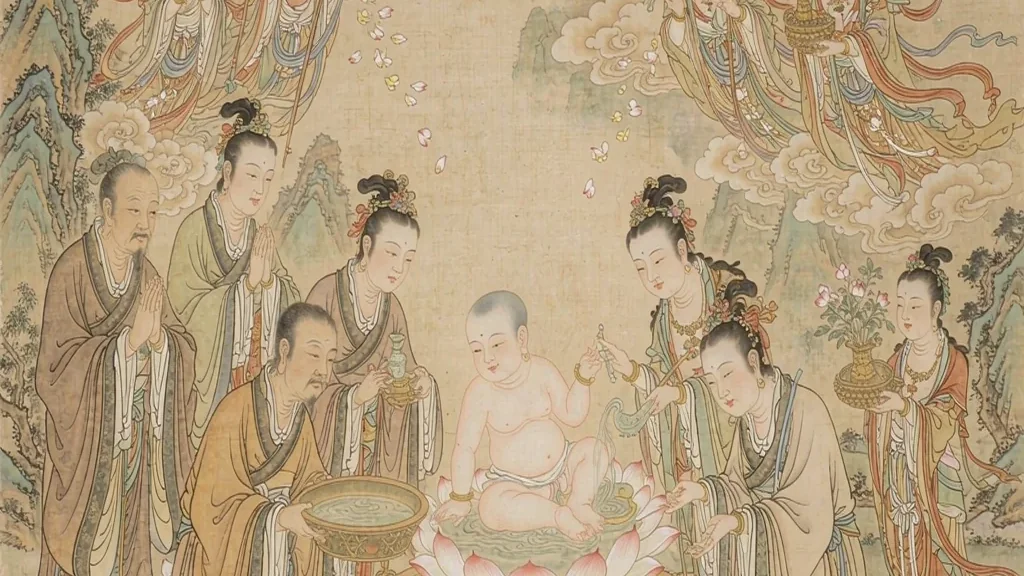
The observance of th fourth lunar month, across China, temple courtyards fill with the scent of sandalwood and the sound of chanting as Buddhists gather to celebrate the birth of Prince Siddhartha Gautama — the future Buddha who would awaken to the nature of reality and set the wheel of Dharma turning. The Buddha's Birthday (佛诞节, fó dàn jié), also known as the Bathing Buddha Festival, is the most joyous occasion in the Chinese Buddhist calendar, a celebration that combines solemn ritual with communal festivity.
The Legend of the Prince's Birth
According to traditional accounts, Queen Maya of the Shakya clan dreamed of a white elephant entering her side — a mysterious conception that signaled the birth of an extraordinary being. Ten lunar months later, she traveled to her parents' home in Devadaha for the birth, stopping along the way in the Lumbini Grove. As she reached up to grasp a branch of a sal tree, the prince emerged from her side, painlessly and miraculously, attended by heavenly beings.
The newborn prince reportedly took seven steps immediately after birth, and at each step, a lotus flower bloomed beneath his foot. Raising his right hand, he declared: "In heaven above and earth below, I alone am the World-Honored One." This bold pronouncement, whether taken literally or symbolically, announced the arrival of a being who had achieved the ultimate potential of human consciousness — a being who would show others the same path.
Chinese Buddhists inherited this Indian narrative but adapted it to Chinese cultural sensibilities. The seven steps were interpreted as representing the seven directions (four cardinal, four intermediate, plus up and down), and the lotus symbolism resonated deeply with Chinese Buddhist aesthetics. The bathing ritual that defines the festival originated from the legend that nine dragons appeared in the sky and showered the infant with perfumed water.
The Bathing Buddha Ritual
The central ritual of the Buddha's Birthday is the bathing of a small statue of the infant Buddha. A bronze or porcelain figure of the baby Buddha is placed in a decorated basin, his right hand pointing upward and his left hand pointing downward. Devotees approach the basin with a small ladle and gently pour fragrant water — usually infused with sandalwood, saffron, or other perfumes — over the statue while reciting verses of gratitude and aspiration.
The ritual is rich with symbolic meaning. Bathing the Buddha is not about cleaning a statue, which is already pure; it is about purifying one's own mind. Each ladle of water represents washing away defilements — greed, hatred, and ignorance — from the mind. The fragrant water represents the sweet scent of virtue and the pure qualities that Buddhists seek to cultivate. As one bathes the Buddha, one symbolically bathes one's own Buddha-nature.
In Chinese monasteries, the bathing ritual is performed with great solemnity. The abbot or senior monk leads the ceremony, accompanied by chanting, bell ringing, and incense offerings. Lay devotees line up to participate, often bringing their own small Buddha statues for blessing. The water used in the ceremony is collected and given to attendees as blessed water, believed to bring protection and good fortune.
Temple Celebrations and Public Festivities
Beyond the bathing ritual, Buddha's Birthday is marked by a range of festivities. Temples are decorated with lanterns and banners, and scenes from the Buddha's life are displayed in murals and tableaux. Monks deliver sermons on the significance of the Buddha's birth, and devotees often take the eight precepts for the day — a temporary period of intensified practice that includes vegetarianism, celibacy, and abstinence from entertainment.
In many communities, the festival includes public processions. A statue of the infant Buddha is carried through the streets on a decorated palanquin, accompanied by monks chanting, laypeople carrying incense and flowers, and traditional musicians playing drums, gongs, and cymbals. These processions transform the celebration from a private temple ritual into a public declaration of Buddhist identity.
The festival is also a time for charitable activities. Many temples distribute free vegetarian meals, organize blood drives, or make donations to schools and hospitals. The spirit of the Buddha's birth — a moment of infinite compassion entering the world — is expressed through acts of generosity and kindness. The Buddha's Birthday is thus not only a celebration of the past but a renewal of Buddhist values in the present.
Variations Across Chinese Buddhism
The celebration of Buddha's Birthday varies across the different traditions of Chinese Buddhism. Chan monasteries emphasize meditation and silent reflection, often incorporating longer sitting periods into the day's schedule. Pure Land temples focus on recitation of the Buddha's name, especially the phrase "Namo Amitabha Buddha," as a way of connecting with the compassionate energy of Buddhahood.
Tibetan Buddhist communities in China celebrate with their own distinct rituals, including elaborate butter sculpture offerings and masked cham dances. Theravada Buddhist communities among China's ethnic minorities, such as the Dai people in Yunnan, celebrate with water-splashing activities that echo the bathing ritual in a more exuberant form. The diversity of celebrations reflects the diversity of Chinese Buddhism itself.
In recent years, the Chinese government has recognized Buddha's Birthday as an official holiday in some regions with significant Buddhist populations. The festival has also gained visibility through state-sponsored cultural events that highlight Buddhism's contribution to Chinese heritage. While always primarily a religious celebration, Buddha's Birthday has increasingly become an occasion for showcasing China's Buddhist cultural legacy.
The Meaning of the Buddha's Birth
For Chinese Buddhists, the Buddha's Birthday is not merely a commemoration of a historical event but an affirmation of a universal possibility. The Buddha was not born a Buddha — he was born a human being who, through his own effort and insight, became awakened. His birth represents the potential for awakening that exists in every human being. To celebrate the Buddha's birth is to celebrate one's own potential for enlightenment.
The bathing ritual, with its emphasis on purification and aspiration, encapsulates this meaning. As the fragrant water flows over the statue, the practitioner is reminded that the Buddha-nature within them is already pure and radiant, needing only to be uncovered. The Buddha's Birthday is thus both a joyful celebration and a serious call to practice: if the prince could become the Buddha, so can you.
The Dream of the White Elephant
Before the story of the birth itself lies the conception legend, beloved across the Buddhist world. According to tradition, Queen Maya dreamed that a white elephant entered her side, foretelling a miraculous pregnancy; ten months later, while pausing in the Lumbini garden on the way to her parents' home, she gave birth. This gentle, symbolic account explains the Buddha's superhuman origin without a human father's ordinary role, and it ties his coming to signs of purity and power. The white elephant became one of the most common images in Buddhist birth art, appearing in murals and sculptures from India to China. By framing the event as both natural and wondrous, the story invites devotees to see the Buddha's birth not as mere history but as a cosmic event charged with meaning for all who hear it.
Buddha's Birthday Across Asia
Although the festival centers on the same figure, its expression differs widely across the Buddhist world. In Sri Lanka and much of Southeast Asia the birth, enlightenment, and death are fused into Vesak, observed with lantern festivals, mass almsgiving, and the washing of statues. In Tibet the birth is honored within the broader set of Buddha-day observances, often with cham dances and butter offerings. Chinese communities emphasize the bathing rite and vegetarian feasting, while Japanese temples pour sweet amacha tea over flower-canopied images on April 8. These varied customs show how a single Indian memory was adapted to local climates, foods, and artistic tastes, yet everywhere the core gesture stays the same: honoring the arrival of a teacher who pointed beyond suffering.
A Day in the Buddhist Year
Buddha's Birthday belongs to a rhythm of sacred anniversaries that structure the Buddhist calendar. Alongside it stand the Buddha's Enlightenment Day, marking his awakening under the Bodhi tree, and his Parinirvana Day, marking his final passing, the three often called the three great Buddha days. Together they trace the arc of a life understood as a deliberate descent into the world and a deliberate departure from it, each moment an occasion for reflection rather than mere commemoration. In China these days are woven into the lunar calendar alongside seasonal festivals, and monasteries mark them with special services, sutra readings, and communal meals. For lay believers the cycle offers regular pauses to renew faith, examine conduct, and reconnect with the community of the sangha.
❓ Frequently Asked Questions
📝 Chinese Vocabulary
佛诞节 — : Buddha's Birthday; the festival celebrating the Buddha's birth.
浴佛 — : Bathing the Buddha; the central ritual of the festival.
灌沐太子 — : The bathing of the infant prince; another name for the ritual.
九龙吐水 — : Nine dragons spouting water; the legend of the Buddha's first bath.
蓝毗尼 — : Lumbini; the garden where the Buddha was born.
释迦牟尼 — : Sakyamuni, the historical Buddha, born Prince Siddhartha, whose birth is celebrated on Buddha's Birthday.
悉达多 — : Siddhartha, the given name of the Buddha before his enlightenment, meaning one who achieves his goal.
摩耶夫人 — : Queen Maya, the mother of the Buddha, who according to tradition gave birth to him in Lumbini.
🎉 Fun Facts
- The Buddha's Birthday is one of the three major Buddha-day festivals in Chinese Buddhism, along with his Enlightenment Day and his Parinirvana Day.
- In the Japanese tradition, Buddha's Birthday is celebrated on April 8 and involves pouring sweet tea (amacha) over Buddha statues.
- The tradition of bathing the Buddha may have originated from an Indian custom of bathing newborn infants, adapted into Buddhist ritual practice.
- According to legend the newborn prince took seven steps at birth and, pointing to the sky and the earth, declared that this was his final life, a moment often painted in temple murals.
- In several Chinese regions the festival is joined with the merit-making practice of releasing captive birds or turtles, an act of compassion performed on the holy day.
- Although most Chinese Buddhists observe the birth on the eighth day of the fourth lunar month, Theravada communities celebrate Vesak on a different calendar date, uniting the Buddha's birth, enlightenment, and death in one festival.