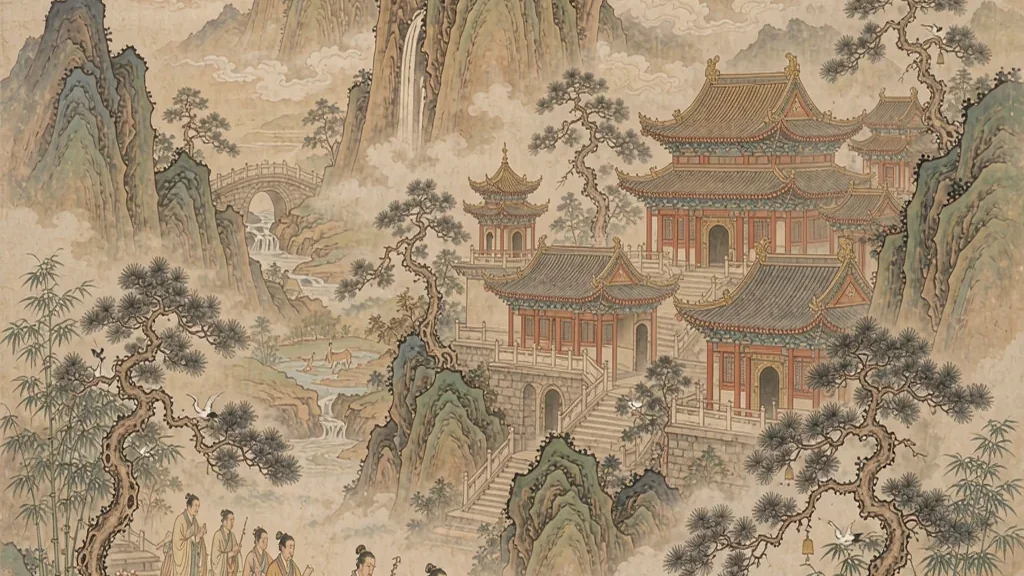
For a Chinese Buddhist, the holiest ground is not found in a single place but scattered across the vast geography of the Middle Kingdom — four sacred mountains where the bodhisattvas have made their earthly abodes, ancient caves that hold the Buddha's relics, and monasteries perched on cliffs and peaks that seem to touch the heavens themselves. Chinese Buddhist pilgrimage (朝山, cháo shān) is a practice as old as Buddhism in China, combining the physical demands of long journeys with the spiritual aspiration to encounter the sacred. To walk the pilgrim's path is to enact the Buddhist journey from ignorance to awakening, one step at a time.
The Four Sacred Mountains
Chinese Buddhism recognizes four sacred mountains, each associated with a major bodhisattva. Mount Wutai (五台山) in Shanxi is the abode of Manjusri (文殊菩萨), the bodhisattva of wisdom. Wutai's five peaks, which gave the mountain its name, are said to be crowned with the five wisdoms of the Buddha. The mountain is dotted with over 120 temples, some dating back to the Tang dynasty. Pilgrims climb the thousand steps to the summit, chanting Manjusri's mantra and seeking visions of the bodhisattva.
Mount Emei (峨眉山) in Sichuan is the mountain of Samantabhadra (普贤菩萨), the bodhisattva of practice. The mountain's misty peaks and lush forests have inspired poets and painters for centuries. The summit, at 3,099 meters, offers the famous "Buddha's Light" — a rainbow halo phenomenon that pilgrims interpret as Samantabhadra's blessing. The climb traditionally takes three days, passing through temples and teahouses that dot the trail.
Mount Putuo (普陀山) is an island off the coast of Zhejiang, sacred to Avalokitesvara (观音菩萨), the bodhisattva of compassion. Putuo is unique among the four sacred mountains in being accessible only by sea — a geographical fact that reinforces its symbolism as a Pure Land on earth. The island is covered with temples, caves, and stone carvings, and the sound of the waves is said to be Avalokitesvara's dharma teaching.
Mount Jiuhua (九华山) in Anhui is the mountain of Kshitigarbha (地藏菩萨), the bodhisattva who vowed to save all beings in the hell realms. Jiuhua is particularly associated with death and the afterlife; many pilgrims come to pray for deceased relatives. The mountain's name, meaning "Nine Glories," refers to nine peaks that resemble lotus blossoms. The ancient cypress trees that cover the slopes are draped with prayer scarves, each one a petition or gratitude.
The Historical Pilgrims: Faxian and Xuanzang
The great Chinese pilgrims who traveled to India in search of scriptures set the template for Buddhist pilgrimage in the Chinese imagination. Faxian (法显, 337–422 CE) was the first Chinese monk to reach India and return, traveling overland across Central Asia and returning by sea through Southeast Asia. His record of his journey, the Record of Buddhist Kingdoms, provided Chinese Buddhists with their first detailed account of the Indian Buddhist world.
Xuanzang (玄奘, 602–664 CE), the most famous Chinese pilgrim, spent 17 years traveling to India and back, studying at the great monastic university of Nalanda and bringing back 657 Buddhist texts. His pilgrimage was a physical ordeal — crossing the Gobi Desert, passing through the Hindu Kush, evading bandits and hostile officials — but it was also a spiritual transformation. Xuanzang's journey became the template for Chinese Buddhist hagiography: the arduous path, the overcoming of obstacles, the attainment of wisdom, and the return to share it with others.
These historical pilgrims established the patterns that later domestic pilgrims would follow: the preparation through precept-keeping and purification, the reliance on faith and merit, the collection of relics and scriptures as tangible evidence of spiritual accomplishment, and the integration of pilgrimage into one's overall Buddhist practice.
The Practice of Pilgrimage: Body, Speech, and Mind
Chinese Buddhist pilgrimage is a full-body practice. Pilgrims often prostrate the entire way to a sacred site — standing upright, kneeling, extending the body fully on the ground, rising, walking three steps, and repeating. This practice, known as "great prostrations" (大礼拜, dà lǐ bài), turns the pilgrim's body into an instrument of devotion, measuring the distance to the sacred site with the length of their own body.
Throughout the journey, pilgrims chant the bodhisattva's name or mantra. A pilgrim to Mount Putuo, for example, continuously recites "Namo Guan Shi Yin Pusa" (南无观世音菩萨) — "Homage to Avalokitesvara Bodhisattva." The chanting is not merely vocal; it is a cultivation of the mind, an attempt to merge one's awareness with the bodhisattva's compassion. The sound of chanting on the pilgrimage path is constant, creating an auditory environment of devotion.
The mental aspect of pilgrimage involves maintaining continuous mindfulness and devotion. Pilgrims are instructed to regard every person they meet as a manifestation of the bodhisattva, every difficulty as a teaching, every blessing as a reminder of the Dharma. The pilgrimage is a living meditation, conducted in the midst of the ordinary world rather than in the protected environment of a monastery.
Sacred Sites as Pure Lands
Chinese Buddhist theology holds that the four sacred mountains are not merely locations where bodhisattvas have appeared but are actual manifestations of the bodhisattva's Pure Land — a realm of enlightenment that is always present but usually invisible. The mountain's physical geography — its peaks, caves, springs, and forests — is the bodhisattva's body, and the pilgrim who sees with the eye of faith perceives this directly.
This theology means that pilgrimage is not about going to a special place but about learning to see a place as it truly is. The mountain is always sacred; the pilgrim's journey is a process of becoming receptive to that sacredness. The physical climb, the chanting, the prostrations, the encounters with resident monks — all of these are methods for stripping away the ordinary perception that sees only rock and trees and revealing the vision that sees the bodhisattva's realm.
This understanding has important ethical implications. Pilgrims are expected to treat the mountain with reverence — not littering, not damaging plants, not disturbing the wildlife. The mountain is not a resource to be exploited but a teacher to be honored. Environmental degradation on sacred mountains is not merely a practical problem but a spiritual offense.
Pilgrimage in Modern China
Buddhist pilgrimage has experienced a massive revival in China since the 1990s. The four sacred mountains now receive millions of visitors annually — a mixture of devout pilgrims, casual tourists, and commercial interests. The infrastructure of pilgrimage — cable cars, paved roads, hotels, souvenir shops — has transformed the experience. A modern pilgrim can reach the summit of Mount Emei in hours rather than days, and the trail is lined with vendors rather than meditation huts.
This commercialization has generated debate within the Buddhist community. Some argue that the ease of modern travel undermines the ascetic character of pilgrimage; others counter that making sacred sites accessible allows more people to benefit from them. Many monasteries have responded by establishing "quiet zones" where pilgrims can maintain a traditional practice environment, and by offering guided pilgrimage retreats that combine the modern infrastructure with traditional practice.
Despite the changes, the essential meaning of pilgrimage persists. Every year, thousands of Chinese Buddhists still choose to walk, prostrate, and chant their way to the sacred mountains. They go not as tourists seeking entertainment but as practitioners seeking transformation. In their aching knees, their chanting voices, and their open hearts, the ancient tradition lives on.
Mountains as Mandala: Reading the Sacred Geography
Chinese Buddhist pilgrimage treats landscape as scripture. Each sacred mountain is understood not just as a place but as the earthly body of a bodhisattva, its peaks, springs, and temples mapping a spiritual geography that the pilgrim reads with the feet. The clustered monasteries, inscribed steles, and numbered arhat caves turn a hike into a guided contemplation, where every vista carries a teaching. This way of sanctifying terrain drew on older Chinese reverence for holy mountains, so that Buddhism and native sacred geography reinforced each other. To climb was to ascend through levels of meaning, from the physical effort of the body to the symbolic ascent toward awakening. The mountain thus becomes a three-dimensional sutra, patiently studied by those who walk it.
Women and Family on the Pilgrimage
Although the classic image of a pilgrim is a lone robed monk, Chinese pilgrimage has long been a lay and family affair, with women especially prominent among the crowds. Entire households traveled to Mount Putuo to petition Guanyin for children or healing, and elderly devotees saved for years to make a once-in-a-lifetime ascent. The journey was both pious and social: a rare sanctioned reason for women to travel, meet kin from other villages, and step outside daily routine. For many the journey was also a rare holiday, a moment of leisure shared with friends and relatives. Guidebooks, hired porters, and roadside temples grew up to serve them. In this light pilgrimage was not only devotion but a cherished communal experience, weaving individual prayer into the fabric of family and village life across the countryside.
Pilgrimage and the Tourism Era
Today the sacred mountains draw not only the faithful but millions of tourists, and the line between pilgrimage and travel has blurred. Cable cars now carry visitors who once prostrated every step, while apps map the routes and book the guesthouses. Monasteries have expanded to host both pilgrims and vacationers, and local economies thrive on the flow. Critics worry that commerce swamps devotion, yet many visitors still light incense, bow at the main hall, and feel the old power of the place. The mountains have always been shared spaces where religion, nature, and society met; the modern era simply intensifies that mix. For believers, the summit remains what it was, a chance to stand closer, if only for a moment, to the object of their vow.
❓ Frequently Asked Questions
📝 Chinese Vocabulary
朝山 — : Pilgrimage to sacred mountains; literally "paying homage to the mountain."
四大名山 — : The four famous mountains; the sacred sites of the bodhisattvas.
大礼拜 — : Full-body prostrations; an extreme form of pilgrimage practice.
朝圣 — : Pilgrimage; journey to a sacred site.
舍利 — : Relics; physical remains of Buddhas or saints, often pilgrimage destinations.
五台山 — : Mount Wutai, the northern sacred mountain dedicated to the bodhisattva Manjusri and a major pilgrimage center.
普陀山 — : Mount Putuo, the island mountain off the Zhejiang coast dedicated to the bodhisattva Guanyin.
地藏 — : Ksitigarbha, the bodhisattva of the underworld who vows to save beings in hell, honored at Mount Jiuhua.
🎉 Fun Facts
- Mount Wutai has one of the oldest surviving wooden buildings in China — the East Hall of Foguang Temple, built in 857 CE.
- The "Buddha's Light" on Mount Emei is a natural rainbow phenomenon caused by sunlight refracting through mist, but it is traditionally interpreted as Samantabhadra's blessing.
- Xuanzang's 17-year pilgrimage from China to India covered approximately 10,000 miles, equivalent to walking from New York to Buenos Aires.
- Pilgrims to Mount Wutai have long reported visions of the bodhisattva Manjusri appearing as a glowing child or a passing monk, a belief that drew even foreign travelers and emperors.
- The full circuit of all four sacred mountains once took devout pilgrims months or even years on foot, a journey some undertook prostrating every few steps.
- At Mount Putuo, the island home of Guanyin, the faithful often circle the rocky coast at dawn, believing the sound of the sea carries the bodhisattva's response to prayers.