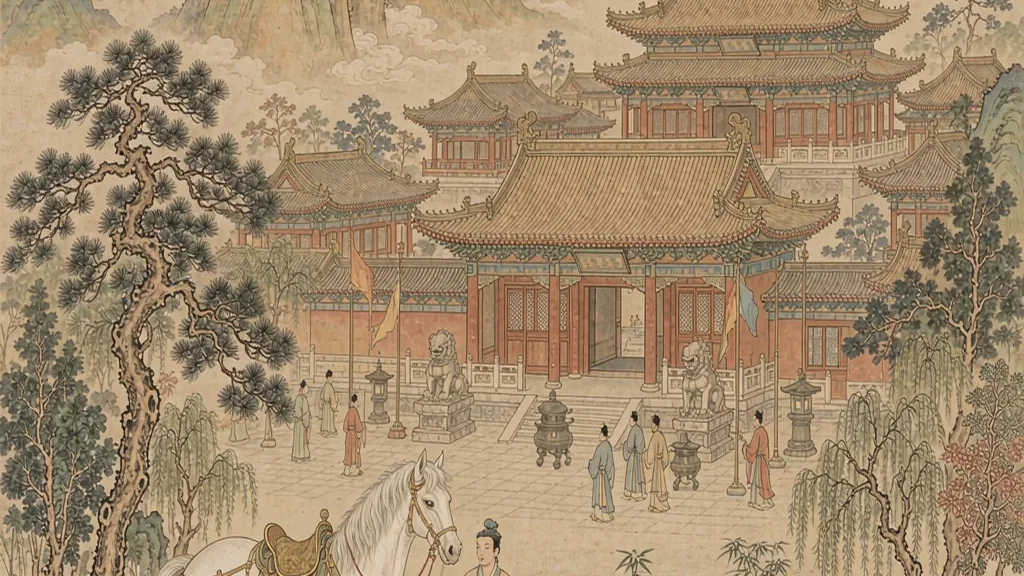
On the outskirts of the ancient city of Luoyang, a temple complex with white stone horses standing guard at its entrance marks the birthplace of Chinese Buddhism. The White Horse Temple (白马寺, bái mǎ sì), founded in 68 CE during the Eastern Han dynasty, was the first Buddhist temple ever built on Chinese soil. Its founding story, blending history and legend, encapsulates the dramatic encounter between Indian Buddhism and Chinese civilization that would transform both traditions.
The Emperor's Dream and the Envoys
The founding of White Horse Temple begins with a dream. Emperor Ming of Han (汉明帝, r. 57–75 CE) reportedly dreamed of a golden figure flying over his palace — a figure his ministers identified as the Buddha, a sage from the West. Inspired, the emperor sent a delegation of envoys, including Cai Yin and Qin Jing, to Central Asia to learn about this foreign teaching. This imperial mission is the traditional starting point of Chinese Buddhism.
The envoys returned around 67 CE with two Indian Buddhist monks, Kashyapa Matanga (迦叶摩腾) and Dharmaratna (竺法兰), along with sacred texts, images, and relics. They traveled on white horses carrying sutras — hence the temple's name. The emperor, pleased with what he learned, ordered the construction of a monastery in the capital Luoyang to house the monks and their scriptures. This monastery became the White Horse Temple.
Modern historians treat this story with caution. Buddhism had probably entered China through trade routes decades or even centuries earlier. But the White Horse Temple narrative served an important function: it gave Chinese Buddhism an official, imperial pedigree. The dream of Emperor Ming was the Chinese equivalent of Constantine's vision of the cross — a founding myth that linked the new faith to state power.
The Translation Workshop That Changed China
White Horse Temple became China's first translation center for Buddhist texts. Kashyapa Matanga and Dharmaratna immediately began working on the Sutra of Forty-Two Sections (四十二章经), a concise anthology of Buddhist teachings traditionally regarded as the first Buddhist scripture translated into Chinese. The text presents Buddhism in terms that a Chinese audience could understand, emphasizing karma, morality, and the path to liberation.
The translation method established at White Horse Temple became the model for all subsequent Chinese Buddhist translation projects. Indian or Central Asian monks would recite or read the original text aloud, while Chinese collaborators would render it into literary Chinese. This collaborative process — foreign reciter, Chinese translator, scribe, editor — produced a vast canon of Chinese Buddhist literature that would eventually dwarf the original Indian corpus in sheer volume.
The temple's role as a translation center continued for centuries. During the Northern Wei and Tang dynasties, White Horse Temple housed some of China's greatest translators, including the Kuchean monk Kumarajiva, who worked there after his capture by Chinese forces. The temple's libraries accumulated thousands of scrolls, making it one of the most important repositories of Buddhist learning in the medieval world.
Architecture and the Qiyun Pagoda
The temple complex that visitors see today has been rebuilt many times, as the original Han dynasty structures did not survive the centuries of warfare and natural disasters. The current layout dates largely from Ming and Qing dynasty restorations, but it follows the pattern established in the original design: a central axis with gates, halls, and pagodas arranged in strict symmetry according to Chinese architectural principles.
The Qiyun Pagoda (齐云塔), a thirteen-story brick pagoda standing about 35 meters tall, is the temple's most striking structure. Originally built during the Eastern Han and rebuilt during the Song dynasty, it exemplifies the fusion of Indian stupa forms with Chinese tower architecture. The pagoda once housed relics of the Buddha and served as a focal point for circumambulation rituals.
The temple grounds also include a unique international section, added in recent decades, featuring Buddhist temples built in Indian, Thai, Burmese, and Tibetan styles — a reflection of Buddhism's pan-Asian heritage and a testament to White Horse Temple's role as the symbolic root of the entire tradition in East Asia.
The Monastic Community Through History
White Horse Temple's monastic community has waxed and waned with the fortunes of Chinese Buddhism. During the Northern Wei dynasty, when Buddhism was the state religion, the temple housed hundreds of monks and operated extensive landholdings. The Tang dynasty saw further expansion, with imperial patronage funding elaborate ceremonies and new construction.
The temple suffered during the Great Buddhist Persecution of 845 CE, when Emperor Wuzong ordered the destruction of thousands of monasteries and the laicization of hundreds of thousands of monks and nuns. White Horse Temple was not destroyed but was severely diminished. It recovered during the Song dynasty but never regained its earlier prominence, as the center of Chinese Buddhism shifted southward. In 1961, it was declared a National Key Cultural Relic, ensuring state protection. Today, it functions as both an active monastery and a major historical site, attracting pilgrims and tourists who come to walk the grounds where Chinese Buddhism began.
White Horse Temple in the Buddhist Imagination
For Chinese Buddhists, White Horse Temple is not merely a historical site but a living symbol of the tradition's origins. Pilgrims visit to pay homage to the founding patriarchs, to circumambulate the Qiyun Pagoda, and to connect with the moment when the Dharma first arrived in China. The temple's name appears in countless Buddhist texts, and its story is taught to children in Buddhist families across East Asia.
The temple also represents a theological ideal: the harmonious meeting of Indian and Chinese civilizations under imperial patronage. In the White Horse Temple narrative, the Dharma comes from the West but takes root in Chinese soil through the intelligent cooperation of foreign monks and Chinese rulers. This ideal of cross-cultural religious transmission has shaped Chinese Buddhist identity from the Han dynasty to the present day.
White Horse Temple on the Silk Road
White Horse Temple stands near the eastern terminus of the Silk Road, and its founding story is inseparable from the long exchange of people and ideas between Han China and the cultures of the West. The envoys who returned with the two Indian monks traveled the same Central Asian corridors later used by merchants, artisans, and pilgrims, and the scriptures they carried were among the first Indian religious texts to enter China by land. In the centuries that followed, the temple served as a way station where traveling monastics from India, Central Asia, and later Korea and Japan could rest, study, and translate before journeying on. Its very existence marks the moment when a road built for silk and horses also began to carry Buddhism deep into Chinese soil, reshaping the religious landscape for the next two thousand years.
The Stupas of the Founding Monks
Within the temple grounds stand two modest commemorative stupas said to mark the resting places of Kasyapa Matanga and Dharmaratna, the Indian monks credited with establishing the monastery. These tombs are among the most revered early-Buddhist relics in China, treated by later generations as tangible proof of the religion's foreign yet welcome origins. Devotees and pilgrims have paid respects at the stupas for over nineteen centuries, and they remain focal points of ritual at the site. The presence of the monks' tombs inside the compound reinforced White Horse Temple's status not merely as a building but as a burial shrine of the faith's founders on Chinese soil. In this way the temple fused two roles, a working monastery and a sacred cemetery, that would recur in the layout of major Buddhist sites throughout China.
White Horse Temple Today
Far from being a museum piece, White Horse Temple remains an active monastic center and a living place of worship. Daily chanting, offering rituals, and lay devotions continue in its halls, while the surrounding courtyards host visitors from across China and abroad. In recent decades the site has expanded into an international temple zone, with newly built halls in Indian, Thai, and Burmese architectural styles donated by those countries, symbolizing Buddhism's pan-Asian family. Annual festivals and the Buddha's birthday draw large crowds, and the temple's gardens, ancient steles, and the Qiyun Pagoda offer quiet spaces for reflection. Listed among China's most important cultural sites, White Horse Temple today bridges its role as a cradle of Chinese Buddhism and as a modern, open monument where history, faith, and tourism meet.
❓ Frequently Asked Questions
📝 Chinese Vocabulary
白马寺 — : White Horse Temple; the first Buddhist temple in China.
四十二章经 — : The Sutra of Forty-Two Sections; the first Chinese Buddhist text.
汉明帝 — : Emperor Ming of Han; the emperor whose dream inspired Buddhism's official arrival.
迦叶摩腾 — : Kashyapa Matanga; one of the first two Indian monks at White Horse Temple.
齐云塔 — : Qiyun Pagoda; the landmark pagoda at White Horse Temple.
竺法兰 — : Dharmaratna, the Indian monk who, with Kasyapa Matanga, brought Buddhism to the Han court and helped translate the first sutras.
永平 — : The reign era of Emperor Ming of Han, during which the dream-embassy to the West is traditionally dated, around 68 CE.
洛阳 — : The eastern Han capital near which White Horse Temple was founded, in present-day Henan province.
🎉 Fun Facts
- The white stone horses at the temple entrance were not originally part of the temple — they were moved from a nearby Song dynasty imperial tomb.
- The Sutra of Forty-Two Sections originally consisted of 42 short passages inscribed on wooden tablets, resembling the Confucian Analects in format.
- Emperor Ming's dream of a golden figure is strikingly similar to a story about Emperor Asoka in Indian Buddhist tradition, suggesting possible Buddhist influence on the Han court before the official mission.
- The temple's name is said to come from the white horse that carried the Buddhist scriptures and images back from the West on the imperial envoys' return journey.
- White Horse Temple's layout became the template for countless later Chinese monasteries, with its north-south axis, central hall, and enclosing courtyards.
- White Horse Temple today includes a row of foreign-style Buddhist halls built through international cooperation, including Indian, Thai, and Burmese pavilions.