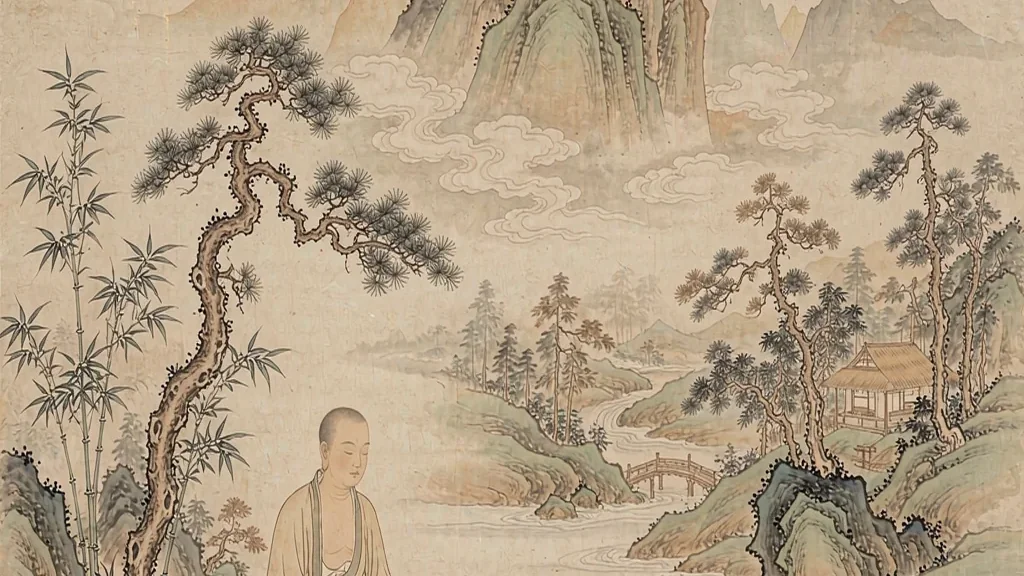
Tang dynasty China bristled with monastic scholarship, yet one school declared that the entire Buddhist canon was a finger pointing at the moon — and that the moon itself was already inside you. Chan Buddhism (禅宗, chán zōng), which would later flourish as Zen in Japan, broke from every contemporary tradition by insisting that enlightenment was not earned through centuries of textual study or ritual repetition, but could flash into being in a single, unguarded moment. This radical claim reshaped Chinese Buddhism and produced some of the most iconoclastic teachers, paradoxical koans, and austere ink paintings in Asian history. Understanding Chan means entering a world where the master might answer your deepest question with a shout, a slap, or a cup of tea.
The Indian Roots and the Flower Sermon
Chan tradition traces its lineage back to the Buddha himself through a famous silent transmission. According to the legend, the Buddha once held up a flower before an assembly at Vulture Peak. Only the disciple Mahakashyapa smiled. The Buddha then declared that he had transmitted the "special transmission outside the teachings" — a wordless realization that bypassed scripture altogether. This story, whether historical or not, captures the Chan conviction that truth cannot be trapped in language.
The word chán is a Chinese transliteration of the Sanskrit dhyāna, meaning meditative concentration. But Chan is far more than meditation technique. It is a comprehensive approach to awakening that treats direct experience as the sole authority. Where other schools built elaborate philosophical systems, Chan kept returning to the raw moment of awareness, trusting that the mind, when stripped of its layers, already sees clearly.
Bodhidharma and the Arrival in China
The semi-legendary Indian monk Bodhidharma (菩提达摩) arrived in China around the early sixth century CE and became the first patriarch of Chan in the East. His reported encounter with Emperor Wu of Liang — in which the emperor asked about his merit from building temples and Bodhidharma replied "no merit" — set the anti-authoritarian tone that would define the school. Bodhidharma then retreated to the Shaolin Temple, where he is said to have faced a wall for nine years in silent meditation.
Historians debate the details of Bodhidharma's life, but his symbolic role is unmistakable. He represented a transmission that was foreign to Chinese scholarly Buddhism: a teaching that valued realization over learning, direct pointing over commentary. His legacy includes not only a spiritual lineage but also the association with Shaolin martial arts, though the historical link is tenuous at best.
The Split: Northern Gradual vs. Southern Sudden
During the Tang dynasty, Chan divided into two major branches. The Northern School, associated with Shenxiu (神秀), taught gradual purification — polishing the mirror of the mind until it reflected reality without distortion. The Southern School, championed by Huineng (惠能), the illiterate sixth patriarch, rejected gradualism outright. Huineng's famous verse countered Shenxiu: "Originally there is no tree of enlightenment, nor a stand with a mirror bright. Since all is empty from the start, where can the dust alight?"
The Southern School's "sudden enlightenment" model eventually became mainstream Chan. Huineng's teachings, recorded in the Platform Sutra, emphasize that enlightenment is not something to be achieved but something to be recognized as already present. This doctrine of innate awakening — that all beings already possess Buddha-nature and merely fail to see it — gave Chan its characteristic combination of radical egalitarianism and stubborn practicality.
Modern scholarship treats the sudden-gradual distinction as less absolute than Chan legends suggest. Both schools employed meditation and study, and the polemics between them were as much about institutional authority as doctrinal purity. Nevertheless, the Southern School's victory shaped Chan's identity as the school of abrupt awakening.
The Golden Age: Chan Masters of the Tang and Song
The Tang dynasty produced a galaxy of Chan masters whose words and deeds became the koan literature still studied today. Mazu Daoyi (马祖道一) famously declared that "mind is Buddha" and taught through shouts and whacks. Linji Yixuan (临济义玄), founder of the Linji (Rinzai) school, instructed his students to "kill the Buddha if you meet him" — a shocking directive meant to destroy attachment to any concept, even the concept of enlightenment itself.
During the Song dynasty, Chan matured into an institutional force. The great koan collections — the Blue Cliff Record, the Gateless Gate, and the Record of Linji — were compiled, providing structured curricula for meditation practice. The Caodong (Soto) school, founded by Dongshan Liangjie and developed by Hongzhi Zhengjue, emphasized silent illumination (mòzhào) as an alternative to the dramatic encounters of Linji. Both approaches continue to be practiced today.
Chan's Influence on Chinese Culture
No school of Chinese Buddhism left a deeper mark on the secular arts. Chan aesthetics shaped Song dynasty landscape painting, where vast empty spaces invited the viewer to contemplate what was not depicted. Monks like Guanxiu painted arresting arhats, while poet-recluses like Hanshan wrote verses that doubled as Zen teachings. The spare, asymmetrical beauty of a tea ceremony, the deliberate simplicity of a rock garden, the brushstroke that captures a bamboo stalk in a single motion — all reflect the Chan value of seeing directly, without decoration.
The influence extended to Neo-Confucianism as well. Song thinkers like Zhu Xi borrowed Chan meditative techniques while rejecting Chan metaphysics, creating a synthesis that dominated Chinese intellectual life for centuries. Chan also shaped Chinese martial arts, particularly through the Shaolin Temple tradition, where meditative discipline was applied to combat training. The word gōngfu itself carries Chan overtones of sustained, mindful practice.
In literature, Chan paradoxes inspired generations of poets. Wang Wei, Su Shi, and countless others wrote poems that function like koans, inviting the reader into a direct encounter with reality rather than a discursive explanation. The Chinese literary emphasis on suggestion over statement, on the space between words, owes an immense debt to Chan's suspicion of language.
Chan in the Modern World
Chan Buddhism declined in China during the late imperial period but experienced a revival in the twentieth century, particularly through the efforts of masters like Xu Yun (虚云), who revitalized the Linji and Caodong lineages. In the West, Chan's Japanese export — Zen — became one of the most influential Asian spiritual traditions, attracting artists, writers, and seekers from D.T. Suzuki to Jack Kerouac. Today, Chinese Chan is experiencing renewed interest both in mainland China and in the global diaspora.
The appeal of Chan in a secular age is not hard to understand. Its minimal ritual, its distrust of authority, its insistence that ultimate truth is accessible here and now — these qualities resonate with modern seekers who are skeptical of organized religion but hungry for genuine experience. Chan does not ask for belief; it asks for attention. In an era of constant distraction, that demand feels more urgent than ever.
Chan's Transmission to Japan
Chan reached Japan in the late twelfth century when the monk Eisai returned from China with the Rinzai (Linji) lineage and taught that meditation could be practiced alongside other Buddhist rites. A generation later, Dogen traveled to China, trained in the Caodong tradition, and founded the Soto school, emphasizing just sitting (shikantaza) as the full expression of awakening. Japanese Zen wove Chan practice into native arts: the tea ceremony, Noh drama, calligraphy, and the dry rock garden all became vehicles for the same wordless insight. Where Chan in China later faded as a separate institution, Zen in Japan endured as a disciplined monastic order and, from the twentieth century, a global emblem of Japanese spirituality. Today Zen temples from Kyoto to California teach the forms Eisai and Dogen imported, and the encounter between Chinese Chan and Japanese culture remains one of the most fruitful transmissions in the whole of Buddhist history, still shaping how the West imagines meditation.
Chan in Everyday Life
Beyond monasteries, Chan shaped how many Chinese learned to meet ordinary moments. Its saying that 'chop wood, carry water' is itself enlightenment reframed labor and routine as practice rather than obstacles to it. The habit of mindful tea-drinking, the appreciation of a single brushstroke, and the comfort of a sudden laugh at life's absurdity all carry Chan's fingerprint. In the modern world, elements of Chan appear in mindfulness and meditation apps, corporate calm-training, and popular books on focus. Though often stripped of its Buddhist framework, the underlying move remains the same: to stop chasing elsewhere and notice the awake mind already present in this breath, this task, this cup. The result is a quietly influential ethos that values attention over achievement and presence over accumulation, an attitude that has outlasted the particular temples that first taught it and now colors everyday life far from any mountain hermitage.
❓ Frequently Asked Questions
📝 Chinese Vocabulary
禅宗 — : Chan School; the Chinese tradition of meditative Buddhism.
菩提达摩 — : Bodhidharma; the first Chan patriarch in China.
公案 — : koan; a paradoxical dialogue used as a meditation tool.
顿悟 — : sudden enlightenment; the hallmark of the Southern Chan school.
坐禅 — : seated meditation; the core practice of Chan.
教外别传 — : a transmission outside the orthodox teachings
见性成佛 — : seeing one's own nature and becoming a Buddha
不立文字 — : not founded upon words and letters
教外别传 — : a transmission outside the orthodox teachings
见性成佛 — : seeing one's own nature and becoming a Buddha
不立文字 — : not founded upon words and letters
🎉 Fun Facts
- The Shaolin Temple's association with martial arts began centuries after Bodhidharma's time and has no basis in early Chan texts.
- Huineng, the sixth patriarch, was said to be illiterate — yet his teachings became the only Chinese Buddhist text honored as a "sutra."
- The Japanese word "Zen" comes from the Chinese "Chan," which itself comes from the Sanskrit "dhyāna" — the word has traveled through three languages in 1500 years.
- The Platform Sutra linked to Huineng is the only Chinese Buddhist writing ever honored with the title 'sutra,' normally reserved for the Buddha's own words.
- Chan's 'stick and shout' (棒喝, bàng hè) technique used a blow or sudden cry to startle a student past logical thought.
- The Caodong school (Japanese Soto) favored 'silent illumination,' a quiet sitting practice that contrasted with the dramatic Linji style yet aimed at the same insight.
- The Platform Sutra linked to Huineng is the only Chinese Buddhist writing ever honored with the title 'sutra,' normally reserved for the Buddha's own words.
- Chan's 'stick and shout' (棒喝, bàng hè) technique used a blow or sudden cry to startle a student past logical thought.
- The Caodong school (Japanese Soto) favored 'silent illumination,' a quiet sitting practice that contrasted with the dramatic Linji style yet aimed at the same insight.