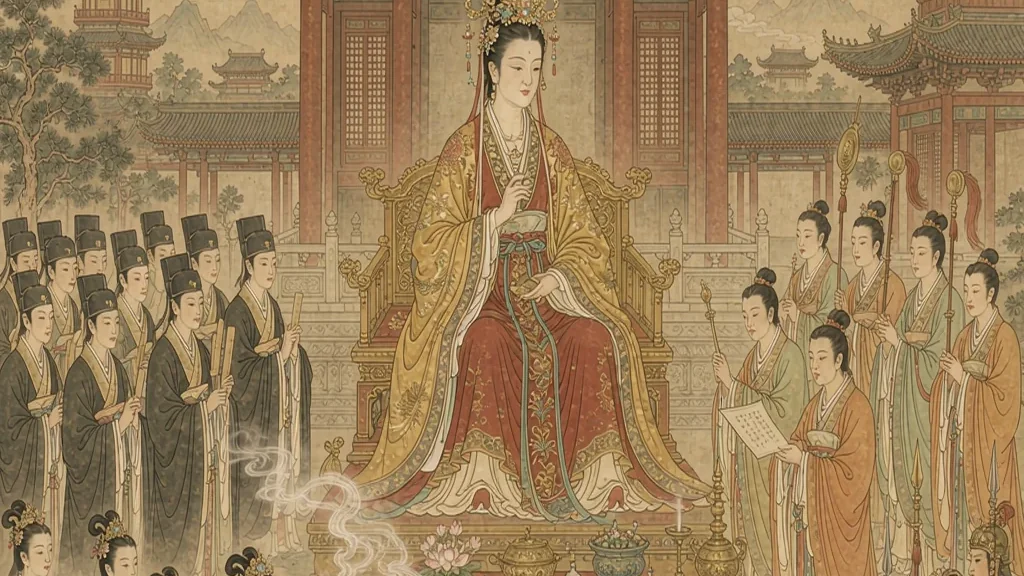
For over half a century, a woman held the reins of the most powerful empire on earth, and her hand guided Buddhism from a tolerated faith into the commanding height of Chinese spiritual life. Empress Wu Zetian (武则天, 624–705 CE), the only female emperor in Chinese history, did not merely patronize Buddhism — she weaponized it, reformed it, and elevated it to a state ideology that would shape East Asian Buddhism for centuries. Her reign marked a turning point where religion, politics, and gender converged in a drama that still fascinates historians.
The Confucian Trap and the Buddhist Escape
When Wu Zetian seized effective power in the 660s, she faced an almost insurmountable ideological problem. Confucian state doctrine held that a woman could not rule — the cosmic order demanded male sovereignty. To legitimize her authority, Wu turned to Buddhism, which offered a far more flexible cosmology. Buddhist texts, particularly the Great Cloud Sutra, contained prophecies of a female ruler who would appear as a bodhisattva to spread the Dharma. Wu's propagandists eagerly promoted this connection, presenting her as an incarnation of Maitreya, the future Buddha.
The political calculus was brilliant. By casting herself as a Buddhist savior-queen, Wu bypassed the Confucian bureaucracy and appealed directly to the monastic establishment, which owed its privileges to her favor. She commissioned statues, sponsored translations, and built temples on a scale that no previous Tang ruler had matched. Buddhism provided both a divine mandate and a counterweight to the scholar-official class that resented her rule. The sutra describes a goddess named Pure Radiance who receives a prophecy from the Buddha: after his death, she will be reborn as a universal monarch who rules a kingdom and spreads the Dharma. Wu's court scholars produced a commentary explicitly identifying the empress with this prophesied ruler. Copies of the sutra were distributed to every prefecture, and temples named Dayun (Great Cloud) were established across the empire.
Modern scholars debate whether Wu genuinely believed in her Buddhist identity or used it cynically. The evidence suggests a combination of both. She funded massive translation projects, studied Buddhist philosophy under eminent monks, and participated in religious ceremonies. But she also ruthlessly suppressed Buddhist officials who opposed her and manipulated monastic appointments for political ends. The line between devotion and statecraft blurred completely.
The Famen Temple Finger Bone and State Buddhism
Perhaps the most dramatic display of Wu's Buddhist piety was her treatment of the Famen Temple's relic — reportedly a finger bone of the Buddha himself. In 660 CE, she orchestrated a grand ceremony to bring the relic to the palace, where it was venerated with extravagant offerings. The event drew thousands of monks, officials, and commoners, transforming a private devotion into a public spectacle of imperial power under Buddhist auspices.
This pattern of relic veneration became a hallmark of Tang Buddhist politics. By controlling access to sacred objects, the emperor — or empress — positioned themselves as the mediator between the Buddha's grace and the Chinese people. Wu's handling of the Famen relic set a precedent that later Tang rulers would follow, each competing to outdo the previous in displays of devotion.
The White Horse Temple Connection and Wu's Legacy
Wu Zetian's connection to the White Horse Temple (白马寺) ran deep. Although the temple was already centuries old by her time, she undertook major renovations and expanded its libraries. More importantly, she elevated several of its abbots to positions of national influence, creating a network of loyal Buddhist officials who legitimized her reign in the eyes of the monastic community.
The empress also commissioned the construction of the Bright Hall (明堂) and the Heavenly Hall (天堂) in Luoyang, her eastern capital. These massive structures, which served as venues for Buddhist ceremonies, were among the tallest buildings in East Asia at the time. They proclaimed, in stone and timber, that the Tang empire was now a Buddhist state.
Evaluating Wu's Buddhist Revolution
Wu Zetian's patronage permanently changed Chinese Buddhism. She broke the Confucian monopoly on political legitimacy and demonstrated that Buddhism could serve as a state ideology. The translation projects she funded produced some of the most important Chinese Buddhist texts, including critical works of the Consciousness-Only (Yogacara) school. The monastic establishment gained unprecedented wealth and political influence, setting the stage for both the later Tang persecution of Buddhism and the school's remarkable resilience.
Her reign also left a complicated legacy for women in Buddhism. While Wu used Buddhist doctrine to justify female rule, she did nothing to improve the status of Buddhist nuns or to challenge the patriarchal structures within the sangha. Her empowerment was personal, not institutional. Nevertheless, the image of a female Buddhist emperor — however singular — expanded the imaginative possibilities of Chinese Buddhist culture.
After her death, the succeeding Tang emperors reversed many of her policies, and the Confucian historians who wrote the official dynastic histories portrayed her as a usurper and a tyrant. But Buddhism never forgot her. In temples across China, statues and murals commissioned by Wu Zetian still stand, silent witnesses to the woman who made Buddhism the imperial faith.
The Great Cloud Sutra Propaganda
The cornerstone of Wu's Buddhist legitimation was the 'Great Cloud Sutra' (大云经). In 690 her supporters presented a commentary claiming the text prophesied a female ruler who was a manifestation of Maitreya (弥勒). Wu distributed the commentary to every prefecture and ordered monasteries built in its name, broadcasting the message that heaven sanctioned her throne. This was perhaps the boldest use of scripture for political ends in Chinese history, and it shows how fluid Buddhist prophecy could be when wedded to ambition. By publishing the prophecy nationwide, she turned a private doctrine into a public charter, so that every county shrine repeated the claim that her reign was written in the sutras. By publishing the prophecy nationwide, she turned a private doctrine into a public charter of her reign.
The Mingtang and Astronomical Symbolism
At Luoyang Wu raised the Mingtang, a colossal 'Hall of Light' meant to be the cosmic and political center of her realm. Topped by a giant revolving bronze sphere and phoenix, it embodied a Buddhist-Confucian cosmology in which the ruler sat at the axis of the universe. She later added the 'Heavenly Hall' (天堂) to house a monumental Buddha. These structures were as much theological statements as architecture, staging her authority as both emperor and universal Buddhist sovereign before audiences of court and clergy. The buildings burned and were rebuilt, yet as spectacle they succeeded: for a generation the empire's center was a cosmos rendered in bronze and timber around the person of the empress. As spectacle the Mingtang succeeded: for a generation the empire's center was a cosmos built around her person.
Patronage of the Sangha
Beyond monuments, Wu cultivated the monastic establishment directly. She convened debates, endowed translation projects, and received the bodhisattva precepts, styling herself a patron of the Dharma. Foreign and Chinese monks competed for her favor, and Esoteric and Huayan masters gained court positions under her. This patronage strengthened Buddhism's institutions even as it tied the sangha to the throne. Her reign thus marked a peak of imperial-Buddhist alliance, after which later rulers grew wary of such closeness. The monks who blessed her rule gained riches and status, but also a dependence that would prove dangerous once the political wind turned. When the Tang was restored, some of those same monks faced reproach for the closeness they had so eagerly cultivated at court.
Buddhism After Wu's Reign
After Wu abdicated in 705 and the Tang restored, her Buddhist propaganda was partly dismantled, yet the faith she elevated kept its prominence. The Huayan school she sponsored endured, and the memory of a Buddhist empress lingered as a startling precedent. Later Confucian historians condemned her as a usurper who abused religion, while Buddhists remembered a supreme defender of the Dharma. The mixed verdict reflects the unresolved tension her reign exposed between Chinese political norms and the universalist claims of the Buddhist kingship she enacted. Wu's experiment showed both the power and the peril of making the throne rest, even partly, on the authority of the sangha. Wu's experiment showed both the power and the peril of resting the throne partly on the authority of the sangha.
❓ Frequently Asked Questions
📝 Chinese Vocabulary
武则天 — : Wu Zetian; the only female emperor in Chinese history.
大云经 — : The Great Cloud Sutra; the text used to legitimize Wu's reign.
明堂 — : The Bright Hall; Wu's grand ceremonial building in Luoyang.
法门寺 — : Famen Temple; site of the Buddha's finger bone relic.
弥勒 — : Maitreya; the future Buddha, whom Wu claimed to embody.
女皇 — : female emperor
佛教 — : Buddhism
净土 — : pure land
🎉 Fun Facts
- Wu Zetian invented a new Chinese character for her own name: 曌 (zhào), meaning "sun and moon shining in the sky."
- The Bright Hall she built was over 86 meters tall — among the tallest wooden structures ever constructed in East Asia.
- Wu was originally a concubine of Emperor Taizong before she married his son, Emperor Gaozong — a scandal that Confucian moralists never tired of denouncing.
- Wu Zhao used the 'Great Cloud Sutra' to argue that a woman's rule was prophesied, making Buddhism a tool of female sovereignty.
- She built the Mingtang, a vast symbolic 'Hall of Light,' as the ritual center of her regime and its Buddhist cosmology.
- The Famen Temple finger bone of the Buddha, rediscovered with a trove of Tang treasures, was among the relics she honored most.