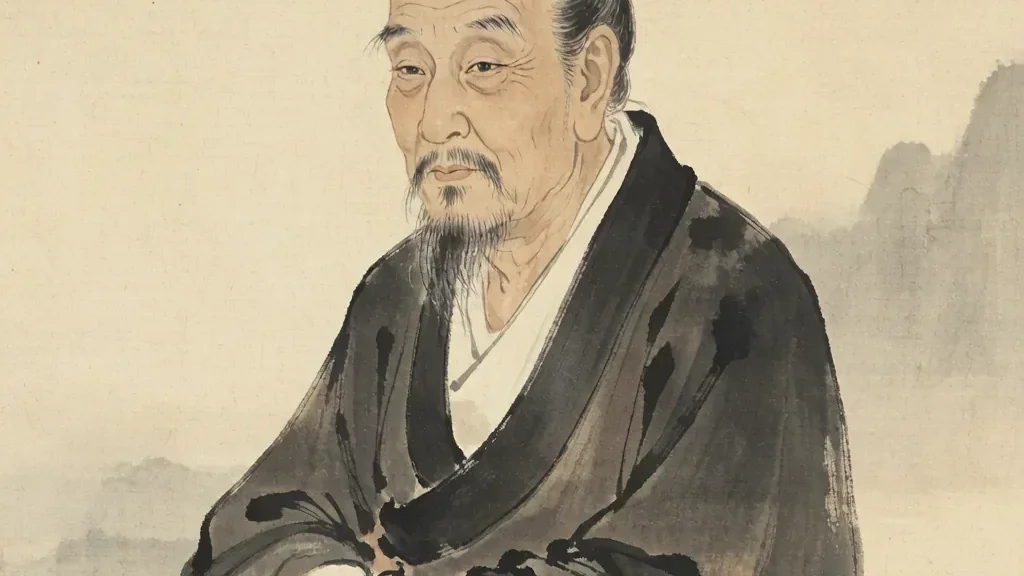
Among the founders of Chinese Buddhist schools, one man stands out not for his travels, his miracles, or his political influence, but for the sheer depth and systematic rigor of his philosophical vision. Zhiyi (智顗, zhì yǐ) never left China — he never made the pilgrimage to India that was the dream of every serious monk — yet he created the first genuinely Chinese system of Buddhist philosophy, a comprehensive synthesis of Indian doctrine and Chinese sensibility that would shape East Asian thought for over a millennium. He is the philosopher's philosopher of Chinese Buddhism.
The Dream That Foretold a Master
Zhiyi was born in 538 CE in Huarong (in modern Hunan Province) during the turbulent period of the Southern and Northern Dynasties. According to legend, his mother dreamed that a white light entered her body, and the house was filled with a mysterious fragrance when he was born. His family was a prestigious clan of scholar-officials, and Zhiyi received a classical Confucian education before turning to Buddhism at age seventeen after the death of both his parents in the wars that ravaged the region.
He studied under Master Huisi (慧思) at the Dasu Monastery on Mount Dasu in Henan. Huisi, a visionary monk who combined meditation practice with devotion to the Lotus Sutra, recognized Zhiyi's extraordinary potential and transmitted his deepest teachings to him. When Huisi left for the south, he instructed Zhiyi to travel to Mount Tiantai in Zhejiang Province and establish a community there — a mandate that would determine the course of Chinese Buddhist history.
The Great Calming and Contemplation
Zhiyi's magnum opus is the Mohe Zhiguan (摩诃止观, "Great Calming and Contemplation"), a massive treatise on meditation practice that systematically integrates every aspect of Buddhist theory and practice. The text is structured around the "ten objects of contemplation" and the "ten modes of contemplation" — a comprehensive curriculum that guides the practitioner from basic mindfulness to the highest realization. It is not a book to be read but to be practiced, a manual for the transformation of consciousness.
The title itself expresses Zhiyi's central method. Zhi (止, śamatha) is calming — the stabilization of the mind through concentration. Guan (观, vipaśyanā) is contemplation — the analytical investigation of reality. For Zhiyi, these two practices are not separate; they are two aspects of a single path. Calming without contemplation leads to dullness; contemplation without calming leads to intellectualization. The path to enlightenment requires both, in perfect balance.
The Three Truths and Mutual Inclusion
Zhiyi's philosophical masterpiece is the doctrine of the Three Truths. Emptiness (kōng) means that nothing has independent existence. Conventional existence (jiǎ) means that things nevertheless appear and function within the web of cause and effect. The Middle (zhōng) means that emptiness and conventional existence are not two different things but the same reality seen from two perspectives. This third truth was Zhiyi's original contribution — it went beyond Nagarjuna's two-truth scheme by adding a positive, integrative dimension.
From the Three Truths, Zhiyi derived his most radical teaching: the mutual inclusion of all phenomena. If every moment of consciousness contains all three truths, then every moment contains the entire universe. A single thought, Zhiyi claimed, contains "three thousand realms" — all the realms of beings (hells, hungry ghosts, animals, humans, gods, and Buddhas) and all their interrelationships. This is not poetry; it is a precise statement about the nature of reality as Zhiyi understood it. Each moment is the whole of existence, seen from a particular angle.
The Classification of Buddhist Teachings
One of Zhiyi's most enduring contributions was his classification of the Buddhist canon into the "Five Periods and Eight Teachings." This system arranged the Buddha's sermons chronologically: first the Avatamsaka Sutra, then the Agamas, then the expanded Mahayana sutras, then the Perfection of Wisdom texts, and finally the Lotus Sutra and Nirvana Sutra as the complete and final teaching. This was not a historical claim about what the Buddha actually taught — it was a hermeneutic framework for understanding the relationship between different texts.
The classification showed that the Buddha adapted his teaching to the capacity of his audience. Beginners received simple teachings; advanced practitioners received profound ones. But all of them, from the simplest to the most profound, were valid expressions of the same truth. The Lotus Sutra, as the final teaching, revealed that all previous teachings were "skillful means" (upaya) leading to the one vehicle of Buddhahood. This inclusive vision allowed Tiantai to embrace the entire Buddhist canon without contradiction.
Zhiyi's Legacy
Zhiyi died in 597 CE after entrusting his community to his disciple Guanding (灌顶). The Tiantai school continued to flourish, spreading to Japan as Tendai and to Korea as Cheontae. Zhiyi's works — over thirty volumes — remain a living tradition, studied by monks and scholars in China and beyond. His insistence that philosophy and meditation are inseparable, that theory is empty without practice, continues to challenge those who would reduce Buddhism to either intellectual exercise or mindless technique.
In the twentieth century, Zhiyi was rediscovered by Western philosophers who recognized in his system a sophistication comparable to Hegel, Whitehead, and other major figures of European thought. The doctrine of mutual inclusion, with its radical rejection of atomism and its embrace of holistic interdependence, has been seen as a forerunner of ecological thinking. Zhiyi built his system on a mountain in sixth-century China, but his vision of a universe in which each part contains the whole speaks to concerns that are urgently contemporary.
The Three Great Treatises
Zhiyi's authority rests on three monumental works expounding the Lotus Sutra: the 'Profound Meaning of the Lotus' (法华玄义), the 'Words and Phrases of the Lotus' (法华文句), and the 'Great Calming and Contemplation' (摩诃止观). Together they cover doctrine, textual exegesis, and practice, the three pillars of his system. The treatises turned a single sutra into a total Buddhist philosophy and a total method of cultivation, so that later Tiantai could say the whole of Buddhism was contained in the Lotus and the Lotus in a single sitting of the mind. No earlier Chinese master had bound commentary and meditation into one unified architecture, and that integration is Zhiyi's lasting claim to be called the systematizer of Chinese Buddhism. No earlier master had bound commentary and meditation into one unified architecture as Zhiyi did.
Settling on Mount Tiantai
After years of wandering study, Zhiyi settled on Mount Tiantai in Zhejiang, where he founded the monastery that gave the school its name. The mountain's seclusion suited the long retreats of calming-and-insight practice he prescribed, and the local rulers who supported him let the community flourish. From this base his disciples spread the teaching across the south and, after imperial invitation, to the north. Tiantai thus became both a doctrine and a place, a living center whose rhythm of chanting and sitting defined the school for centuries. The mountain remains, to this day, a working monastic site where visitors can trace the terraces and halls that first gave Zhiyi's ideas a home. The mountain remains a working monastery where visitors can still trace the terraces that first gave his ideas a home.
Influence on Later Schools
Zhiyi's synthesis radiated far beyond Tiantai as a separate sect. His classification of teachings (判教) was adopted by rivals to place themselves, and his 'calming and insight' method became the shared meditation backbone of Chan and the devotional schools. In Japan, where Tiantai became Tendai under Saicho, it birthed both esoteric Buddhism and the Nichiren movement. Even schools that rejected his metaphysics kept his practice. Few individual teachers have shaped the daily spiritual life of East Asian Buddhism as lastingly as Zhiyi. His great achievement was to show that the bewildering variety of the Buddha's words could be arranged into one coherent path, and that the path could actually be sat upon. His achievement was to show the Buddha's words could be arranged into one coherent path, and the path actually sat upon.
❓ Frequently Asked Questions
📝 Chinese Vocabulary
智顗 — : Zhiyi; the founder of Tiantai Buddhist philosophy.
摩诃止观 — : the Great Calming and Contemplation; Zhiyi's meditation manual.
一念三千 — : one thought contains three thousand realms; Zhiyi's doctrine of mutual inclusion.
五时八教 — : the Five Periods and Eight Teachings; Zhiyi's classification system.
天台山 — : Mount Tiantai, the school's seat
止观 — : calming and insight meditation
法华玄义 — : the Profound Meaning of the Lotus Sutra
判教 — : the classification of teachings
🎉 Fun Facts
- Zhiyi's Great Calming and Contemplation was originally an oral teaching — his disciple Guanding transcribed and edited it into its final form of 20 fascicles.
- Emperor Yang of Sui was a devoted patron of Zhiyi and awarded him the title "Great Teacher of the Nation" (国师), one of the highest honors ever given to a Buddhist monk.
- Zhiyi predicted his own death, gathered his disciples, and gave final instructions before passing away in meditation posture on November 21, 597 CE.
- Zhiyi spent his formative years on Mount Tiantai, whose name his school took, organizing practice around its quiet peaks.
- His three great works — the 'Profound Meaning,' the 'Words and Phrases,' and the 'Great Calming and Contemplation' of the Lotus — are called the 'three great treatises' of Tiantai.
- A legend says Zhiyi's birth was foretold by a dream, marking him from the start as an extraordinary teacher.