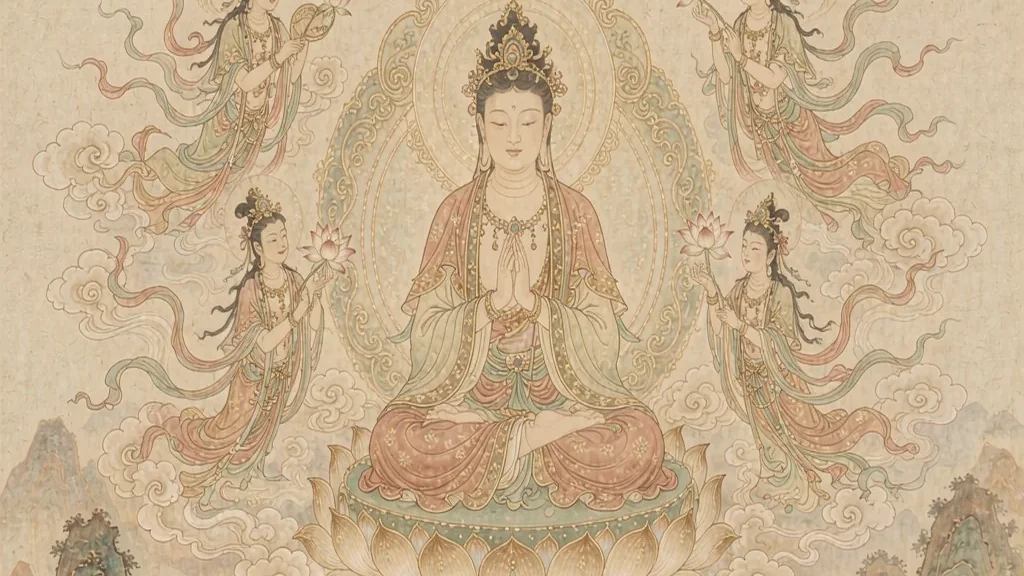
No Buddhist text in East Asia is chanted more frequently, copied more often, or memorized by more people than the Heart Sutra — a scripture so concise that its entire message fits on a single page, yet so profound that it has generated commentaries spanning thousands of volumes. The Heart Sutra (心经, xīn jīng) distills the essence of Mahayana Buddhist philosophy into a radical declaration: form is emptiness, emptiness is form. Understanding this short text is essential to understanding Chinese Buddhism itself.
Origins: From Large to Heart
The Heart Sutra belongs to a class of Mahayana texts called the Prajnaparamita (Perfection of Wisdom) sutras, which began appearing in India around 100 BCE and expanded into a vast literature over the following centuries. The "Large" Prajnaparamita Sutra runs to 100,000 verses. The Heart Sutra, by contrast, is an extreme abridgment — a distillation of the entire perfection of wisdom tradition into just 260 Chinese characters in Xuanzang's famous translation.
The precise origins of the Heart Sutra are debated. It was likely composed in China rather than India, drawing on Indian Prajnaparamita material but condensing and reorganizing it for Chinese readers. The text exists in Sanskrit, but the Sanskrit version appears to be a back-translation from Chinese, suggesting that the Heart Sutra is a Chinese creation that was later adopted into the Indian Buddhist canon. If true, this makes the Heart Sutra one of the most influential Chinese compositions in the history of world religion.
Xuanzang and the Transmission
The most famous version of the Heart Sutra is the translation attributed to Xuanzang (玄奘, 602–664 CE), the great Chinese pilgrim who traveled to India and returned with hundreds of Buddhist texts. According to tradition, Xuanzang received the sutra from a sick Indian monk during his journey through the desert, and chanting it protected him from demons and bandits. Whether or not the legend is true, Xuanzang's translation became the definitive version used throughout East Asia.
Xuanzang's translation is a masterpiece of concision. Every character carries weight. The opening line — Guānzìzài Púsà xíng shēn bōrě bōluómì duō shí, zhào jiàn wǔ yùn jiē kōng ("Avalokitesvara Bodhisattva, practicing the deep perfection of wisdom, saw that the five aggregates are all empty") — establishes the entire framework of the teaching in a single sentence.
The Core Teaching: Form Is Emptiness
The Heart Sutra's central claim is the identity of form and emptiness. Sè jí shì kōng, kōng jí shì sè (色即是空, 空即是色) — "Form is precisely emptiness, emptiness is precisely form." This is not a negation of the world but a claim about its nature. The world we perceive through our senses is not ultimately real in the way we assume it to be. Things do not have fixed, independent existence. They arise dependently, persist momentarily, and pass away. "Emptiness" (śūnyatā) is not a void but the absence of inherent, self-sufficient being.
The sutra applies this logic to every category of Buddhist analysis: the five aggregates (form, sensation, perception, mental formations, consciousness), the twelve sense spheres, the eighteen elements, the twelve links of dependent origination, and the four noble truths. All are empty. All lack inherent existence. Even nirvana — the ultimate goal of Buddhist practice — is not a place to go or a state to achieve but a recognition of what has always been the case.
The famous mantra at the sutra's conclusion — Gate gate paragate parasamgate bodhi svaha — reinforces this message. Roughly translated: "Gone, gone, gone beyond, completely gone beyond, enlightenment, hail!" The mantra is a journey beyond all conceptual frameworks, including the framework of the sutra itself. The text deconstructs its own teaching, leaving the practitioner in silence.
The Heart Sutra in Chinese Buddhist Practice
No other Buddhist text is as deeply embedded in Chinese Buddhist practice as the Heart Sutra. It is chanted daily in virtually every Chinese Buddhist monastery. It is recited at funerals, weddings, and festivals. It is copied by calligraphers as a meditative practice. It is printed on amulets and talismans. It is the first text memorized by novice monks and the last text recited by dying devotees.
The sutra's brevity makes it portable and accessible. A practitioner can carry a copy in a pocket, recite it in minutes, and contemplate its meaning throughout the day. This portability was crucial in Chinese Buddhist history, where the vastness of the canon could be overwhelming. The Heart Sutra was the essential teaching, the "heart" (心) of the perfection of wisdom, a complete path in 260 characters.
The text also has a strong apotropaic (protective) function in Chinese Buddhism. Chanting the Heart Sutra is believed to ward off evil spirits, remove obstacles, and purify negative karma. This protective aspect, which may seem at odds with the sutra's philosophical radicalism, represents the practical, this-worldly dimension of Chinese Buddhist practice that coexists with the pursuit of ultimate wisdom.
Commentaries and Philosophical Influence
The Heart Sutra generated major commentaries by all the great Chinese Buddhist schools. The Sanlun (Three Treatises) school used it to expound Madhyamaka philosophy. The Faxiang (Dharma-character) school analyzed its teachings through the lens of Yogacara. Chan masters treated it as a direct expression of awakened mind. Tiantai and Huayan incorporated it into their vast doctrinal systems.
The most influential commentary in East Asia is the Heart Sutra with Full Phrasing, which fills in the abbreviated passages to make the text more comprehensible. Another key commentary is attributed to the Tang scholar-monk Kuiji (窥基), a disciple of Xuanzang, who provided a systematic philosophical analysis that remains a standard reference.
In the modern period, the Heart Sutra has been interpreted by Buddhist modernists as compatible with science, psychology, and secular philosophy. Its teaching that reality is constructed by the mind, that things lack fixed essence, and that liberation comes through seeing through illusion resonates with contemporary trends in cognitive science and existential philosophy. The Heart Sutra may be 1,500 years old, but its questions feel urgently modern.
The Negation of the Skandhas
After naming the five aggregates — form, feeling, perception, mental formations, and consciousness — the Heart Sutra declares that each is empty. This is the sutra's method: not to deny experience but to strip it of the illusion of a permanent self standing behind it. By extending the negation to the twelve sense-spheres, the eighteen elements, and even the Four Noble Truths and the path itself, the text drives home that liberation is not gained by acquiring something new but by seeing through the conceptual layers that falsely divide reality. The stark list form makes the teaching easy to chant and memorize. In a few hundred characters the sutra compresses the whole Perfection of Wisdom into a chantable formula that a beginner can recite and a master can spend a lifetime unpacking.
The Mantra of Perfect Wisdom
The Heart Sutra closes with a Sanskrit mantra left untranslated even in Chinese recitation: 'gate gate paragate parasamgate bodhi svaha,' often glossed as 'gone, gone, gone beyond, gone altogether beyond, awakening, so be it.' Traditional commentary reads it as a condensed restatement of the whole Prajnaparamita: the mind crossing beyond suffering and beyond the beyond. Kept in its original tongue, the mantra marks the limit of words and invites a leap that explanation cannot supply, a fitting end to a scripture built on negation. By ending in sound rather than sense, the sutra enacts its own lesson: the final step past emptiness is not another concept but a wordless crossing, sealed in a language no one in the congregation needs to parse.
Heart Sutra in Art and Daily Rite
The Heart Sutra's brevity made it portable across every medium. It appears carved in stone, brushed as calligraphy by emperors and monks, and chanted at the opening of daily services, funerals, and meals throughout East Asia. In Japan it is recited at the start of Zen sitting periods; in Tibet it opens many rituals. Its 260 characters (in the Chinese version) are treated almost as a talisman, copied for merit and protection. Few texts so short have been so universally woven into the daily rhythm of Buddhist life. A pilgrim may hear it at dawn, a mourner at a funeral, and a student before an exam, so that its strange music of emptiness accompanies nearly every threshold of ordinary existence.
❓ Frequently Asked Questions
📝 Chinese Vocabulary
心经 — : The Heart Sutra; the most popular Buddhist text in East Asia.
色即是空 — : "Form is precisely emptiness"; the sutra's central teaching.
般若波罗蜜多 — : Prajnaparamita; the perfection of wisdom.
观自在菩萨 — : Avalokitesvara; the bodhisattva of compassion who teaches the sutra.
五蕴 — : The five aggregates; the components of sentient existence.
空 — : emptiness, sunyata
舍利子 — : Shariputra, the sutra's interlocutor
咒 — : the mantra at the close of the sutra
🎉 Fun Facts
- Xuanzang's version of the Heart Sutra contains only 260 Chinese characters — shorter than most emails.
- The Heart Sutra was one of the first Buddhist texts translated into Tibetan, Korean, Japanese, Vietnamese, Mongolian, and Manchu, spreading with Buddhism across East Asia.
- Calligraphers throughout East Asian history have competed to produce the most beautiful Heart Sutra copies — the most famous versions are considered national treasures in Japan and China.
- The Heart Sutra is the shortest of the Prajnaparamita texts, often just a single page, yet it is the most recited scripture in East Asian Buddhism.
- Its closing mantra — 'gate gate paragate parasamgate bodhi svaha' — is left in Sanskrit even in Chinese recitation, a rare retained transliteration.
- The sutra negates not only form but also feeling, perception, formation, and consciousness, declaring even the path and awakening are empty.