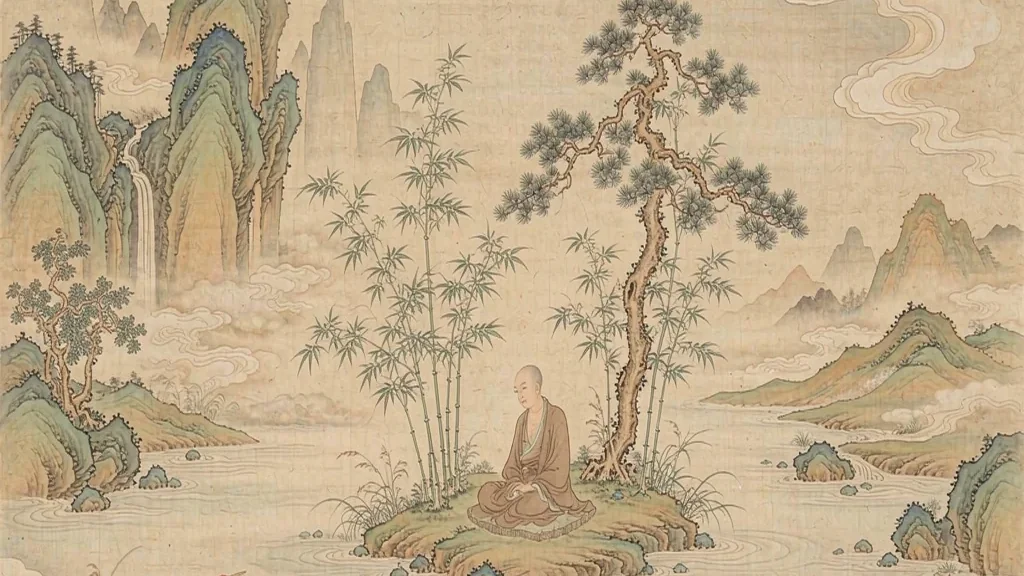
The Sanlun school, literally the "Three Treatise school," was the first distinct philosophical school of Chinese Buddhism and the principal vehicle through which the Madhyamaka teaching of Nagarjuna entered and shaped Chinese thought. Founded on the three treatises translated by Kumarajiva in the early fifth century, the Middle Way and Twelve Gates treatises of Nagarjuna and the Hundred Verse treatise of Aryadeva, it taught that all phenomena are empty of intrinsic existence and that liberation requires the relinquishment of every fixed conceptual position, including the concept of emptiness itself. Flourishing from the Later Qin through the Sui and early Tang, the school reached its systematic height under the master Jizang before being absorbed into the broader currents of Chinese Buddhism as more affirmative schools such as Tiantai, Huayan, and Chan rose to prominence. Though short-lived as an independent institution, Sanlun furnished the dialectical grammar on which later Chinese Buddhism was built.
Name and Scriptural Basis
The name Sanlun, "three treatises," refers to the three cornerstone texts of the school, all rendered into Chinese by Kumarajiva at Chang'an. The first is Nagarjuna's Middle Way treatise, a verse work laying out the eight negations and the dialectic of dependent origination; the second is Nagarjuna's Twelve Gates treatise, a shorter work in twelve sections refuting the categories of being and non-being; and the third is Aryadeva's Hundred Verse treatise, a polemical extension of the master's position against heretical views. Together these formed the exegetical core that defined the school's identity.
Unlike schools founded on a single sutra, Sanlun was built on shastras, the philosophical commentaries of the Indian Madhyamaka masters, which is why it is often described as the most strictly philosophical of the early Chinese schools. Its practitioners saw themselves not as inventing doctrine but as faithfully unfolding the rational structure of the Buddha's emptiness teaching, using the treatises as a scalpel to cut through every form of conceptual attachment.
Transmission from Nagarjuna to China
The intellectual lineage of Sanlun runs from Nagarjuna, the second-century Indian founder of Madhyamaka, through his disciple Aryadeva, then through the later commentators Buddhapalita and Bhaviveka, whose works were known in fragments to Chinese monks. Kumarajiva translated the foundational treatises and thus became the effective founder of the Chinese line, though he did not organize a school as such. His disciples, especially Sengdao and Sengzhao, began the work of explaining the texts in a Chinese idiom.
Over the next two centuries, a succession of lecturers refined the interpretation, debating questions such as whether emptiness is a positive reality or a mere negation, and how the Middle Way relates to the Buddha nature teaching gaining currency in China. These debates prepared the ground for Jizang, who surveyed the whole tradition and produced the definitive synthesis. The transmission was thus a gradual acculturation of Indian dialectic into Chinese scholastic life.
Kumarajiva's Foundational Translations
The school could not have existed without Kumarajiva's translations, completed at Chang'an after 401 under the patronage of Yao Xing. His renderings of the three treatises were celebrated for their clarity and philosophical precision, capturing the tricky negations of Nagarjuna in elegant Chinese. Because his versions quickly became standard, the Sanlun masters always worked from his text rather than from later revisions, and their commentaries are essentially extended meditations on his wording.
Kumarajiva's choice to translate the Madhyamaka corpus rather than merely the popular sutras was fateful. It gave Chinese Buddhists access not just to the devotional Mahayana but to its rigorous logical underpinning, enabling a truly indigenous philosophical engagement. The Sanlun school was the first fruit of that engagement, proving that Chinese monks could master and develop Indian abhidharma-level argumentation rather than only absorbing doctrine devotionally.
The Eight Negations and Middle Way
The heart of Sanlun teaching is Nagarjuna's eight negations: no birth, no cessation, no permanence, no annihilation, no coming, no going, no difference, no identity. These deny the basic categories by which ordinary thought constructs a fixed world, showing that all things arise only in dependent co-origination and therefore lack own-being. The Middle Way is not a compromise between extremes but the insight beyond all extremes, including the extreme of asserting a middle.
The school taught that this emptiness is not nothingness but the very condition of possibility for cause and effect. If things had intrinsic existence they could never change or interact; because they are empty, they can arise dependently. Sanlun thus defended emptiness against the charge of nihilism by linking it intimately to the conventional truth of moral and causal order, a move central to its entire project of reconciling liberation with everyday responsibility.
Jizang and the Systematization
The school reached its maturity with Jizang, who was born in 549 and became its great systematizer. He wrote commentaries on all three treatises, formulated the method of "destroying attachments" by negating thesis after antithesis, and organized the Sanlun curriculum into a coherent curriculum recognized by the Sui court. His writings remain the richest source for the school's thought and the standard reference for East Asian Madhyamaka.
Jizang's systematization was also a defense against rival schools. He argued that the three treatises exhaust the Mahayana and that more affirmative teachings such as the Buddha nature were provisional expedients. By drawing the school's boundaries through rigorous negation, he gave Sanlun a clear, if paradoxical, identity. His success ensured that the school would be remembered as the authoritative Chinese expression of Nagarjuna's philosophy even after its institutional decline.
The Method of Negation
Sanlun practice is fundamentally a discipline of deconstruction. Rather than meditating on a positive object, the adept learns to dismantle every proposition, asking what it presupposes and showing that presupposition to be unfounded. Jizang formalized this as the "fourfold negation" of being, non-being, both, and neither, and as the progressive "three rounds of negation" that strip away coarse and subtle attachments until only the non-abiding middle remains.
This apophatic method aimed not at producing a new doctrine but at curing the mind of its compulsive conceptualizing. The school compared the process to using a poison to cure a poison, or a thorn to remove a thorn, where the dialectic is discarded once its therapeutic work is done. Such imagery shows Sanlun's affinity with later Chan, which also sought liberation beyond words, though Chan expressed the same insight through silence and encounter rather than through treatise commentary.
Relation to the Buddha Nature Debate
A recurring tension for Sanlun was its relation to the rising Buddha nature doctrine, which taught that all beings possess an eternal enlightened essence. From a strict Madhyamaka standpoint, to reify such an essence as a positive substance risked exactly the eternalism Nagarjuna opposed. Jizang therefore interpreted the tathagatagarbha provisionally, as a pedagogic device pointing to emptiness rather than as a metaphysical entity to be affirmed.
This stance set Sanlun apart from schools like Huayan and the Buddha nature-inflected Chan, which embraced the positive language of innate luminosity. Yet the debate was productive, forcing Chinese Buddhism to articulate how emptiness and the enlightened mind relate. Sanlun's skeptical pressure prevented the Buddha nature teaching from collapsing into a crude soul-theory and kept the tradition honest about the limits of conceptual description.
Comparison with Other Schools
Compared with Tiantai, which ranked the teachings into a harmonious whole culminating in the Lotus, Sanlun refused all ranking and insisted that emptiness alone is ultimate, with every system merely provisional. Compared with the consciousness-only Weishi school, which analyzed mind into eight consciousnesses, Sanlun denied any ultimate substrate and treated such analysis as a useful but empty map. Compared with Huayan, which celebrated the interpenetration of phenomena, Sanlun warned that even interdependence must not be clung to.
Against Chan, the relation is more intimate and more competitive. Both value wordless realization, but Sanlun approached it through exhaustive argument while Chan approached it through sudden gesture. Later Chan masters sometimes dismissed Sanlun as "view Buddhism," trapped in ideas, yet they inherited its negating logic. The school thus functioned as the critical conscience of Chinese Buddhism, the voice that reminded every positive construction of its own emptiness.
Decline and Absorption into Chan
By the high Tang, Sanlun as an independent school was in retreat. The consciousness-only school of Xuanzang attracted the best scholastic talent with its systematic psychology and imperial backing. Tiantai and Huayan offered more comprehensive soteriologies that satisfied devotional and philosophical needs at once. Most decisively, Chan absorbed the Sanlun insight into emptiness into its non-conceptual practice, rendering the treatise-based school redundant for many monks.
After Jizang's generation, few major Sanlun commentators emerged in China, and the lineage faded into the general Buddhist curriculum. Its texts, however, remained required study, and its negations lived on in Chan encounter dialogue and in the dialectical chapters of later syntheses. The school did not so much die as dissolve into the bloodstream of Chinese Buddhism, its distinctive contribution becoming everyone's common sense.
Survival in Japan as Sanron
While Sanlun declined in China, its teachings were transmitted to Japan, where they survived as the Sanron school, one of the six great Nara-period schools. Japanese monks such as Chitsu and Chiran studied the three treatises and established a continuous commentarial tradition based on Jizang's works. Sanron remained an important philosophical discipline in Japanese monastic education even after the rise of Tendai and Shingon.
The Japanese transmission is historically precious because it preserved the Madhyamaka interpretation after the Chinese line weakened. Scholars reconstruct aspects of Chinese Sanlun through Japanese Sanron materials, and the school's emphasis on emptiness continued to inform Japanese Buddhist thought, particularly in its dialogue with the more positive Tendai and Pure Land movements. Thus the "three treatises" outlived their native school by crossing the sea.
Historical Significance
The Sanlun school matters because it inaugurated Chinese Buddhist philosophy. Before it, Chinese monks received doctrines; with it, they began to reason rigorously in the Indian mode, testing positions against Nagarjuna's dialectic. It trained the intellectual habits, the vocabulary of emptiness and two truths, and the tolerance for paradox that made the later flowerings of Tiantai, Huayan, and Chan possible. Without Sanlun, Chinese Buddhism might have remained a collection of devotional cults rather than a philosophical civilization.
Its ultimate lesson is that the deepest teaching cannot be captured in any statement, not even in the statement that all is empty. By refusing to rest in any view, Sanlun protected Buddhism from becoming just another metaphysics and kept alive the liberating edge of the Middle Way. That refusal, perfected by Jizang and carried to Japan, remains one of China's great gifts to the intellectual history of Asia.
❓ Frequently Asked Questions
What is the Sanlun school?
Sanlun, the Three Treatise school, was the first philosophical school of Chinese Buddhism, founded on Kumarajiva's translations of Nagarjuna's and Aryadeva's Madhyamaka treatises teaching universal emptiness.
Which texts define the school?
The three treatises are Nagarjuna's Middle Way and Twelve Gates treatises and Aryadeva's Hundred Verse treatise, all translated by Kumarajiva at Chang'an.
Who was its great systematizer?
Jizang, born in 549, wrote the definitive commentaries, formulated the method of destroying attachments, and organized the school's curriculum under the Sui court.
How did it teach emptiness?
It used the eight negations and progressive dialectic to show all things lack intrinsic existence, denying even emptiness as a fixed view to open the non-abiding middle.
Why did the school decline?
More affirmative and comprehensive schools such as Weishi, Tiantai, Huayan, and Chan drew followers, with Chan absorbing its emptiness insight and making the treatise school redundant.
How did it survive in Japan?
The teachings were transmitted as the Sanron school of the Nara period, preserving Jizang's commentaries and keeping Madhyamaka alive in Japanese Buddhism.