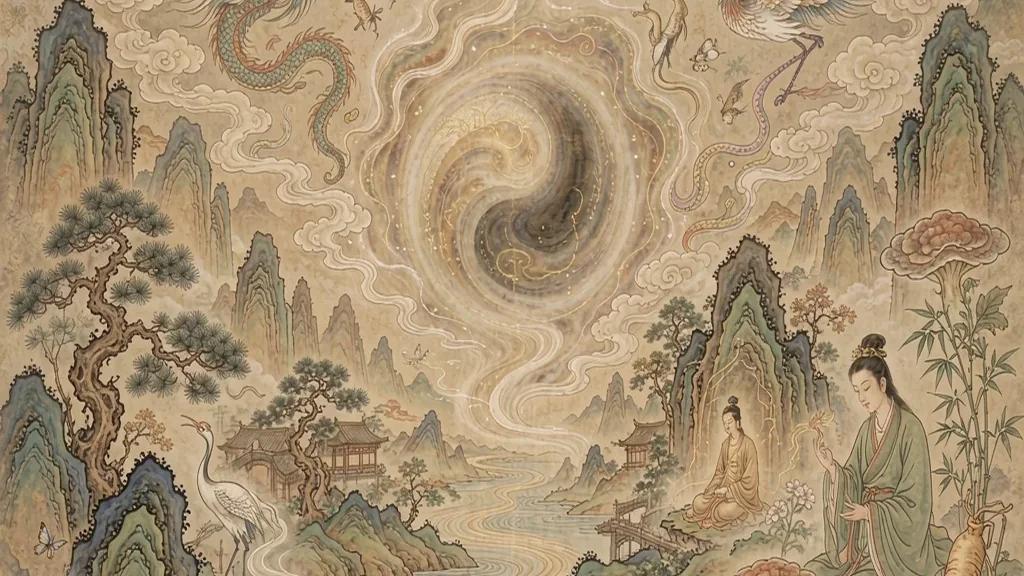
The Daoist classics are the foundational scriptures of one of China's great native philosophical and religious traditions. Centered on the enigmatic Dao De Jing attributed to Laozi and the exuberant inner-alchemy allegory of the Zhuangzi, these texts teach that the ultimate reality—the Dao, or Way—is ineffable, spontaneous, and self-so, and that human flourishing comes from aligning with its natural flow rather than forcing outcomes. Over two millennia the Daoist classics have inspired mysticism, political quietism, poetry, and medicine, offering a counterweight to Confucian activism and a deep well of Chinese ecological and aesthetic sensibility.
The Dao De Jing and Its Mystery
The Dao De Jing (also called the Laozi) is a short work of about five thousand characters arranged in eighty-one chapters, mixing poetry and aphorism. Tradition ascribes it to Laozi, a curator of archives who, according to legend, dictated it at the border as he left civilization for the west.
Modern scholarship places its composition in the late Warring States period, likely the product of many hands drawing on a southern, possibly Chu, milieu. Its opening line warns that the Dao that can be spoken is not the constant Dao, setting a tone of deliberate paradox.
Though terse, the book became one of the most translated works in world literature, valued for its brevity and depth by readers from poets to generals.
The Central Idea of the Dao
The Dao is the nameless source and pattern of all things, "the mother of the ten thousand beings." It does nothing, yet through it all is done. It cannot be pinned down by concepts, yet it is nearer than breath.
Unlike a creator-god, the Dao does not act with intention; it is the spontaneous order whence things arise and to which they return. To know it is not to define it but to attune to it, the way water finds its level without deliberation.
This non-theistic, process conception of ultimate reality is distinctive: the sacred is the ordinary rhythm of nature, not a person beyond the world.
Wuwei: Non-Forcing
The practical heart of the Dao De Jing is wuwei, often rendered "non-action" but better understood as "non-forcing" or "effortless action." The sage acts without striving, accomplishes without claiming credit, and guides by emptiness rather than command.
In governing, wuwei means minimal interference: a light touch lets the people prosper of themselves. "Govern the state as you would cook a small fish"—handle it too much and it falls apart. The best rule is scarcely noticed.
In personal life, wuwei means not swimming against the current of things, but finding the line of least resistance where action and spontaneity coincide. This is not laziness but a higher skill.
The Zhuangzi and the Play of Perspective
The Zhuangzi, named for its eponymous author or compiling circle, is the other great Daoist classic. Where the Dao De Jing is oracular, the Zhuangzi is playful, rambling, and rich with fables—the butterfly dream, the cook who carves oxen by the间隙 (gaps), the debate on the joy of fish.
Zhuangzi delights in relativizing every fixed view. He asks whether we can know which is the true perspective, human or butterfly, and mocks Confucians and logicians alike for mistaking their corner for the whole. His freedom is the liberation from rigid positions.
The text's ideal is the "perfected person" who wanders beyond convention, at ease in the world's changes, untroubled by praise, blame, life, or death.
Yin, Yang, and the Cosmic Breath
Daoist classics assume a cosmos of qi, the vital breath, circulating as yin and yang. The Dao breathes the world into being through this rhythm; harmony is the balanced flow of breaths, and disorder is their blockage or excess.
This physiology of the cosmos grounds Daoist longevity practices: if the body is a microcosm of the Dao's breath, then nurturing that breath through breathing, diet, and stillness can prolong life. The classics thus point from philosophy to practice.
Later Daoist religion built elaborate alchemy on these hints, but the classics themselves keep the teaching simple: follow the breath of nature, do not dam it.
Political Quietism
In an age of warring states, the Dao De Jing's politics were radical: less government, fewer desires, a people who are content and unmarked by cunning. The sage-ruler "does not dare to act grandly," and therefore completes great things.
This quietism was sometimes read as advice to rulers to manipulate by seeming weak—a "use the soft to overcome the hard" stratagem—and indeed the text's lines were quoted by statesmen. But its core is a suspicion of overengineering society.
Daoist political thought thus offers a perennial critique of hubristic control, resonating with later libertarian and ecological suspicions of domination.
Daoism and Chinese Religion
From the classics grew a religion: the Daoist church organized around the Celestial Master, with rituals, gods, and scriptures layered atop the philosophical base. The Zhuangzi's immortals and the Dao De Jing's "long-lived" became figures of a salvation cult.
Yet the philosophical classics remained the esoteric core even as popular Daoism multiplied deities and rites. The two—philosophical and religious Daoism—are distinct yet continuous, like a river and its delta.
Festivals, talismans, and temple liturgy all ultimately cite the authority of the Dao, making the classics the headwaters of a living faith.
Influence on Art, Medicine, and Ecology
Daoist naturalness shaped Chinese landscape painting, where emptiness and spontaneity are prized, and influenced poetry that finds the sublime in rivers and mists. The medical canon Huangdi Neijing is steeped in Daoist cosmology.
Ecologically, the Daoist vision of humans as one strand in the ten-thousand-things, not masters of nature, has been read as an early environmental ethic. Its humility before the self-so stands against conquest of the world.
Even martial arts such as taiji quote the classic's teaching of soft overcoming hard, embodying philosophy in movement.
Enduring Appeal of the Classics
The Daoist classics endure because they speak to a hunger for simplicity amid complexity. Their paradoxes frustrate the literal mind and refresh the weary one; their quietism is a refuge from ceaseless striving.
Read today, they offer a corrective to the myth of total control and a vocabulary for living with uncertainty. The Dao that cannot be named remains the most named-about silence in Chinese thought.
Whether as mysticism, politics, or poetry, the Dao De Jing and Zhuangzi remain open invitations to step out of the noise and into the flow.
❓ Frequently Asked Questions
What are the Daoist classics?
The main Daoist classics are the Dao De Jing attributed to Laozi and the Zhuangzi, foundational texts of philosophical Daoism.
What is the Dao?
The Dao is the ineffable, spontaneous source and pattern of all things—not a god but the natural order whence beings arise.
What does wuwei mean?
Wuwei means non-forcing or effortless action: achieving results by aligning with nature rather than striving against it.
How do the two classics differ?
The Dao De Jing is terse and oracular; the Zhuangzi is playful and fable-rich, relativizing fixed views.
Did Daoism become a religion?
Yes; philosophical Daoism spawned a popular religion with gods and rites, while keeping the classics as its core.
Why read them today?
They offer a critique of control and a vocabulary for simplicity, ecology, and living with uncertainty.