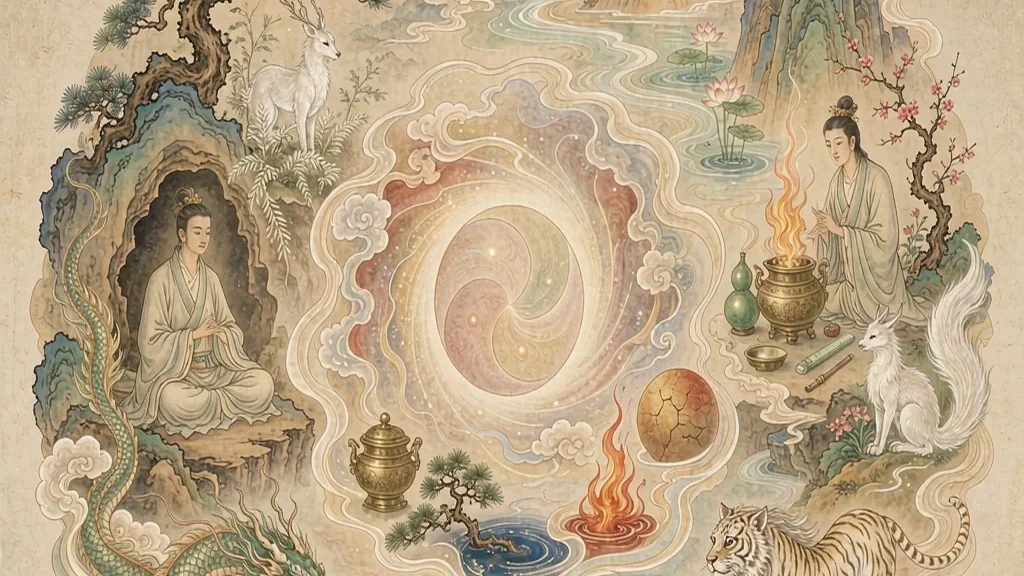
Daoist alchemy (daojia liandan) is the complex of practices in China aimed at prolonging life and ultimately achieving immortality (xian) by refining the body's vital substances. It divides into waidan (external alchemy), the compounding of mineral and metallic elixirs, and neidan (internal alchemy), the psycho-physiological cultivation of the adept's own breath, essence, and spirit. Rooted in Daoist religion yet drawing on medicine, cosmology, and meditation, alchemy became one of the most elaborate inner technologies of pre-modern China.
External Alchemy (Waidan)
Waidan practitioners heated and reacted minerals—chief among them cinnabar (mercuric sulphide) and arsenic compounds—to produce "golden elixirs" thought to transmute the body and conquer death. The logic was that what transforms base metal into gold could transform a mortal into an immortal.
Elaborate laboratories, furnaces, and timing by the calendar marked the art. Emperors and aristocrats famously consumed these preparations, sometimes with fatal results from heavy-metal poisoning—a tragic irony of the pursuit of longevity.
Internal Alchemy (Neidan)
As external alchemy's dangers became clear, many adepts turned inward. Neidan treats the human body as a furnace and its energies as ingredients: essence (jing), breath (qi), and spirit (shen) are refined through meditation, breathing, and visualisation.
The goal is to "return to the primordial" (fanben huan yuan), circulating and sublimating inner substances until an imperishable "embryo of immortality" forms within. The language deliberately mirrors laboratory alchemy but describes inner work.
The Three Treasures
Neidan rests on the triad of jing (essence), qi (vital breath), and shen (spirit). Through cultivation, essence is converted into qi, qi into spirit, and spirit into the void—a graded refinement sometimes called the "three vehicles."
This somatic cosmology shows how thoroughly Daoist alchemy fused physiology with metaphysics: the microcosmic body was a workshop in which cosmic processes were re-enacted and reversed.
Cinnabar and the Cosmos
Waidan theory held cinnabar—red mercury ore—to be the quintessence of yang, and its cyclical heating and cooling mirrored the cosmic alternation of yin and yang. The elixir was, in effect, condensed cosmic vitality.
The same symbolic chemistry fed neidan, where "cinnabar fields" (dantian) in the body store and refine energy. The vocabulary of ore and furnace migrated seamlessly into the language of the interior.
Scriptures and Lineages
Key texts include the Cantong qi (Token for the Agreement of the Three), a cryptic poem linking the Changes, cosmology, and alchemy, and later neidan manuals such as those of the Quanzhen (Complete Reality) school of the Yuan era.
Alchemical transmission was often secretive, passed master to disciple with diagrams and coded verse. The obscurity was partly protective, partly a test of the adept's seriousness.
Alchemy and Daoist Religion
Daoist alchemy belongs to the organised Daoist religion rather than to philosophical Daoism alone. Temples, ordination, and ritual surrounded the solitary laboratory, and immortals (xian) populated the pantheon as attainable goals.
This distinguishes it from the quietism of the Daode jing; religious alchemy added technique, hierarchy, and a promise of post-mortem or deathless existence that the early philosophers never claimed.
Relation to Medicine
Alchemy and the medical school were close cousins. Both mapped the body's conduits and vital breath; alchemy simply aimed higher—at transformation rather than mere balance. Many physicians practised alchemical hygiene.
Breathing exercises (tu na), gymnastics (daoyin), and dietary regimens straddled the two fields, so that "nourishing life" (yangsheng) formed a shared continuum from health to immortality.
Dangers and Disillusion
The toxicity of mercury and arsenic elixirs caused real harm, and several Tang emperors are said to have died from their quest. Such episodes fed later scepticism and accelerated the shift toward internal methods.
Yet the external tradition was not purely destructive; its intense observation of chemical change contributed to Chinese proto-chemistry and pharmacology.
Legacy and Modern Interest
Neidan survives today in Daoist monasteries and in global wellness and meditation circles, often stripped of its immortality claims but retaining its breathing and visualisation techniques. It is studied historically as a remarkable psychology of the body.
As a cultural achievement, Daoist alchemy shows a civilisation that took the refinement of life with utmost seriousness—treating the human frame as a cosmos to be consciously perfected.
Why It Matters
Daoist alchemy matters because it married cosmology, chemistry, and spirituality into a single disciplined project: the deliberate cultivation of longevity. Few traditions so thoroughly interiorised the universe.
For modern readers it offers both a cautionary tale about the lure of quick transcendence and a profound example of somatic self-cultivation that still informs practice worldwide.
The Alchemical Body and the Cinnabar Fields
Internal alchemy maps the body as a subtle geography. Below the navel lies the lower cinnabar field (dantian), the furnace where essence and breath are gathered; a middle field at the heart governs spirit; an upper field in the head is the seat of pure awareness. The adept's practice is, in part, a guided circulation of energy through this inner landscape, reversing the ordinary outward leakage of vitality.
This somatic map let neidan practitioners speak of "leading the fire" and "refining the mercury" within, using the vocabulary of the external laboratory to chart inner process. The body became at once workshop, furnace, and product—a microcosm in which the cosmic cycle of generation was deliberately re-run toward immortality.
Alchemy, Poetry, and the Literati
Daoist alchemy left a mark on elite culture well beyond the cloister. Tang poets such as Li Bai evoked immortals and cinnabar isles, and Song literati experimented with breathing and visualisation as refined pastimes. Alchemical imagery—the cauldron, the moon and sun, the embryo—permeated poetry, painting, and garden design as a vocabulary of transformation.
In this cultural afterlife, alchemy supplied a rich symbolic store even for those who doubted its literal claims. The dream of refining the self, like ore into gold, became a metaphor for self-cultivation generally, so that the alchemical imagination outlived the laboratories that first produced it.
The alchemical concern with refinement even influenced cuisine and the arts of the table, where "nourishing life" guided choices of ingredient and preparation thought to conserve vitality. Diet was a mild, daily alchemy, and the line between the pharmacopeia and the kitchen was never firm. In this domestic register the quest to perfect the body entered ordinary routine, long after the great furnaces had cooled.
❓ Frequently Asked Questions
What is Daoist alchemy?
It is the Daoist pursuit of longevity and immortality through refining the body's substances, in external (mineral) and internal (somatic) forms.
What is the difference between waidan and neidan?
Waidan compounds mineral elixirs in a furnace; neidan cultivates the adept's own essence, breath, and spirit through meditation and breathing.
Why was external alchemy dangerous?
Its elixirs used mercury and arsenic, which are toxic; emperors who consumed them sometimes died from poisoning.
What are the "three treasures"?
They are jing (essence), qi (breath), and shen (spirit), progressively refined in internal alchemy.
How is alchemy linked to medicine?
Both map the body's breath and conduits; alchemy aims at transformation while medicine seeks balance, sharing techniques like breathing and daoyin.
Does Daoist alchemy survive today?
Internal alchemy persists in Daoist monasteries and global meditation practice, often as breathing and visualisation techniques rather than immortality quests.