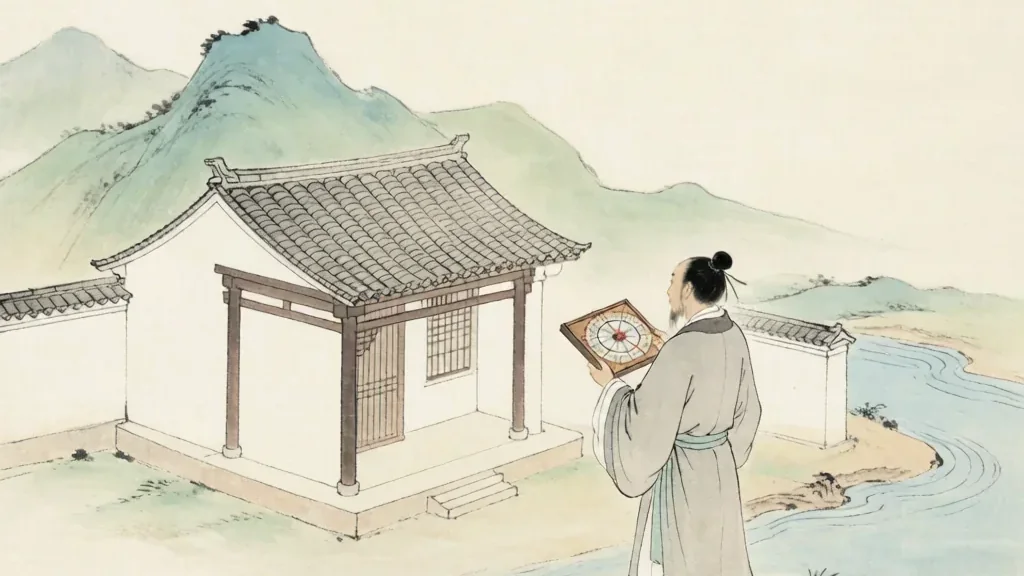
To walk into a Chinese home is often to step into a quiet argument about invisible forces. The arrangement of a door, a bed, a desk, even a fish tank, can be defended as good 风水 (Fēngshuǐ) — literally "wind and water." More than a decorating fad, Feng Shui is an ancient art of placing things in space so that the flow of energy, health, and fortune is helped rather than hindered. Born from observation of landscape and climate, it grew into a whole way of thinking about how human life fits into the living world. To understand Feng Shui is to see how Chinese thought turns the ordinary act of arranging a room into a question of harmony with the cosmos.
Wind, Water, and the Shape of the Land
The name says it plainly. 风 (fēng, wind) and 水 (shuǐ, water) are the two great movers of the natural world — wind scatters, water gathers. Early Feng Shui was the craft of choosing where to live and where to bury the dead by reading the land. A settlement sheltered from harsh winds yet near flowing, clean water was a good site; a spot exposed to cutting gusts or stagnant pools was bad. From these practical beginnings grew a symbolic science of slopes, ridges, rivers, and valleys.
Over centuries the practice split into two broad schools. The "form school" judges the shape of the surroundings — a mountain behind for support, water in front for wealth, side hills like arms embracing a seat. The "compass school" adds a precise grid of directions, using the magnetic lodestone compass (罗盘, luópán) to assign meanings to each bearing. Both share one conviction: place is not neutral, and the right placement lets life flourish.
Qi, the Dragon, and the Flow of Energy
Feng Shui cannot be separated from 气 (qì, the life-breath). The goal of placement is to catch and guide beneficial qi while letting harsh or "sha" energy dissipate. Practitioners speak of the "dragon vein" (龙脉, lóngmài) — lines of subterranean energy running through mountains and ridges, like a bloodstream of the earth. A site on a healthy dragon vein, where qi gathers and settles, is prized above all.
This is why a straight road rushing at a door, or a sharp corner pointing at a bed, is disliked: it is said to "cut" the gentle flow of qi into a hostile jet. The art is to slow, curve, and soften the movement of energy so it pools and nourishes the people inside. Screens, partitions, plants, and rounded forms are all ways of bending the current back into a calm eddy.
The Compass, the Grid, and the Eight Trigrams
The compass school maps a space onto the eight trigrams (八卦, bāguà) of the Yijing and the ten-thousand directions of later charts. Each sector of a home corresponds to a part of life — family, wealth, health, fame, children, knowledge, partnership, and helpful friends. By overlaying this grid on a floor plan, a consultant can suggest, for example, that a cluttered northwest corner weakens mentorship, or that a healthy plant in the southeast supports prosperity.
Critics note that such mappings vary between teachers and eras, and that the system resists proof. Yet the deeper logic is consistent with the rest of Chinese thought: the small space of a dwelling mirrors the large space of the cosmos, and tending the small properly aligns one with the large. Order in the room becomes a training in order of life.
Feng Shui in the Home and the City
In daily life Feng Shui shows up as gentle, sensible habit. Keep the entrance clear so opportunity can enter. Let the bed rest against a solid wall, never under a window or a beam. Place the stove and the work desk where the occupant can see the door without being in its direct line. Avoid mirrors facing the bed, where restless energy might disturb sleep. Many of these rules are simply good ergonomics and psychology dressed in cosmic language — which is part of their staying power.
The art also shaped cities. Imperial capitals were laid out on rigorous north-south axes, with the palace at the center and gates, temples, and markets placed to balance the forces of the realm. The Forbidden City itself is a vast Feng Shui composition, oriented to the cardinal points and ringed by designed hills and water to gather the empire's qi. What looks like decoration is often a statement of cosmic order made in stone.
Criticism, Continuity, and Living Well
Modern science finds no measurable "wind-water energy," and some commercial Feng Shui is little more than wishful consumerism. Taken honestly, though, the tradition offers something modest and useful: attention. It asks people to notice light, air, pathways, and clutter, and to arrange their surroundings with care rather than accident. A calm, ordered, well-lit room does improve mood and focus, whatever name we give the cause.
Feng Shui thus survives not because it moves invisible currents, but because it encodes an old wisdom — that how we place ourselves in space shapes how we feel, act, and relate. Wind and water remind us that we live inside nature's flow, not above it, and that harmony begins at the threshold of our own door.
Auspicious Dates and Timing
Feng shui is not only about space but also about time. Practitioners consult the lunar calendar, the sexagenary cycle of sixty years, and the positions of heavenly stems and earthly branches to pick auspicious moments for moving house, burying the dead, or starting a building. A favourable site could be spoiled, they held, if the work began on a clashing day. Almanacs, still printed and sold today, list which activities suit each date and which to avoid. This marriage of place and timing reflected a worldview in which the cosmos moves in cycles and human acts should ride those cycles rather than fight them. Weddings, business openings, and even surgery are sometimes scheduled by the same logic. To outsiders the calculations can look like superstition, yet the underlying habit, choosing the right moment, is a universal one given a distinctly Chinese cosmic vocabulary.
Feng Shui in the Garden
Chinese gardens are feng shui made visible. Designers arranged rocks to suggest protective hills, dug ponds to gather and slow qi like a gentle stream, and set winding paths so energy, and the visitor, would meander rather than rush. A lone scholar's rock might stand for a mountain, while a moon gate framed a borrowed view from a neighbour's tree. Balance mattered: too much water could drown a garden's vitality, too many sharp angles could cut it. Even the placement of a window or a bench answered to the feel of the whole. The goal was not symmetry, as in formal European gardens, but a natural seeming disorder that still hung together. Walking such a garden was a slow calibration of body and place, the same art of placement that feng shui brought to roofs and thresholds.
A Global Practice
Feng shui travelled well beyond China. In Hong Kong and Singapore it shapes skyscrapers, bank entrances, and the layout of new towns, with consultants hired before major builds. From the late twentieth century it spread to Europe and the Americas as part of interior design and self-help, where it is often simplified to tips about mirrors, clutter, and the position of the bed. Scholars trace its diaspora to Chinese migration and trade, while businesses value it as a cultural gesture toward harmony and good fortune. Critics note that the exported version sometimes loses the cosmological depth of the original, becoming decoration. Yet the core instinct, that the spaces we inhabit shape how we feel and fare, resonates widely. Few traditional Chinese arts have found so many foreign living rooms, even if translated into a softer idiom.
❓ Frequently Asked Questions
📝 Chinese Vocabulary
风水 — : Wind and water; the art of auspicious placement.
气 — : The vital life-breath or energy that placement seeks to guide.
罗盘 — : The magnetic compass used to map directions in Feng Shui.
龙脉 — : The dragon vein, or line of earth-energy through the land.
八卦 — : The eight trigrams used to grid a space onto parts of life.
阴阳 — : Yin and yang, the complementary opposite forces whose balance feng shui seeks to harmonise in a place.
五行 — : The five phases, wood, fire, earth, metal, and water, used to classify and balance the qualities of a site.
明堂 — : The bright hall, the open courtyard or space before a dwelling that gathers light and auspicious energy.
🎉 Fun Facts
- The Forbidden City was laid out as a giant Feng Shui composition, centered on the emperor and balanced to the cardinal directions.
- The compass school can assign each sector of a home to a different aspect of life, from wealth to family to knowledge.
- Many Feng Shui "cures," like a screen at the door, are simply ways to slow rushing energy and create a sense of welcome.
- Ancestral graves were sited with as much care as houses, since a well-placed tomb was believed to channel blessing to later generations.
- The same principles shaped imperial capitals and humble villages alike, with rulers commissioning surveys of mountains and rivers before breaking ground.
- In Chinese gardens, feng shui helped decide where to place rocks, water, and pavilions so the scene would feel both balanced and alive.