Where Confucianism built order through ritual and duty, another great Chinese tradition chose a different path: not against the world, but with it. That tradition is 道家 (Dàojiā) — Daoism, or Taoism. Its central image is water, which yields to every shape yet wears down the hardest stone. Daoism teaches that the deepest wisdom lies in aligning oneself with the 道 (Dào), the "Way" that flows beneath all things. For over two thousand years this vision has shaped Chinese art, medicine, poetry, and the quiet art of simply letting life happen.
The Dao: The Way Beyond Words
The foundational text of Daoism is the 道德经 (Dàodé Jīng), the "Classic of the Way and Its Power," traditionally attributed to a sage called 老子 (Lǎozǐ), "the Old Master," who may have lived in the sixth century BCE. Its famous opening line declares that the Dao which can be spoken is not the eternal Dao. This is the tradition's boldest claim: the ultimate reality is larger than language, larger than any human system, and can only be approached through intuition and experience rather than definition.
The Dao is the source and pattern of everything. It is not a god who sits above the world, but the natural current that moves through it — the rhythm of seasons, the growth of a tree, the turning of fortune. To live well is to discover that current and flow with it, like a leaf on a stream, instead of thrashing against it. This is why Daoist texts often sound paradoxical: they praise softness over hardness, emptiness over fullness, and doing nothing (无为, wúwéi) over forceful action.
Wu Wei: The Power of Not Forcing
The phrase 无为 (wúwéi) is usually translated as "non-action" or "effortless action," but it does not mean laziness. It means not forcing, not acting against the grain of reality. A skilled craftsman or a good ruler, in the Daoist view, achieves results not by straining but by responding naturally to what the moment requires. The river does not "try" to reach the sea; it simply flows, and the sea is reached.
This idea had a political edge. Daoist thinkers were skeptical of ambitious rulers who launched wars and heavy projects. They preferred a government that interfered little, leaving people to live simple, quiet lives. "Govern a great state as you would cook a small fish," warns the Daodejing — handle it too much and you ruin it. The ideal leader is one whose presence is barely felt, yet whose realm prospers.
Laozi and Zhuangzi: Two Voices of the Way
Beyond the shadowy figure of Laozi, Daoism found one of its most brilliant exponents in 庄子 (Zhuāngzǐ), who lived in the fourth century BCE. The book bearing his name is playful, witty, and full of strange tales — a giant fish that becomes a bird, a butterfly dream that blurs the line between waking and sleep. Zhuangzi used humor and paradox to loosen the grip of fixed opinions and to show that what we call "reality" depends on where we stand.
Where the Daodejing speaks in oracles, Zhuangzi tells stories. Both agree that human schemes are small compared with the vastness of the Dao. Zhuangzi famously laughed rather than wept at his wife's death, arguing that she had simply returned to the great transformation of nature. His teaching is not coldness but a kind of freedom — the liberation that comes when we stop clinging to our tiny certainties.
Nature, Immortality, and the Daoist Sage
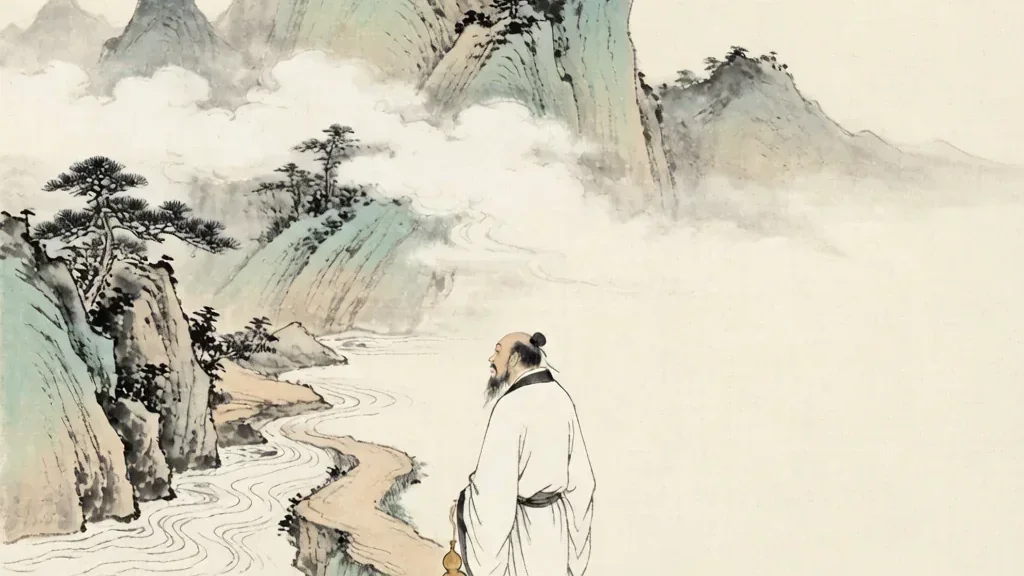
Daoism has always loved nature, not as a resource to exploit but as a teacher to imitate. The sage observes how things grow without being told, how valleys remain low and are therefore filled with water, how the soft outlasts the rigid. Mountains, mists, and old trees became central symbols in Chinese landscape painting, much of it inspired by Daoist feeling for the wild and untamed.
Over the centuries, Daoism also developed a religious and alchemical side, with temples, priests, and practices aimed at long life or even immortality. Breathing exercises, diet, meditation, and the gentle movement of 太极 (tàijí, taiji) all trace back to the Daoist desire to cultivate the body's harmony with the cosmos. Whether seeking a longer life or a freer mind, the Daoist seeks not to conquer nature but to become its companion.
Daoism in Daily Chinese Life
Even Chinese people who have never read the Daodejing live inside its habits. The preference for roundabout, harmonious solutions over head-on conflict; the love of gardens, tea, and quiet; the respect for balance in food and medicine — all carry a Daoist accent. Chinese medicine, with its focus on restoring the body's flow, is deeply Daoist in spirit, as is the art of placement known as 风水 (fēngshuǐ, feng shui).
Daoism also gave China its richest treasury of immortals, legends, and local gods, blending with folk religion so thoroughly that the two are hard to separate. From the playful deities of the kitchen to the austere hermits of the mountains, the Daoist imagination taught that the sacred is not only in temples but in the breeze, the moon, and the unforced moment. In a culture famously devoted to effort, Daoism reminds everyone that sometimes the greatest power is in letting go.
The Uncarved Block and Simplicity
Daoism prizes pu, the 'uncarved block', a symbol of plain, unspoiled simplicity before society imposes its shapes. To return to pu is to shed cleverness, excess desire, and rigid agendas, recovering a natural spontaneity that the Daodejing links to genuine strength. The text repeatedly urges softness over force, emptiness over fullness, and the low place that water naturally takes. This is not laziness but a trust that things unfold best when not over-managed. The ideal person acts without grasping credit and achieves without straining, like the earth that supports all without choice. In daily life this becomes a taste for quiet, for few possessions, and for unhurried days. Artists and gardeners drew on the same spirit, valuing negative space and weathered wood. The counsel to do less, strangely, was meant to let more happen.
Daoism in Art and Poetry
Daoist feeling runs through the great landscapes of Chinese painting and the lines of its poetry. Artists painted misty mountains, empty rivers, and tiny figures to suggest the vast, unnamed dao behind the world, leaving generous blank space as room for the viewer's own breath. Poets from the Tang onward wrote of sitting alone in bamboo groves, listening to the wind, or watching clouds dissolve, turning quiet observation into a kind of practice. The crane, the pine, and the moon became recurring signs of freedom and long life. Even calligraphy, with its spontaneous yet disciplined strokes, was spoken of in Daoist terms as following the brush where it wants to go. This aesthetic valued not precise likeness but mood and resonance, the hint of something larger than the form. Through art, Daoist calm entered everyday seeing.
Meditation and Inner Cultivation
Beyond philosophy, Daoism developed rich methods of inner cultivation aimed at vitality and ease. Practitioners sit in stillness, coordinate breath with attention, and visualize the body's energies circulating along interior pathways. Standing and moving forms, the ancestors of qigong, were used to gather and guide qi, while dietary and breathing regimens sought to preserve life's vitality. Later Daoist lineages built elaborate visualizations, talismans, and communal rites, but the core remained the quieting of the heart and the return to natural rhythm. The aim was less otherworldly escape than a fuller, longer, more harmonious life here. Many of these exercises survived outside temples, folded into popular health practice and martial arts. Modern readers often meet Daoism first through such gentle practices, a living thread of an old art of staying well by staying close to the breath.
❓ Frequently Asked Questions
📝 Chinese Vocabulary
道家 — : The Daoist school of thought.
道 — : The Way, the foundational cosmic principle.
无为 — : Non-action or effortless, unforced action.
老子 — : Laozi, the "Old Master" and traditional author of the Daodejing.
庄子 — : Zhuangzi, the playful Daoist sage and author of the Zhuangzi.
自然 — : Self-so or spontaneity, the naturalness of things unfolding of themselves without forced interference.
逍遥 — : Free and easy wandering, a state of untroubled liberty celebrated in the Zhuangzi.
太极 — : The supreme ultimate, the primal source and turning point from which yin and yang differentiate.
🎉 Fun Facts
- The Daodejing is one of the most translated works in world literature, second only to the Bible in some counts.
- Zhuangzi's butterfly dream asks whether he was a man dreaming of a butterfly or a butterfly dreaming of being a man.
- The Daoist symbol of the yin-yang, though shared across Chinese thought, is most at home in Daoist cosmology.
- Zhuangzi's tales include a giant bird that flies thousands of miles and a cook who carves an ox by feel, using stories rather than arguments to make points.
- Daoist priests developed elaborate rituals, meditation, and breathing exercises, and many later alchemists searched for an elixir of immortality.
- The Daodejing is only about five thousand characters long, yet it has shaped art, politics, and medicine for over two thousand years.