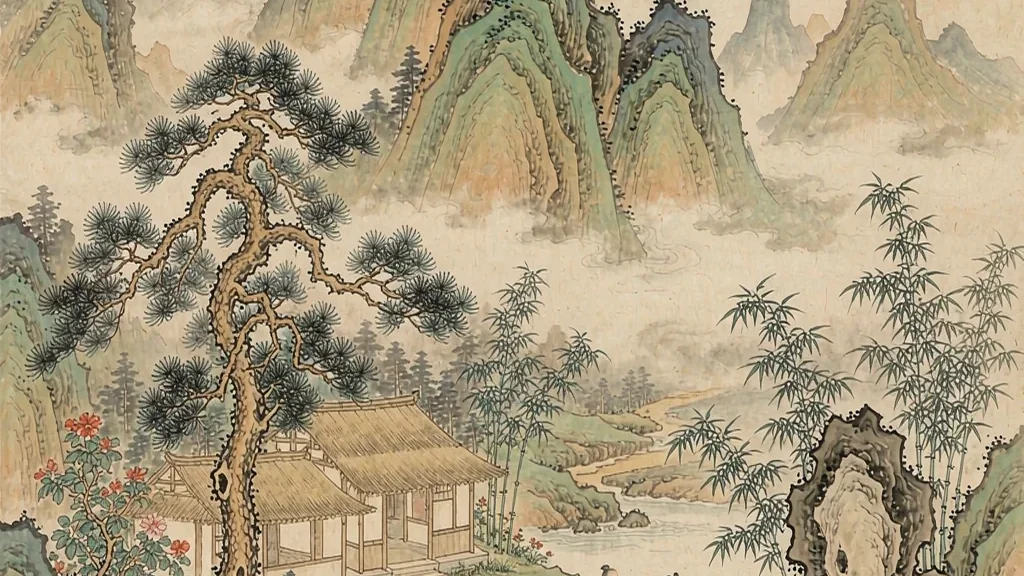
Fengshui, literally "wind and water," is the traditional Chinese art of arranging buildings, tombs, and interiors in harmony with the living energies of the landscape. Far from mere superstition in the eyes of its practitioners, it is a practical ecology of placement rooted in the same cosmological assumptions—yin and yang, the five phases, and the flow of qi—that inform Chinese medicine and philosophy. For more than a millennium fengshui guided the sitting of capitals, villages, and family graves, expressing a worldview in which human dwelling is a participant in, not a conqueror of, the natural order. Its philosophical underpinnings reveal a distinctive Chinese understanding of space, fortune, and the reciprocity between earth and destiny.
Origins in Terrestrial Cosmology
The roots of fengshui lie in the observation that location shapes life. Early settlers noticed that sheltered, well-watered, south-facing sites were healthier and more prosperous, and they encoded this practical wisdom in rules of siting that grew gradually formal.
By the Han dynasty, burial placement had become a matter of cosmic significance. The belief arose that the resting place of ancestors influenced the fortune of descendants, because the qi of the earth, if properly received, would nourish the lineage.
What began as agrarian common sense thus became a cosmological discipline, linking geography, astronomy, and family destiny in one continuous field of force.
Qi, the Dragon, and the Veins of the Earth
At fengshui's core is qi, the vital breath that animates the cosmos. The earth is thought to bear "dragons"—ridges and waterways that are the veins through which auspicious qi flows. A good site lies where this flow gathers and settles rather than where it rushes away.
Practitioners "reads the dragon": they trace mountain ranges as the dragon's spine and rivers as its blood, seeking the "xue," the vital point where energy collects, ideal for a dwelling or tomb.
This organic metaphor treats landscape as a living body. To build well is to listen to the body's pulse, not to override it—an attitude of attentiveness rather than domination.
Yin-Yang and the Five Phases in Placement
Fengshui applies the yin-yang polarity concretely. A south-facing slope is yang (bright, warm, active) and favored for homes; a north-facing, cooler aspect is yin. Water (yin) balances mountain (yang), and the two should meet harmoniously.
The five phases further prescribe correspondences: directions, colors, and materials each carry a phase, and a skilful arrangement keeps them in generative rather than clashing relation. A red (fire) element may be tempered by a water feature, for instance.
Such calculations aim at a balanced microclimate of energy, where no single force dominates to the detriment of the whole—a spatial analogue of bodily health.
The Compass and Form Schools
Two main methods developed. The Form School (xingfa) judges sites by their visible shape—the embrace of hills, the curve of water, the avoidance of sharp or "poisonous" angles. It is the older, more intuitive approach.
The Compass School (lifa) uses the luopan, a layered disc marked with rings of trigrams, directions, and stellar charts, to compute the precise alignment of a building against cosmic coordinates. Time as well as space matters: a direction auspicious in one period may not be in another.
Together they show fengshui as both an art of seeing landscape and a science of calculation, demanding trained judgment to apply.
Fengshui and the Built Environment
The philosophy left a visible mark on China's cities. Imperial Beijing was laid out on cosmic principles: the palace along a central north-south axis, aligned to the polestar, with mountains behind and water before.
Villages were sited to catch beneficial flows and sheltered from harsh winds; the "fengshui forest" planted behind hamlets both conserved soil and symbolized protection. Even room arrangement followed the logic of elemental balance.
In this sense fengshui functioned as an informal environmental planning code, often with genuinely salutary effects on microclimate and community layout.
Tombs, Ancestors, and Lineage Fortune
Perhaps the most solemn fengshui practice concerned graves. Because ancestors were believed to mediate blessing, choosing a tomb where qi pooled was thought to secure descendants' prosperity, health, and office.
Families consulted specialists before burial and might relocate graves if fortune waned, reading misfortune as a sign of disturbed earth-energy. The grave thus became a hinge between the dead and the living.
This practice bound fengshui tightly to filial piety and lineage identity, making geography a moral as well as physical matter.
Connections to Confucian and Daoist Thought
Fengshui draws on Daoist attunement to nature's spontaneity and on the Confucian concern for family continuity. Its respect for the earth's pattern echoes the Daoist classics' teaching of following the Way.
At the same time, its ordering of space reflects a cosmological hierarchy in which human society mirrors heaven and earth. The well-sited house is a small cosmos in right relation to the large one.
Though sometimes at odds with strict Confucian ritualism, fengshui nonetheless served the gentry's vision of a harmonious, governed world extending from the altar to the horizon.
Modern Reassessment and Global Spread
In the twentieth century fengshui was attacked by modernizers as feudal superstition and by Marxists as mystification. Yet it persisted in popular practice and has been partly reinterpreted as traditional ecological wisdom.
Today it circulates globally as a design philosophy, sometimes reduced to decorative tips about mirrors and plants, sometimes studied more seriously as a cultural system of environmental relations. Scholars examine it as vernacular science.
Whether approached as belief or as heritage, fengshui remains a vivid expression of the Chinese conviction that human life is woven into the patterns of wind and water.
Philosophy Beneath the Practice
Stripped of prediction, fengshui's philosophy is a relational ecology: nothing stands alone, space is charged with quality, and the good life requires fitting oneself to the larger rhythms. It resists the modern split of nature and culture.
Its weakness, critics note, is the temptation to treat fortune as tractable by arrangement alone, distracting from social and economic causes. Yet its underlying humility—that place matters, and that we dwell within the earth rather than above it—speaks to contemporary ecological anxiety.
In fengshui, Chinese cosmology becomes livable, a daily practice of aligning hearth and horizon in the same breath of qi.
❓ Frequently Asked Questions
What is fengshui?
Fengshui is the traditional Chinese art of siting and arranging dwellings and tombs in harmony with the flow of qi in the landscape.
What is qi in this context?
Qi is the vital energy flowing through earth and water; good fengshui gathers and balances it rather than letting it scatter.
What are the two main schools?
The Form School reads landscape shapes; the Compass School uses the luopan to calculate alignment with cosmic coordinates.
Is fengshui only about buildings?
No; it also governs tomb placement, believed to influence the fortune of one's descendants through ancestral qi.
How does it relate to Chinese thought?
It applies yin-yang, the five phases, and Daoist attunement, expressing a relational ecology of human and nature.
Is it taken seriously today?
It persists in popular practice and design, and is studied as cultural heritage and traditional ecological wisdom.