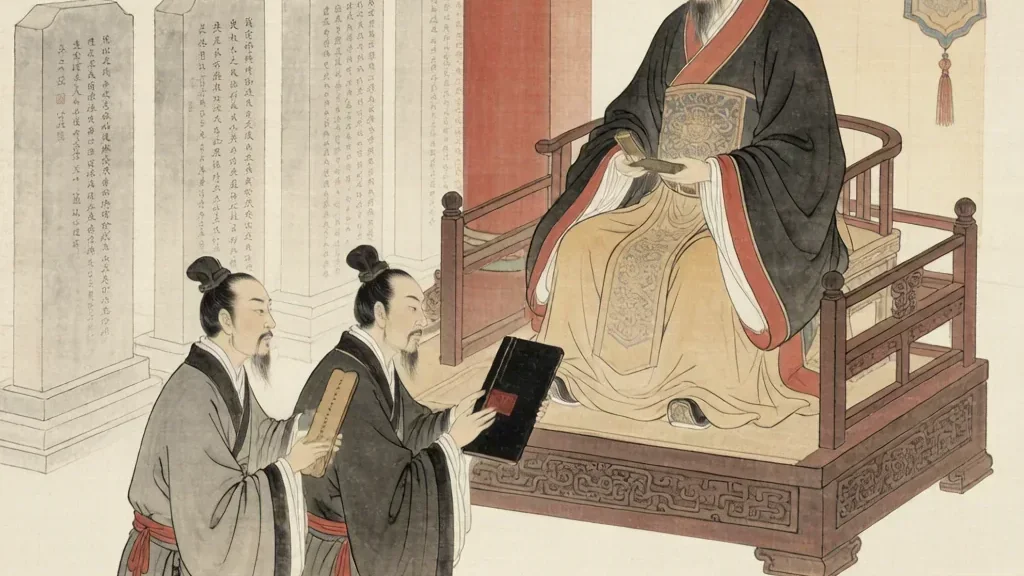
Legalism, known in Chinese as Fajia (法家), was a school of political philosophy in the Warring States period that argued for strong, centralized rule based on clear laws, strict punishments, and administrative method rather than on morals or ritual. Often contrasted with the Confucian faith in virtue, the Legalists offered a hard-edged theory of state power that helped the state of Qin unify China in 221 BCE. Though later dynasties formally honored Confucius, they quietly governed by Legalist methods, making Fajia one of the most consequential—and controversial—currents in Chinese political thought.
Origins of the Legalist School
The label Fajia, "school of fa (law/method)," was applied by later historians to a set of thinkers and reformers who, across several states, sought practical solutions to the chronic warfare of the era. They shared a conviction that moral suasion alone could not secure order in a competitive age, and that the ruler needed impersonal, reliable instruments of control.
Early figures include Guan Zhong of Qi and the anonymous author of the Guanzi, but the mature theory is associated with three masters: Shang Yang of Qin, Shen Buhai of Han, and Shen Dao. Each emphasized a different pillar—law, technique, and authority—that later synthesizers combined.
The Han dynasty bibliographers grouped these writers as one "school," though they differed considerably. What united them was a this-worldly, results-oriented approach to government and a skepticism toward appeals to antique virtue.
Three Pillars: Fa, Shu, and Shi
Legalist theory is often summarized by three terms. Fa is the public law—clear, published standards of reward and punishment applied equally. Shen Buhai stressed shu, the "technique" or administrative art by which a ruler controls officials, keeping them unaware of his true intentions. Shen Dao emphasized shi, the "positional power" or authority inherent in the ruler's seat, which makes even a mediocre man effective when he holds the throne.
The classic statement comes from Han Fei, who combined all three. He argued that a ruler should rely on the objective force of law and position rather than on his personal wisdom or virtue. The system, not the man, guarantees order.
This triad marks a distinctly modern-sounding insight: good institutions outweigh good intentions. The Legalists were, in effect, theorists of bureaucracy and statecraft avant la lettre.
Shang Yang and the Reform of Qin
Shang Yang (d. 338 BCE) was the great practical Legalist who transformed the backward state of Qin into a military powerhouse. Invited by Duke Xiao, he imposed land reforms that broke the old aristocratic holdings, tied reward directly to military merit, and organized the population into mutually responsible units that reported one another's offenses.
His laws were famously strict: a slight crime could bring severe punishment, on the theory that heavy penalties for small faults prevent greater ones. He promoted agriculture and warfare as the only productive occupations, taxing and discouraging commerce, learning, and idleness that did not serve the state.
The results were dramatic. Qin grew rich and strong, eventually conquering its rivals. Shang Yang himself fell victim to court intrigue and was executed, but the institutions he built outlasted him and made unification possible.
Han Fei and the Synthesis
Han Fei (d. 233 BCE) was a prince of Han and a student of the Confucian Xunzi who turned sharply against his teacher's school. His essays—among the finest prose of the period—systematized Legalism and presented it as a complete science of rule, warning rulers against trusting ministers, relatives, or reputations.
He distrusted moral exhortation as ineffective and even dangerous, arguing that people act from self-interest and respond only to calculated incentives. A sage ruler therefore shapes the environment of rewards and punishments so that individual selfishness serves the public good automatically.
Han Fei's work so impressed the King of Qin (the future First Emperor) that he reportedly wished to meet its author. Han Fei was later imprisoned and forced to commit suicide through the plotting of his rival Li Si, yet his ideas became the blueprint of the Qin empire.
Legalism Versus Confucianism
The contrast with Confucianism is the tradition's defining foil. Where Confucians trusted the ruler's virtue and the people's moral education through ritual, Legalists trusted neither; they assumed officials would scheme and people would calculate. They preferred visible law to invisible virtue.
Confucians aimed at transforming the person from within; Legalists aimed at channeling behavior from without. The Confucian gentleman led by example; the Legalist ruler governed by method and deterrence, remaining inscrutable to subordinates.
Yet the two were not wholly separate in practice. As the saying goes, Chinese empires "used Confucianism for show and Legalism for rule." The Han dynasty, while proclaiming Confucian orthodoxy, retained Legalist administration, centralized power, and harsh penal codes.
The Qin Empire and Its Fall
The First Emperor of Qin (r. 221–210 BCE) put Legalism into practice on a vast scale: standardized weights, measures, writing, and law; abolished the old feudal aristocracy; and conscripted labor for roads, walls, and tombs. The state was a disciplined machine geared to expansion and control.
The regime's severity is legendary. It is said to have burned books and buried scholars to suppress dissenting thought, though modern historians debate the scale of these events. What is clear is that Qin relied on fear and fiat more than consent.
When the First Emperor died, the harsh system collapsed under revolt within years. Later writers blamed Legalism's harshness for the dynasty's swift fall, making it a cautionary tale about rule without humanity—even as subsequent states kept its methods.
Legalist Ideas in Later Government
Though discredited by name, Legalist techniques survived in the machinery of every Chinese dynasty. Centralization, a uniform penal code, merit-based appointment (via examinations), strict household registration, and secretive personnel management all bear its stamp.
The Tang and later codes, though Confucian in stated values, were precise legal instruments with graded punishments—a Legalist legacy wrapped in Confucian rhetoric. The censorate and the use of espionage among officials echo Shen Buhai's shu.
Even reformist statesmen who invoked Confucius, such as the Legalist-leaning advisers of various dynasties, drew on the Fajia toolkit when strengthening the state. The school's pragmatism proved more durable than its reputation.
Assessment and Modern Debate
Legalism forces a hard question: can a society be orderly without being humane? Its critics answer that rule by fear breeds resentment and fragility, as Qin showed. Its defenders note that clear law and accountable administration are foundations of any modern state, and that the school anticipated the rule of law in valuing impersonal standards.
Modern scholars are careful to note that Fajia meant "law" in the sense of the ruler's command, not law binding the ruler—so it differs from modern constitutionalism. Still, its emphasis on objective procedure and merit resonates with bureaucratic modernity.
In contemporary China, Legalism is studied both as a native tradition of statecraft and, more cautiously, as a warning. Its place in the canon reminds us that Chinese political thought has always contained a realistic, power-aware strand beside its moral idealism—and that the two have long coexisted.
❓ Frequently Asked Questions
What was the Legalist school in China?
Fajia was a Warring States political philosophy advocating strong central rule through clear laws, strict punishments, and administrative method rather than moral suasion.
What are fa, shu, and shi?
They are law (public standards), technique (the ruler's art of controlling officials), and positional power (authority of the throne)—the three pillars of Legalist theory.
How did Legalism help unify China?
Shang Yang's reforms made Qin militarily strong through merit rewards and tight organization; Han Fei's systematization became the Qin empire's blueprint for central rule.
Why is Legalism compared with Confucianism?
Confucians trusted virtue and ritual; Legalists trusted law and deterrence. Later empires combined them, using Confucian ideals publicly and Legalist methods in administration.
Why did the Qin dynasty fall so quickly?
Its harsh, fear-based rule bred resentment and fragility; after the First Emperor died, revolt toppled the regime within a few years, becoming a cautionary tale.
Does Legalism survive in later Chinese government?
Yes. Centralization, uniform penal codes, merit appointment, and secretive personnel management all reflect Legalist technique even under Confucian official ideology.