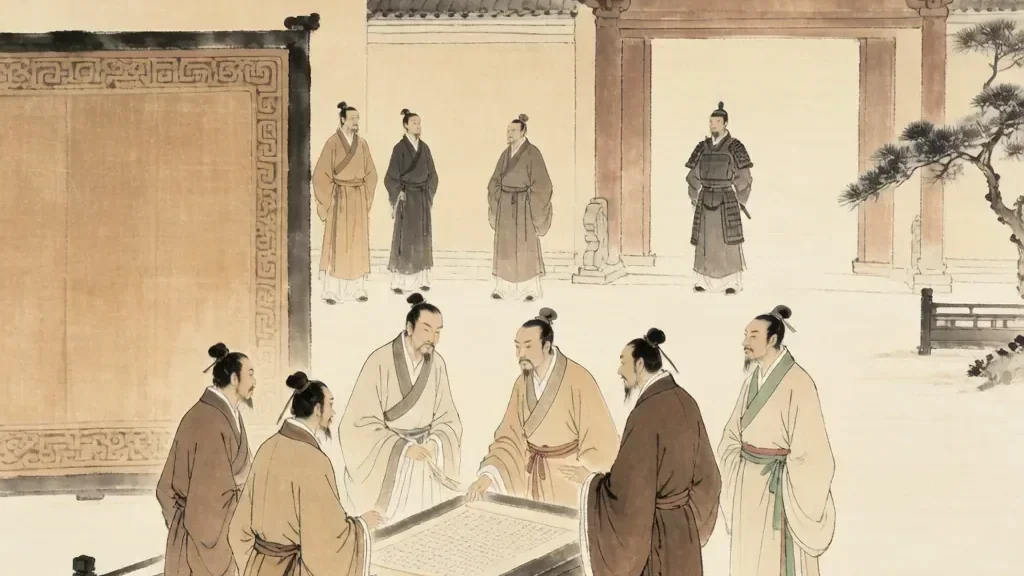
The Zongheng school, often called the "Diplomats" or the "School of Vertical and Horizontal Alliances," was a cadre of political strategists who rose to prominence in the Warring States period, when seven great powers contended for supremacy. Its practitioners—most famously Su Qin and Zhang Yi—traveled from court to court selling their masters a single commodity: advantage. They spun coalitions ("vertical" north-south pacts against the strongest state, or "horizontal" east-west alignments led by Qin) through persuasion, intelligence, and sheer rhetorical force. Though later Confucians despised them as unprincipled dealers in expediency, the Zongheng masters were the original realists of Chinese statecraft and pioneers of the art of negotiation.
The Warring States Crucible
By the fourth and third centuries BCE the Zhou monarchy was a nullity and seven major states—Qin, Chu, Qi, Yan, Zhao, Wei, and Han—fought for ultimate unification. No single power was secure, and the balance of power shifted constantly as states made and broke alliances.
In this environment, a gifted speaker who could persuade a ruler to ally, attack, or hold back could alter the fate of kingdoms. The strategists thrived precisely because rulers needed not sermons but results, and paid well for counsel that worked.
The Jixia Academy and the patronage of warring courts created a market for persuasive talent, and the Zongheng specialists were its most mobile and best rewarded operatives.
Vertical and Horizontal Explained
The school's name encodes its central tactic. "Vertical" (zong) alliance meant a north-south coalition of the eastern states—Qi, Yan, Zhao, Wei, Han, Chu—banding together to check the westward-expanding power of Qin. "Horizontal" (heng) alliance meant an east-west alignment in which a leading state, usually Qin, linked with neighbors to divide and conquer the rest.
These were not ideologies but levers. A strategist might urge one ruler to join the vertical pact in the morning and, at another court, counsel the horizontal in the evening; what mattered was leverage and the interest of the client state.
The oscillation between the two alignments shaped the whole geopolitics of the era and delayed or accelerated Qin's eventual unification, which came under the horizontal strategy.
Su Qin and the Vertical Pact
Su Qin is the archetypal vertical strategist. Legend holds that after early failure he studied tirelessly, then persuaded six states to form a coalition against Qin, wearing the prime ministers' seals of several kingdoms at once. His oratory dwelt on the danger of Qin and the strength available if the weaker states stood together.
His speeches, preserved in texts like the Zhanguo ce, are masterpieces of persuasive rhetoric: they flatter the ruler's dignity, sketch the strategic map, and appeal to survival. They also reveal a keen psychology of audiences.
Whether the stories are inflated, Su Qin stands for the idea that unity among the weak can balance a hegemon—a lesson repeated in later Chinese and world diplomacy.
Zhang Yi and the Horizontal Strategy
Zhang Yi is Su Qin's traditional rival and the great horizontal strategist in service of Qin. He argued that resistance was futile and that the eastern states should ally with Qin, accepting vassalage or partnership in exchange for protection and profit, while Qin picked off the holdouts.
His methods included both inducement and deception: he is credited with trickery that broke enemy coalitions by sowing distrust among their leaders. The contrast between Su Qin's defensive union and Zhang Yi's offensive alignment frames the school's range.
History credits the horizontal approach, backed by Qin's reform-driven strength, with winning the unification of 221 BCE under the First Emperor.
The Art of Persuasion
Zongheng writing is prized for its rhetoric. The strategists used analogy, historical example, exaggerated contrast, and flattery calculated to the listener's vanity and fear. They opened with the ruler's interest, not abstract principle.
The Zhanguo ce (Intrigues of the Warring States) preserves these speeches as literature. They show an early Chinese theory of communication: know the audience, control the frame, and never let logic wander from the hearer's desire.
This pragmatic eloquence influenced later Chinese prose and is studied even today as a foundation of argumentation and negotiation technique.
Relationship to Other Schools
The Diplomats sat uneasily among the "hundred schools." Confucians condemned them for lacking moral commitment; Daoists mocked their anxious busyness; Legalists admired their effectiveness but distrusted independent agents who served any paymaster.
Yet the school shared the realist temper of the age. Like the Legalists it judged policy by results, and like Sunzi it treated conflict as a matter of positioning and psychology rather than ritual.
Simplicity of loyalty was not their virtue; adaptability was. They personified the marketplace of advice in a fragmented world where no ruler's claim was sacred.
The Intrigues of the Warring States
The principal source for the school is the Zhanguo ce, a Han-era compilation of stories and speeches from the contending states. Its tales are often colorful and sometimes unreliable, but they capture the strategists' worldview better than any dry treatise.
The book delights in cleverness for its own sake: assassins, double agents, feigned defections, and last-minute reversals. It celebrates quick wit as a weapon equal to armies.
Although moralists disliked its tone, the Zhanguo ce became a classic of Chinese narrative prose and a quarry for later historians and storytellers.
Legacy in Chinese and World Diplomacy
The vertical-horizontal logic outlived the Warring States. Later eras spoke of "hezong lianheng" whenever regional powers faced a dominant one, and the phrases entered the permanent vocabulary of statecraft.
In imperial times, the diplomatists' reputation dimmed under Confucian moralism, yet their methods survived in the practice of envoys and frontier negotiators. The realist insight—that alliances follow interest, not sentiment—kept resurfacing.
Modern students of international relations find in Zongheng an ancient parallel to balance-of-power theory, making the school a surprisingly contemporary ancestor of realpolitik.
Reassessment as Political Realism
Contemporary scholarship is kinder to the Diplomats than the Confucians were. Rather than mere opportunists, they appear as professionals who supplied what fragmented polities urgently needed: analysis, advocacy, and the courage to tell rulers unpleasant truths about their weakness.
Their amorality is real, but so is their clarity about incentives. In a world of competing states, they argued, survival requires understanding others' interests as clearly as one's own—a lesson with undiminished force.
The Zongheng school thus endures as China's first systematic art of negotiation, a reminder that words, well aimed, can move the course of empires.
❓ Frequently Asked Questions
What was the Zongheng school?
It was a Warring States cadre of diplomatic strategists who brokered alliances through persuasion and realpolitik, often called the School of Diplomats.
What do vertical and horizontal mean?
Vertical (zong) was a north-south coalition against a hegemon; horizontal (heng) was an east-west alignment led by a dominant state such as Qin.
Who were its famous figures?
Su Qin championed the vertical pact; Zhang Yi advanced the horizontal strategy in service of Qin.
Why did Confucians dislike it?
They saw the strategists as amoral opportunists who served any paymaster rather than upholding moral principle.
What source preserves its ideas?
The Zhanguo ce, or Intrigues of the Warring States, collects the speeches and tales of the strategists.
Is it still relevant?
Yes; its balance-of-power logic and persuasive technique echo in modern diplomacy and negotiation theory.