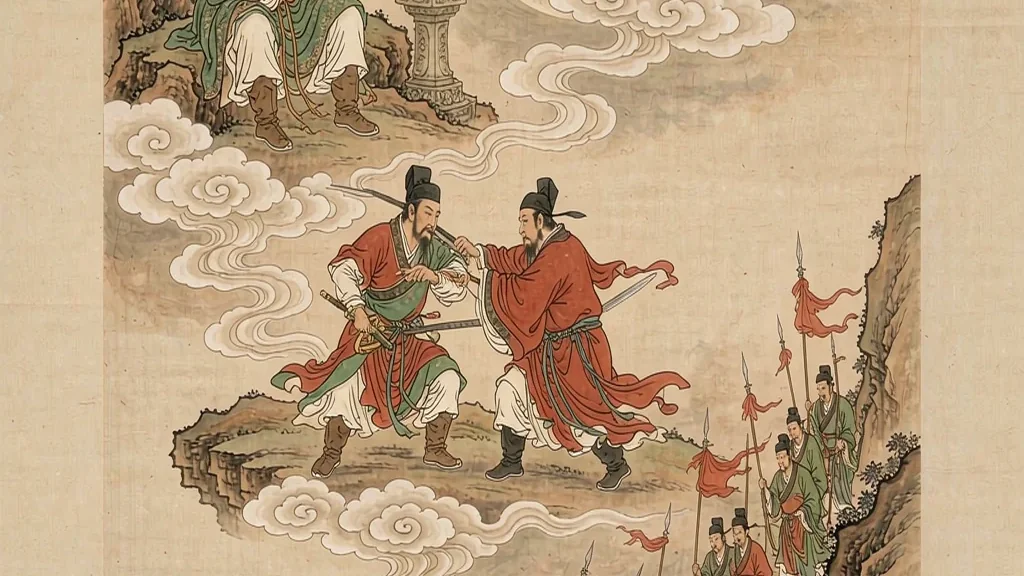
The military philosophy associated with Sunzi, traditionally attributed to Sun Wu of the state of Wu, is one of China's most influential contributions to world thought. Collected in the Art of War (Sunzi bingfa), it is far more than a manual of battlefield tricks: it is a coherent philosophy of strategy that treats war as an affair of the whole state, rooted in calculation, deception, and the supreme aim of winning without fighting. Revering intelligence over brute force, Sunzi teaches that the highest excellence lies in subduing the enemy's army without battle, a idea that has traveled from ancient Chinese courts into modern business, sports, and international relations.
The Historical Figure of Sunzi
Tradition places Sun Wu, known as Sunzi ("Master Sun"), in the late sixth century BCE, serving the king of Wu during the Spring and Autumn period. The Shi Ji recounts that he demonstrated his discipline by drilling the king's concubines, executing two leaders who laughed, and thereby proving that a true commander can make even women into soldiers.
Modern scholarship is cautious: the Art of War as we have it is likely the product of several hands compiled over the Warring States era, crystallizing the hard-won lessons of centuries of interstate warfare. Whether one man wrote it matters less than the consistency of its strategic vision.
What is certain is that the text emerged from a real world of professional commanders, spies, and strategists for whom survival depended on outthinking rivals, not merely outfighting them.
Structure and Core Claims of the Art of War
The received text runs to thirteen chapters, each addressing a facet of war: estimates, waging war, attack by stratagem, dispositions, energy, weaknesses and strengths, maneuver, the nine variables, the army on the march, terrain, the nine kinds of ground, attack by fire, and the use of spies.
Its opening line—"War is a matter of vital importance to the state"—sets a sober tone. Sunzi insists that war must never be entered lightly, because its costs are enormous and its outcomes uncertain. The commander's first duty is therefore calculation: comparing the two sides across five factors—the Way, weather, terrain, command, and discipline.
Throughout, the text privileges foresight and preparation, holding that victorious generals win first and then fight, while the defeated fight first and then seek to win.
The Supreme Art: Winning Without Fighting
The most celebrated Sunzi principle is that the acme of skill is "to attack the enemy's strategy" and, best of all, "to subdue the enemy without fighting." To Sunzi, battle is a last resort, since even a victorious fight wastes lives and resources that a smarter approach could have spared.
This does not mean pacifism. It means that the strategist should shape the situation so thoroughly that resistance collapses before a blow is struck—by isolating the foe, breaking alliances, or posing such overwhelming readiness that the cost of defiance is plain.
The ideal is total victory at minimal cost, a goal reached through psychological and political pressure as much as through arms. This idea distinguishes Sunzi from glorifications of heroism and explains his appeal to statesmen who prefer coercion to carnage.
Deception and the Formless
"All warfare is based on deception," Sunzi declares. When strong, appear weak; when near, appear far; when planning, appear idle. The aim is to lure the enemy into error and then strike the gap thus opened.
Closely tied to this is the ideal of being "formless"—adapting so completely to circumstances that one cannot be pinned down or predicted. Like water, which takes the shape of its container and flows to the lowest place, the good commander has no fixed form but conforms to the enemy's weaknesses.
Such adaptability requires both knowledge of the foe and self-knowledge. Sunzi warns that one who knows the enemy and knows himself need not fear the outcome of a hundred battles, while ignorance of either guarantees peril.
The Role of the Commander
Sunzi assigns the general extraordinary responsibility and autonomy. A worthy ruler, he argues, does not meddle from the court in tactics he cannot see; he entrusts the campaign to a commander who shares the sovereign's interests but exercises field judgment.
The commander must be "wise, trustworthy, humane, courageous, and strict." Crucially, he should be calm and inscrutable, able to conceal his dispositions and exploit the enemy's temper. Anger and covetousness in a leader are dangers to be guarded against, since the enemy will use them as bait.
The relationship between civil and military authority is delicate: the text warns against orders issued from ignorance, yet assumes the commander serves the state's larger interest rather than personal glory.
Terrain, Timing, and Calculation
Several chapters are devoted to terrain and "ground," classifying landscapes—accessible, entrapping, stalemate, narrow, steep, distant—and prescribing how to act in each. Mastery of ground lets a commander turn geography into an ally.
Timing (the "weather" factor) and the reading of omens and morale complete the picture. Sunzi is pragmatic about signs: he values spies and scouts over augury, and he treats soldiers' spirit as a variable to be managed—sharp at first, dulled by prolongation, recoverable through rhythm.
The through-line is calculation: victory belongs to those who have counted the factors beforehand and arranged them in their favor, so that when battle comes it is almost a formality.
Sunzi and the Wider Warring States Thought
The Art of War belongs to a broader milieu of military specialists distinct from, yet overlapping with, the Confucian, Daoist, and Legalist schools. Its emphasis on order, reward, and punishment echoes Legalist statecraft, while its yielding, water-like adaptability resonates with Daoist imagery.
Unlike the chivalric warfare of earlier Zhou custom, Warring States fighting was total and ruthless, and Sunzi's realism reflects that world. He shares with the strategist tradition a conviction that war is a tool of policy, not an end in itself.
Other military texts—the Wei Liaozi, the Wuzi, and the Thirty-Six Stratagems compendium—extend his themes, but Sunzi remains the fountainhead cited across East Asia for two thousand years.
Reception in East Asia and the World
In China, Sunzi was studied by generals from the Han to the modern era and was canonized among the Seven Military Classics used in the imperial examination for officers. Japanese rulers and samurai likewise took it up, and it shaped campaigns from the medieval wars to the early modern period.
In the twentieth century the text was rediscovered in the West, translated repeatedly and applied to business competition, negotiation, and sports coaching. Its aphorisms about knowing the enemy and avoiding direct clash fit comfortably into management seminars.
Critics note that Sunzi assumes a roughly symmetric contest of wits and says little about ideological or total industrial war; nonetheless, its emphasis on intelligence and foresight keeps it relevant wherever strategy is practiced.
Philosophy Beyond the Battlefield
Read philosophically, Sunzi offers a general theory of conflict and accommodation: success comes from alignment with reality, from flexibility, and from the discipline to act only when the odds are shaped. His "win without fighting" is a vision of resolving tension at the level of structure rather than bloodshed.
This makes the Art of War a cousin to Daoist non-forcing (wuwei) and to the Confucian preference for order won by virtue. The strategist and the sage meet in the figure who achieves the greatest effect with the least violence.
For the modern reader, Sunzi remains a meditation on preparation, self-knowledge, and the economy of force—timeless lessons that explain why a slim ancient Chinese book still sits on the desks of generals and executives alike.
❓ Frequently Asked Questions
Who was Sunzi?
Sunzi, or Master Sun, is the traditional author of the Art of War, plausibly a Warring States-era strategist; the text was likely compiled by several hands.
What is the Art of War about?
It is a philosophy of strategy covering planning, deception, terrain, command, and spies, centered on winning at minimal cost.
What does "win without fighting" mean?
It means shaping the situation—politically and psychologically—so the enemy's resistance collapses before battle, achieving victory without bloodshed.
Why is deception important to Sunzi?
Deception misleads the enemy into error, opening weaknesses to exploit while keeping one's own dispositions hidden and unpredictable.
How is Sunzi used today?
Beyond the military, its lessons on preparation and competitive strategy are applied in business, negotiation, and sports.
Is Sunzi connected to other schools?
Its realism overlaps with Legalism's order and Daoism's adaptive yielding, placing it within the broader Warring States thought world.