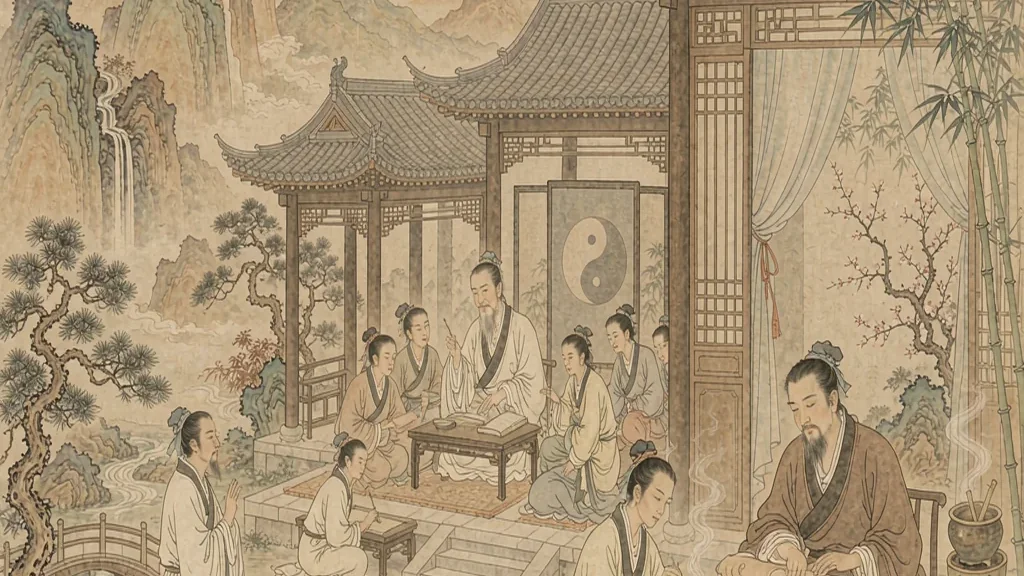
The yijia (医家), or "School of Physicians," designates the medical lineage catalogued among the early Chinese "masters" in the Han bibliography. Though not a philosophical school in the debating sense, it represents a coherent tradition of healing knowledge that grew alongside, and sometimes overlapped with, Daoist, Confucian, and cosmological thought. Centred on the correspondence of body, nature, and cosmos, the yijia produced the foundational texts of Chinese medicine and established an approach to health still practised in modified form across the world today.
Place Among the "Masters"
In the "Treatise on Literature" of the Book of Han, the yijia appear alongside the philosophical schools as a distinct bibliographic category, with a list of medical titles attributed to noted physicians. This placement signals that healing was regarded as a body of specialised, transmissible learning.
Unlike the Confucians or Legalists, the physicians did not argue about the polity; they argued, implicitly, about the body. Yet their writings shared the era's habit of systematising observation into principle.
The Yellow Emperor's Inner Canon
The single most influential medical work associated with the tradition is the Huangdi Neijing ("Inner Canon of the Yellow Emperor"), a dialogue-format compendium probably assembled over centuries. It lays out the breath (qi), the conduits (meridians), and the balance of yin and yang within the person.
Though framed as a conversation with the Yellow Emperor, the text is a layered anthology. Its genius was to embed physiology within a cosmic order, so that treating illness meant realigning the patient with the rhythms of nature.
Qi, Yin-Yang, and the Five Phases
Medical theory borrowed directly from the Yin-Yang and Five Phases cosmology. Health was a smooth circulation of qi; disease was blockage, excess, or the disequilibrium of opposing forces. The physician's task was to restore proportion.
This made the yijia a practical branch of the same cosmology that governed calendrics, state ritual, and agriculture. The body was a microcosm, and the doctor a kind of cosmic tuner.
Diagnosis and the Pulses
Classical physicians relied on palpating the pulses at the wrist, observing colour and voice, and questioning the patient about habits and environment. The famous "four examinations"—looking, listening, asking, feeling—structured the consult.
Pulse lore became extraordinarily refined, with numerous distinct pulse qualities mapped to organs and phases. Whatever one makes of its physiology, the method trained close, patient attention to individual variation.
Pharmacy and the Materia Medica
Alongside needling and breathing, the yijia developed a vast pharmacopeia. The Shennong Bencao Jing, attributed to the culture-hero Shennong, classified hundreds of substances by their natures—hot, cold, toxic, or tonic.
These herbals reflected empirical trial over generations, organised through the same yin-yang and phase logic. The result was a drug tradition both pragmatic and theoretically unified.
Relation to Daoism
Many physicians were also Daoist adepts, and the pursuit of longevity blurred into the pursuit of immortality. Breathing exercises, dietary restraint, and gymnastic "guiding and pulling" (daoyin) straddled medicine and self-cultivation.
This overlap is why Daoist alchemy and the yijia are close cousins: both sought to refine the body's vital stuff, one for health and the other for transcendence. The difference was often a matter of degree.
Surgery and the Legend of Bian Que
Not all early medicine was gentle regulation. Tales of prodigious physicians such as Bian Que describe feats of diagnosis at a distance and even miraculous revival, blending history with hagiography.
Such stories encoded respect for clinical discernment; the physician who "sees" the hidden disorder before symptoms fully show was the ideal the tradition held up.
Canonisation and Continuity
Later dynasties produced monumental works—the Tang pharmacopeia, the Song formula collections, the Ming Compendium of Materia Medica—each building on the Han medical shelf. The yijia thus enjoyed unbroken institutional life.
Imperial medical offices trained and examined practitioners, giving the school a permanence the debating philosophies lost once Confucianism became orthodoxy.
Modern Reckoning
In the modern period, Chinese medicine was both attacked as unscientific and reformed into "traditional Chinese medicine" (TCM) taught alongside biomedicine. The yijia lineage thus survives, contested but living.
For historians, the school matters as proof that early China produced not only political philosophy but also a sophisticated, observation-based science of the body—one still worth studying on its own terms.
Why the School Matters
The yijia remind us that "thought" in early China included the disciplined study of nature's patterns within the human frame. Healing was a way of knowing the world.
Its fusion of cosmology and care offers a contrasting model to mechanistic medicine—one in which the patient is a small universe to be harmonised rather than a machine to be repaired.
Paediatrics, Gynaecology, and the Specialisms
As the yijia matured, its practitioners subdivided into specialisms that the Han catalogue only hints at. Later imperial medicine developed dedicated branches for children, women, wounds, and epidemics, each with its own manuals. The "Essential Recipes Worth a Thousand Gold," compiled by Sun Simiao in the Tang, gathered such knowledge and is often called a medical summa of its age. Specialisation let the school address the body's stages and emergencies with tailored methods.
This division of labour shows the yijia was not only a philosophy of cosmic correspondence but a working profession with schools of practice. Apprentices memorised formularies, observed senior physicians, and gradually took their own patients—a continuity of clinical training that parallels, and long outlasted, the debating schools of the philosophers.
The Physician's Ethics
Medical writing also carried an ethic. The ideal physician was impartial, treating the poor and the noble alike, and the "great physician" (dafuyi) ideal urged compassion and concentration, free of distraction by rank or reward. Sun Simiao's famous preface on medical ethics distilled this professional conscience, insisting that the healer's mind must be calm and his concern equal for all who suffer.
Such statements link the yijia to the broader Confucian and Buddhist moral culture of later China, even as its theory remained cosmological. The physician thus stood at the meeting point of science, ethics, and care—a figure whose authority rested as much on character as on knowledge of the pulses.
The yijia also pioneered a communal dimension of care. Temple pharmacies and charitable dispensaries, supported by monasteries and wealthy patrons, distributed tested formulae to the poor, extending the physician's responsibility beyond the paying household. In this sense the school's ethic was social as well as personal, embedding healing in the fabric of neighbourhood and charity.
❓ Frequently Asked Questions
What is the yijia?
It is the "School of Physicians," the early Chinese medical lineage catalogued among the Han "masters" as a body of specialised healing knowledge.
What is its foundational text?
The Huangdi Neijing, or Inner Canon of the Yellow Emperor, which sets out qi, meridians, and the yin-yang balance of the body.
How did cosmology inform medicine?
Physicians used yin-yang and the Five Phases to explain health as harmony and disease as imbalance, treating the body as a microcosm of nature.
Did physicians use herbs or only needles?
Both; the tradition combined acupuncture, breathing exercises, and a large pharmacopeia classified in works like the Shennong Bencao Jing.
How is the yijia linked to Daoism?
Many physicians were Daoist cultivators, and longevity practices like daoyin overlapped with medical care and alchemy.
Does the tradition survive today?
Yes, in reformed "traditional Chinese medicine" taught alongside biomedicine, making the yijia one of the longest-lived early schools.