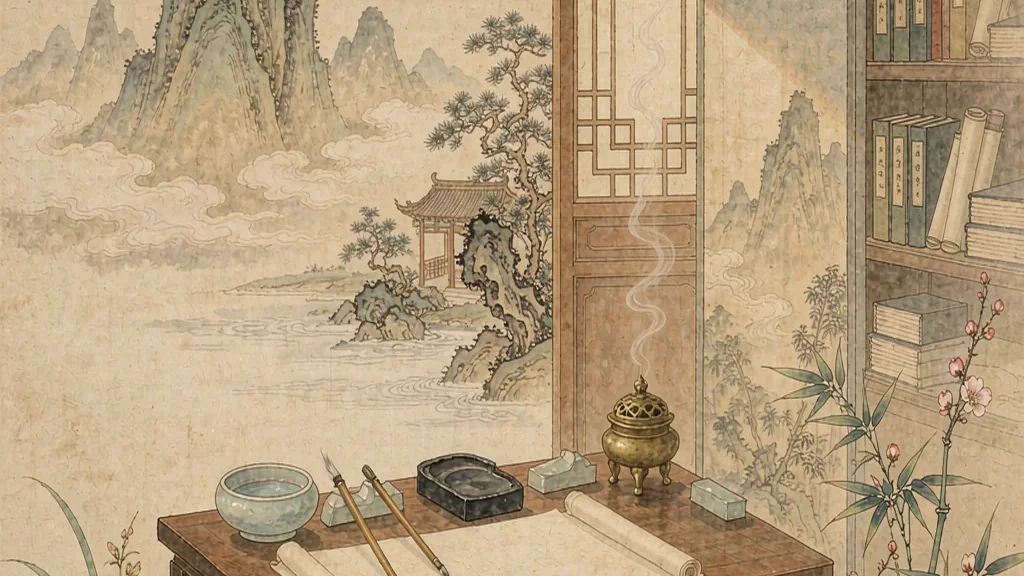
Regular script (kaishu), often called “standard script,” is the upright, squared style of Chinese writing that has served as the everyday and formal hand of China for more than a millennium and a half. With its clear stroke order, balanced proportions, and high legibility, regular script became the foundation of literacy, printing, and official documents, and it remains the style most students learn first. Its development marks the moment Chinese writing settled into the form modern readers recognize.
Origins in the Han and Three Kingdoms
Regular script did not appear all at once. It grew out of clerical script (lishu), the squared, streamlined writing that the Han bureaucracy adopted for speed. As scribes softened the sharp, angular turns of clerical script and regularized the stroke forms, a new manner emerged that was both quicker to write and easier to read. Early examples appear in inscriptions and manuscripts from the late Han and the Three Kingdoms period.
Tradition credits figures such as Zhong Yao of the Three Kingdoms era with shaping the early regular hand. His surviving stele works, though transmitted through copies, show characters already close to the regular ideal: distinct strokes, a clear top-to-bottom and left-to-right order, and a calm, settled posture quite different from the flattened clerical look.
Clerical Script as the Bridge
To understand regular script one must first see clerical script as its parent. Clerical writing flattened rounded strokes into straight or bowed lines and introduced the characteristic “silkworm head and swallow tail” flare on certain strokes. Regular script kept the squared frame but removed the decorative flares, producing a cleaner, more neutral character suited to both monuments and daily use.
This transition was practical as much as aesthetic. A growing empire needed records, laws, and examinations, and a consistent, teachable hand served administration better than regional cursive hands. Regular script answered that need and, once set, proved remarkably stable across centuries and dynasties.
The Tang Golden Age
If regular script was born in the Han, it reached its classical height in the Tang dynasty. Under Tang patronage, master calligraphers codified the rules of structure, proportion, and stroke weight so thoroughly that later generations treated Tang regular script as the universal standard. The four great Tang regular masters—Ouyang Xun, Yu Shinan, Chu Suiliang, and later Yan Zhenqing and Liu Gongquan—each offered a model still copied today.
The Tang achievement was to make regular script both monumental and teachable. Inscriptions on steles showed how characters should look when carved for eternity, while copybooks let students practice the same forms at their desks. The result was a shared visual language that unified the written word across the realm.
Structure and the “Nine Palaces”
Regular-script composition follows principles of balance that teachers summarize in various schemes. One well-known method divides the character’s space into a grid so that components are placed with awareness of the whole, avoiding crowding or drift. The aim is a stable center of gravity, even if the character is visually asymmetrical.
Stroke order matters greatly: usually one writes from top to bottom and left to right, with enclosing strokes completed before their contents. Mastery of order is not mere etiquette; it produces better-balanced characters and, because the hand learns habits, it makes faster cursive writing possible later. Regular script is thus the grammar on which other styles build.
Stroke Types and the Eight Principles
The basic vocabulary of regular script is a small set of stroke types—dot, horizontal, vertical, hook, rising, left-falling, right-falling, and so on. A famous teaching device, the “Eight Principles of Yong,” uses the character yong (eternal) to demonstrate eight fundamental strokes in one word, making it a classic first exercise for students.
Each stroke has a beginning, a middle, and an end, with changes of pressure that give it life. A good regular-script dot is not a flat speck but a small, weighted shape; a horizontal is not a ruler-line but a slightly living band. These subtleties separate competent regular script from mechanical printing, and they are what connoisseurs look for in fine examples.
Role in Printing and Literacy
When woodblock printing arose in the Tang and bloomed in the Song, the regular-script forms used by scribes became the models for carved type. The printed book thus carried regular script into every household that could own one, fixing its shapes even more firmly in the collective eye. Later movable type and modern typefaces are still descendants of regular-script forms.
For literacy, regular script was decisive. Because it is the most legible style, it became the hand taught to children and the script of examinations, ledgers, and law. A person who could write regular script could function in nearly every written context of traditional life, which is why it outranked cursive and clerical for everyday purposes.
Regular Script Among the Other Styles
Chinese calligraphy recognizes several major scripts—seal, clerical, regular, running, and cursive—and regular script sits in the middle as the most balanced and readable. Running and cursive are quicker, freer developments of it; seal and clerical are older, more archaic forms. Knowing regular script is therefore the key that unlocks the others.
Artistically, regular script is prized for dignity and clarity rather than spectacle. A fine regular-script work can be profoundly moving through its calm order, yet it rarely has the theatrical energy of wild cursive. Collectors value both, but for different moods and occasions, and a complete calligrapher was expected to command regular script above all.
Learning Regular Script Today
Modern students, whether in China or abroad, almost always begin with regular script. They start by tracing and copying famous stele inscriptions—often by Yan, Liu, Ouyang, or Zhao Mengfu—then progress to writing from memory. The discipline of copying masters is considered essential; invention is welcome only after the rules are absorbed.
Digital tools have changed practice but not the standard. Fonts labeled “regular script” appear in word processors, yet serious learners still turn to brush and ink, because the living quality of pressure and speed cannot be reproduced by a keyboard. Regular script thus remains both a practical alphabet of Chinese culture and a living art.
❓ Frequently Asked Questions
What is regular script?
Regular script is the upright, squared style of Chinese writing that became the standard hand for literacy, printing, and official use.
Where did regular script come from?
It developed from clerical script during the late Han and Three Kingdoms era as scribes regularized and simplified the older squared writing.
Why is the Tang dynasty important to it?
Tang masters codified its rules of structure and proportion, making Tang regular script the universal standard later generations copied.
What are the Eight Principles of Yong?
They use the character yong, meaning “eternal,” to demonstrate eight fundamental stroke types in a single word, a classic first exercise.
Is regular script still used today?
Yes; it remains the style taught to beginners and the basis of printed Chinese typefaces, though serious learners still practice it with brush and ink.
How does it relate to cursive and running scripts?
Running and cursive are quicker, freer developments built on regular-script forms, so mastering regular script is the key to the other styles.