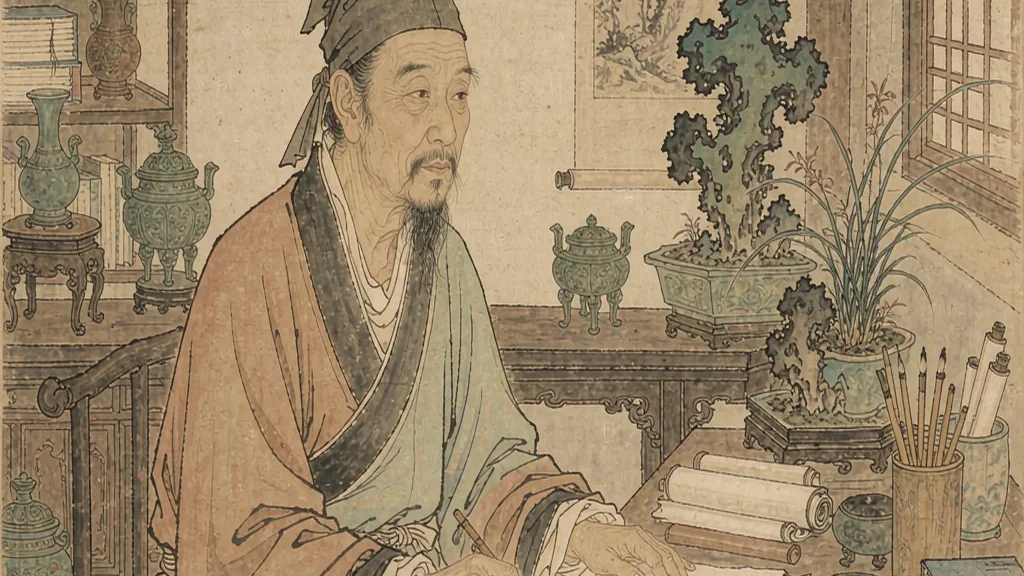
Jin Nong (1687–1763) was a Qing dynasty painter, calligrapher, and poet who became the acknowledged leader of the “Eight Eccentrics of Yangzhou,” a loose group of individualist artists. Though he turned seriously to painting only in his later years, he had already made his name with a bizarre, archaic script of his own invention—the “lacquer script”—and with a personality that embodied the scholar-outsider. His work shows how the eighteenth century prized oddness and learned play over smooth academic perfection.
Life of a Late-Qing Individualist
Jin Nong was born in Hangzhou and was recognized early as a brilliant, if unruly, scholar. He traveled widely, collected antiquities, and mingled with the wealthy merchants of Yangzhou, a city whose booming economy let artists live by their brush without court office. Though he sat for the examinations, he never gained high rank, and he came to personify the gifted man who refused the usual road.
In his fifties, after a life of poetry and antiquarian study, he began to paint in earnest, producing quirky figures, plum blossoms, and Buddhist subjects. By then his calligraphy was already notorious, and the two arts reinforced each other: the same stark, deliberate hand appears in both his writing and his brush drawings.
The “Lacquer Script” (Qishu)
Jin Nong’s most striking calligraphic invention is the “lacquer script” (qishu), so called because its thick, flat, glossy strokes resemble the look of painted lacquer. The characters are built from broad, even bands with squared ends and little taper, giving an archaic, almost inscriptional feel unlike the flowing norms of his time.
He claimed to have modeled it on very old stele scripts, and indeed it echoes the stiff grandeur of ancient stone writing. But the result is unmistakably his own: purposeful, slightly clumsy in a calculated way, and instantly recognizable. The lacquer script became his signature and a favorite of collectors who wanted something unlike the polished academic hand.
Member and Leader of the Eight Eccentrics
The “Eight Eccentrics of Yangzhou” were not a formal school but a nickname for a set of Yangzhou artists known for personal, sometimes strange styles and for independence from court taste. Jin Nong is often listed first among them, a mark of his stature as their intellectual anchor.
What united the group was less a method than an attitude: a willingness to be odd, to mix classes and genres, and to sell art to merchants rather than serve princes. In Jin Nong’s case this meant writing in invented scripts, painting plums with a childlike directness, and signing works with mock-humble, witty colophons that teased the buyer and himself at once.
Antiquarian Learning and Its Influence
Jin Nong was a serious student of antiquity, especially early inscriptions and bronze and stone writings. His devotion to old forms fed both his lacquer script and his taste for subjects drawn from the distant past. He owned and studied rubbings, and his eye for the archaic shaped a style that looked deliberately “old-fashioned.”
This antiquarian bent places him among the scholars who, in the Qing, turned from polite Song-Ming literati grace toward the raw power of early inscriptions. Though he was no stele-school theorist, his practice anticipated the era’s hunger for ancient vigor, and later stele enthusiasts admired his willingness to be unfashionable.
Painting: Plums and Odd Figures
As a painter Jin Nong is best loved for blossoming plum branches, which he rendered with sparse, bony strokes and an air of gentle eccentricity. He also painted Buddhist and Taoist figures, self-portraits, and occasional landscapes, usually with a plain, almost naive touch that critics either mocked or treasured.
His painting and calligraphy share a deliberate stiffness that reads as sincerity. Where a fluent master might dazzle, Jin Nong understates, and the restraint became a kind of signature. The “Eccentric” label fits: his art refuses to flatter the viewer’s eye and asks instead for a taste for the plain and the odd.
Persona, Commerce, and the Market
Yangzhou’s merchant wealth created a new kind of art market, and Jin Nong thrived in it without surrendering his independence. He was known to hire assistants to help produce paintings bearing his name, a common and accepted practice then, and he wrote playful contracts and inscriptions that show a sharp awareness of art as commerce.
This blend of integrity and market sense makes him a fascinating figure for modern art history. He was neither a pure court servant nor a starving rebel but a professional eccentric who made a living by being himself—an early example of the artist as brand built on personality.
Legacy and Later Reputation
Jin Nong’s reputation grew after his death, as the individualist strain in Chinese art gained favor. Collectors prize his lacquer-script couplets and his plum paintings, and historians cite him as proof that the Qing produced more than academic clones. His influence runs through later “odd” calligraphers who valued character over correctness.
In the modern period he is celebrated for anticipating the break from smooth academicism and for showing that invented, archaic-looking scripts could be art. For students he is a lesson that calligraphy need not imitate the masters to be valid; a strongly personal, even strange, hand can earn a permanent place if it is coherent and honest.
Why Jin Nong Matters
Jin Nong matters because he enlarged the idea of what calligraphy could be. By inventing the lacquer script he proved that a learned person could create a new archaic manner rather than merely repeat old ones, and by leading the Yangzhou eccentrics he helped make individuality a recognized virtue in art.
His life also captures a social shift: the move of artistic leadership from court to city, from official to merchant-backed freelance. That shift defines much of later Chinese art, and Jin Nong stands near its beginning, a scholar who became, willingly, a professional oddity.
❓ Frequently Asked Questions
Who was Jin Nong?
He was a Qing dynasty scholar, calligrapher, and painter, acknowledged leader of the Eight Eccentrics of Yangzhou and inventor of the “lacquer script.”
What is the “lacquer script”?
It is his invented style with thick, flat, even strokes resembling painted lacquer, modeled loosely on ancient stele writing but distinctly personal.
Who were the Eight Eccentrics of Yangzhou?
They were a group of individualist Yangzhou artists known for odd, independent styles and for serving the merchant market rather than the court.
What did Jin Nong paint?
He is best known for plum blossoms and for quirky Buddhist, Taoist, and figure subjects painted with a plain, deliberate hand.
Why is he historically important?
He showed that a strongly personal, invented script could be art, and he marked the shift of artistic leadership from court to city.
Did he study antiquities?
Yes; he was a serious student of bronzes and stone inscriptions, and that learning shaped both his calligraphy and his taste.