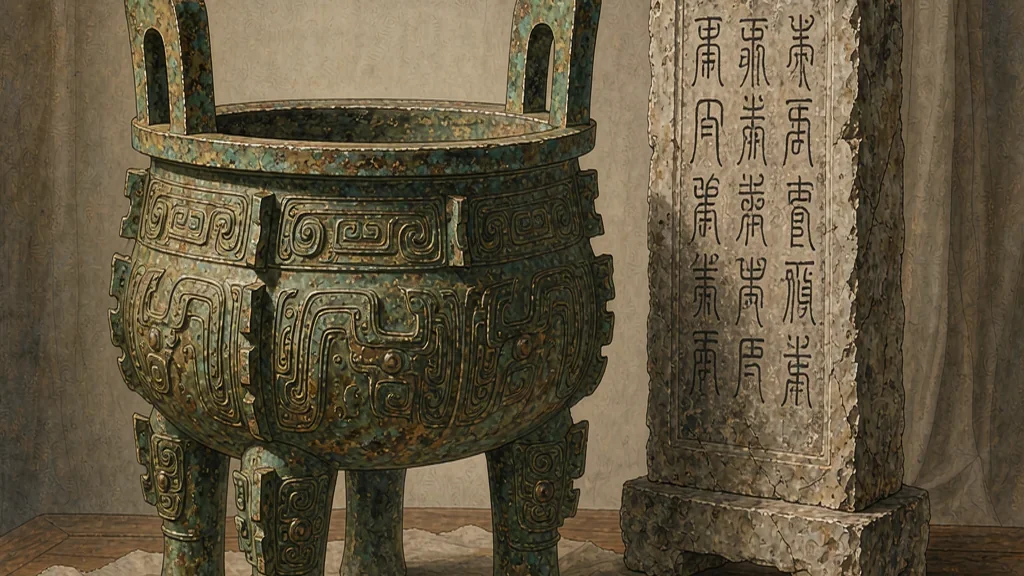
Jinshi calligraphy refers to the current of Chinese brush writing deeply influenced by the study of jin shi, the broad field of "metal and stone" — ancient bronzes, stone inscriptions, seals, and carved artifacts. From the later imperial period, scholars who handled these archaic objects brought their squared, blunt, and monumental qualities into their own writing. This turn toward antiquity reshaped taste, challenged the dominance of elegant literary models, and produced some of the most distinctive calligraphy of the past few centuries.
What Jinshi Means
The phrase jin shi literally pairs metal and stone, the two durable materials on which early Chinese writing was preserved. Study of such objects was itself a respected scholarly discipline, combining epigraphy, history, and connoisseurship.
When calligraphers absorbed the look of these artifacts, their writing changed. They sought the weight and rawness of carved or cast characters rather than the polished ease of court models, valuing substance over surface grace.
Roots in Bronze and Stone Study
Scholars collected rubbings of bronzes and steles, pored over their inscriptions, and tried to date styles. This close looking trained their eyes to admire forms that were old, weathered, and sometimes awkward by later standards.
The discipline blurred the line between researcher and artist. A person might spend mornings cataloging a bronze and evenings writing in a manner plainly borrowed from it, so that learning and creating fed each other.
Seal and Clerical Revivals
Jinshi taste revived the archaic scripts. Seal script, with its balanced curves, and clerical script, with its flat power, became vehicles for an antique sensibility that stood apart from fashionable running-script elegance.
Writers used these older modes to signal learning and seriousness. A couplet in a robust clerical hand could read as a statement of values, not merely a decoration, because the style itself evoked the authority of the past.
The Stele School Connection
Jinshi calligraphy is closely tied to the stele school, which favored learning from stone inscriptions over from literary model letters. Both movements shared a hunger for archaic vigor and a suspicion of over-refinement.
The alliance was practical as well as philosophical. Rubbings of steles were the raw material of metal-and-stone study, so a scholar already handling them naturally adopted their manner. The two streams reinforced one another.
Artists Who Embodied the Style
Several later masters are associated with the jinshi turn. Some began as scholars of ancient inscriptions and only later became known for writing that carried the squared, bony quality of stone cuts.
These figures often excelled in seal and clerical script and in robust regular script. Their prestige helped legitimize a rougher, more structural aesthetic that had once been considered unpolished by court-centered critics.
Seals and Carved Sources
Seal carving and jinshi calligraphy overlapped, since both dealt with the translation of characters into hard, relief surfaces. A writer interested in stone cuts was usually also a seal lover, and the two arts cross-trained the hand.
The squareness of seal characters, designed for carving, left a mark on brush writing too. Jinshi calligraphers welcomed that influence, letting the logic of the chisel inform the logic of the brush.
Aesthetic Values
The jinshi look prizes mass, tension, and an almost architectural balance. Where elegant models chase fluency, this current chases presence, the sense that each stroke is weight-bearing and rooted.
Critics described the ideal in terms of bone and strength rather than mere prettiness. The compliments one wanted were words implying solidity and antique feeling, not surface charm.
Contrast with the Tie Tradition
The tie tradition, based on refined model letters, represented the opposite pole. Jinshi writers did not reject it outright, but they argued that exclusive devotion to gentle models produced weak, imitative hands.
The productive tension between the two currents energized later calligraphy. Many fine writers blended them, taking structure from stone and life from letters, refusing to choose absolutely between antiquity and elegance.
Legacy in Modern Calligraphy
The jinshi spirit survives in much modern writing that values boldness and archaic reference. Contemporary seal and clerical specialists, and artists who mix scripts, owe a clear debt to this turn toward the ancient.
It also broadened what counted as beautiful, teaching viewers to find grace in ruggedness. That lesson remains useful whenever calligraphy risks slipping into mere prettiness, a constant temptation in any long tradition.
Rubbings as the Bridge
The link between jinshi study and brush writing ran through rubbings, the inked impressions taken from carved surfaces. Scholars handled these sheets daily, and their eyes absorbed the squared, weathered look of the stone.
Making and reading rubbings was itself a craft that taught patience and close looking. A good rubbing revealed not just characters but the texture of weathering, and that texture fed the writer's sense of age.
Because rubbings could be shared and copied, a fine stele in a remote place could influence hands across the country. The rubbing was the pipeline that carried antiquity into the study and then onto the paper.
Jinshi and the Antique Market
As interest in ancient metal and stone grew, a lively trade in bronzes, rubbings, and seals developed among scholars and dealers. Owning a fine rubbing or a genuine rubbing of a famous stele signaled both learning and taste.
This market had a scholarly side and a speculative one. Serious researchers used objects to date styles, while collectors competed for prestige, and the two motives often mixed in the same person.
The commerce helped preserve artifacts by giving them value, but it also spawned fakes. Learning to spot a forged bronze or a tampered rubbing became part of the jinshi scholar's practical skill.
Regional Centers of the Movement
The jinshi turn was not uniform but concentrated in certain scholarly regions where antiquarian study was strong. Local academies and collecting families kept the taste alive and passed it to pupils.
In these centers writers met to compare rubbings, debate readings of worn characters, and practice the bony, squared hand together. Such communities gave the style its social base.
When members of these circles rose to office or moved, they carried the manner with them, so what began as a regional habit gradually became a national current in later calligraphy.
❓ Frequently Asked Questions
What is jinshi calligraphy?
It is brush writing shaped by the study of ancient bronzes and stone inscriptions, favoring archaic weight and structure over refined elegance.
How is it connected to the stele school?
Both value learning from stone inscriptions and archaic vigor, and rubbings of steles were the shared raw material of the movement.
Which scripts did jinshi writers favor?
They revived seal script and clerical script, and wrote robust regular script, using older modes to signal learning and seriousness.
How does it differ from the tie tradition?
The tie tradition learns from elegant model letters and prizes fluency, while jinshi seeks the bony, monumental feel of carved origins.
Why did scholars turn to this style?
Handling ancient artifacts trained their eyes to admire aged, substantial forms and to distrust writing they felt was merely decorative.
Is jinshi influence still seen today?
Yes, modern seal and clerical specialists and mixed-script artists owe a clear debt to its preference for bold, archaic reference.