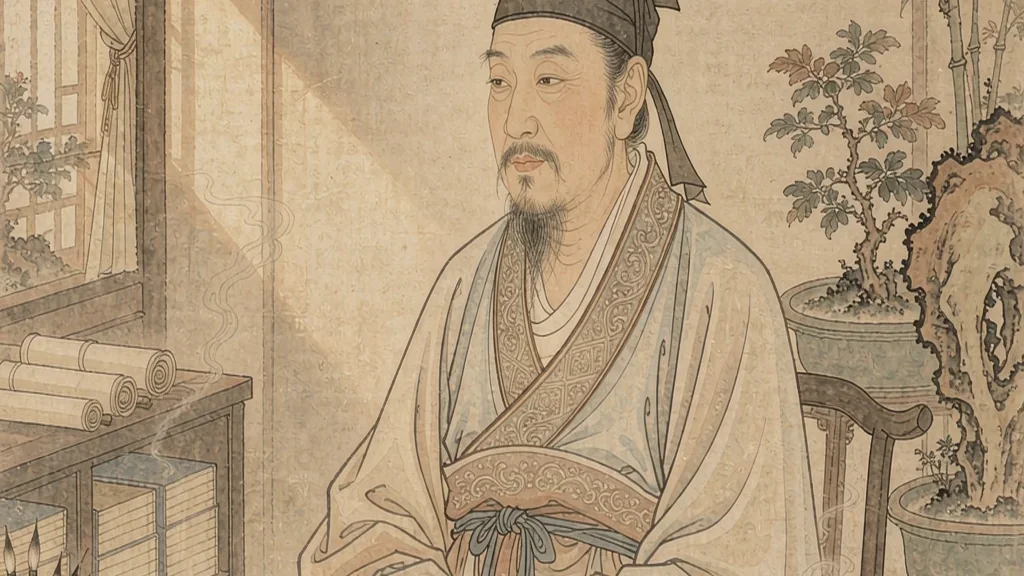
Dong Qichang was a late-Ming dynasty scholar, painter, and calligrapher whose influence on Chinese art theory was extraordinary. As a writer he practiced a refined, literary running script; as a theorist he proposed the famous division between northern and southern modes of painting and writing, and he championed a calligraphy of scholarly ease over blunt force. His ideas shaped taste for centuries, and his own brush work remained a model long after his death.
A Scholar of Many Arts
Dong moved comfortably among writing, painting, and criticism, which was typical of the literati ideal he embodied. He was not a specialist technician but a cultured gentleman whose arts reinforced one another.
His reputation rested as much on his judgments as on his productions. Collectors and students wanted his opinions, and his writings circulated widely, making him a taste-maker for his age and the next.
His Calligraphic Manner
In brush work Dong favored a light, fluent running script with generous open space and a calm, slightly detached tone. His lines avoid heaviness, aiming instead at what might be called a literary breathiness.
He drew on the elegant model-letter tradition rather than on rough stone cuts, and his hand reads as confident without being aggressive. The effect is restrained, even courtly, which suited his self-image as a refined scholar.
The Northern and Southern Division
His best-known theory split painting and, by extension, calligraphy into northern and southern tendencies: one more disciplined and bounded, the other more spontaneous and inspired. The scheme was descriptive more than absolute.
Though scholars debate its historical accuracy, the division was enormously influential because it gave collectors a vocabulary. It organized a confusing field into recognizable temperaments and guided what people sought to own.
Theory of Learning and Transformation
Dong taught that one must first learn from the ancients thoroughly, then transform that learning into something personal. He warned against both shallow novelty and mindless imitation, seeking a middle path.
This balanced doctrine appealed to the literate class, who saw themselves as heirs rather than rebels. It authorized respect for tradition while leaving room for the individual, a comforting and durable formula.
The Literati Ideal
Central to Dong's value system was the idea that a work should carry a scholarly aura, a sense of reading and reflection behind the brush. Technique mattered, but the scent of books mattered more.
This ideal privileged amateurs of high culture over professional artisans. It deepened the long literati claim that true art comes from the person's learning, not merely from trained hand, a claim with both lift and limit.
Calligraphy and Painting as One
Dong held that brush principles unite writing and painting. The same control of line, ink, and rhythm should appear in both, so a calligrapher's training fed his painting and vice versa.
This unity was more than metaphor for him; he practiced it. His paintings show calligraphic strokes, and his calligraphy shows a painter's sense of composition and void, blending the two arts in one sensibility.
Influence on Later Masters
Dong's prestige reached later emperors and the court, notably shaping the taste of Qing rulers who collected and imitated him. His theory became almost orthodox in certain circles for a long time.
Later calligraphers either followed his refined manner or defined themselves against it. Either way he set the terms of debate, which is the surest sign of a theorist who truly mattered.
Criticism and Limits
Not everyone admired him. Some felt his lightness could turn thin, and that his southern preference undervalued vigorous, structural work. Rivals in the stele camp explicitly pushed against the manner he represented.
Modern scholars also note that his northern-southern scheme simplifies a complex history. Yet even his critics grant his intelligence and his role in focusing the tradition's self-understanding.
Dong's Place Today
Today Dong Qichang is studied as both artist and theorist, a rare double status. Exhibitions pair his writing with his painting, and his texts are read by anyone working on Chinese art theory.
His calligraphy rewards patient looking, because its virtues are quiet: spacing, ease, and a refusal of strain. In a tradition given to drama, his restraint remains a distinct and instructive voice.
Dong and the World of Collecting
Dong lived when collecting old masterpieces became a serious pursuit for officials and wealthy families, and his judgments helped set prices and reputations. A work he praised gained standing, while one he ignored could languish, so his pen functioned almost like a market force.
He often borrowed, studied, and annotated pieces in prominent collections, leaving records of what he saw and valued. These notes turned private viewing into public opinion, since others read his remarks to decide what they themselves should esteem.
The network of collectors around him formed a community of taste. Through letters and loans they circulated not only objects but opinions, and Dong sat near the center of that web, shaping what later ages would remember.
His Studio and Written Legacy
Dong wrote extensively, and his studio name became attached to a body of notes, prefaces, and theoretical remarks that outlived his paintings. These texts are where his ideas survive most directly, quoted by later critics as authority.
He used writing to explain his preferences rather than merely to display them. A short remark by him could reframe how a whole lineage was understood, showing that in the literati world the essay was itself a brush of sorts.
Later anthologies gathered his sayings, sometimes loosely, which complicates the scholarly task of telling his exact words from later attributions. Even so, the gathered corpus shows a consistent mind returning to ease, learning, and transformation.
Reception in the Qing Court
After his death Dong's standing rose further under Qing rulers who admired his refined manner and collected his works in quantity. Court painters and calligraphers studied him as a model of scholarly grace.
His northern-southern scheme was taught and debated within official circles, giving a private theory the weight of institutional endorsement. Examinations and academies echoed his preferences for generations.
This court favor also drew pushback, as some later writers felt his dominance crowded out other approaches. The very success that made him canonical also made him a target, a familiar fate for theorists who win too completely.
❓ Frequently Asked Questions
Who was Dong Qichang?
A late-Ming scholar, painter, and calligrapher whose theories of art, especially the northern-southern division, shaped Chinese taste for centuries.
What is his calligraphy like?
Light, fluent running script with generous open space and a calm, refined tone drawn from the elegant model-letter tradition.
What is the northern-southern division?
His scheme splitting arts into disciplined versus spontaneous tendencies, a descriptive vocabulary that guided collectors and critics.
How did he think one should learn?
First master the ancients thoroughly, then transform that learning into something personal, avoiding both shallow novelty and blind imitation.
Why was he controversial?
Some found his lightness too thin, and stele-camp rivals rejected the refined manner he represented in favor of vigor.
How is he viewed today?
As both artist and theorist; his writing and painting are exhibited together and his texts remain core reading in Chinese art theory.