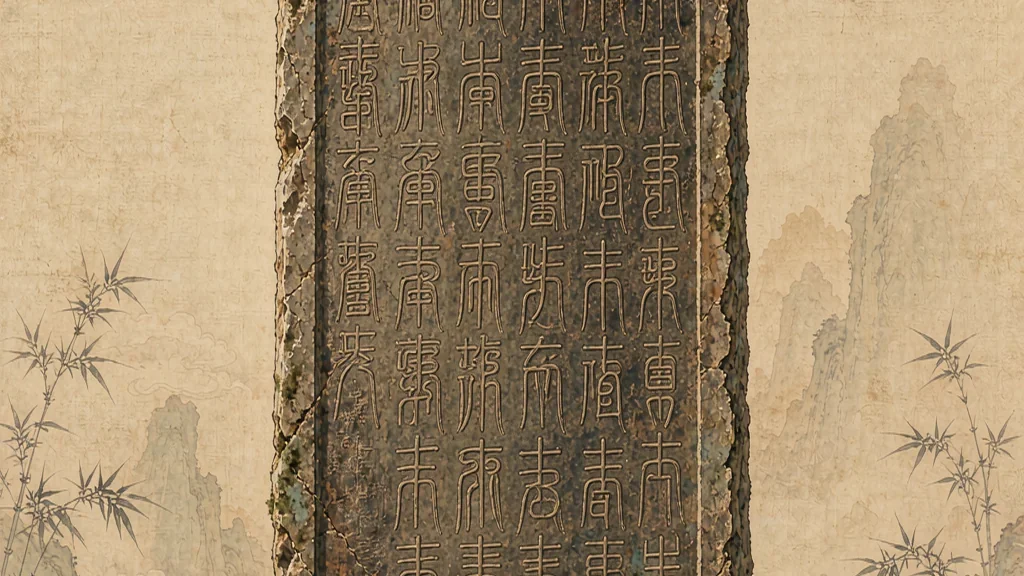
Stele calligraphy (beishu) is the art of Chinese writing as carved into stone monuments, cliff faces, and cave walls. For most of history the only way a great work survived was to be cut into rock and reproduced as rubbings, so the stone inscription became the main vehicle by which calligraphy was taught and remembered. To study stele calligraphy is to study the bones of the tradition: the monumental, public, and enduring face of Chinese writing from the Han through the Tang and beyond.
What Is a Stele?
A stele (bei) is an upright stone slab, usually with a rounded or carved top, bearing an inscription—often a commemorative text, a sutra, or an official edict. The calligraphy was first written on paper, pasted to the stone, and then carved by a specialist cutter who tried to preserve the brush’s qualities in relief or intaglio. The finished stone was set up in a temple, tomb, or cliff for public viewing.
Because stone resists time far better than paper or silk, steles became the archives of calligraphy. A writer whose scrolls rotted could still speak to later centuries through a carved inscription, and the most famous steles were visited, admired, and copied by generations of students.
From Paper to Stone: The Carving Process
The standard method was to write the text in ink on a “trace” paper, attach it face-down to the polished stone, and have a carver cut along the strokes. A skilled cutter could render even the pressure and speed of the brush, though some inevitably flattened or altered the original. In a few cases the calligrapher himself guided the cutting, and in others the carver was the true co-author.
Cliff inscriptions (moya) skipped the slab and were cut directly into mountainsides, often on a huge scale for maximum drama. These required teams of workers and a steady hand, and they remain among the most awe-inspiring calligraphic sights in China, readable from a distance and weathered into the landscape.
Rubbings: The Way Steles Were Read
A rubbing (taben) is made by laying damp paper on the carved stone, pressing it into the incised strokes, and then tapping ink over the surface so the raised parts turn black and the cut lines stay white. The result is a reverse-image copy that can be taken again and again and sent anywhere.
Rubbings were the photocopiers of the pre-modern world. They let a student in a distant province learn from a Tang master’s stele without ever seeing the stone, and they built the shared visual curriculum that unified Chinese calligraphy. Fine early rubbings are now prized collectibles in their own right.
Major Periods of Stele Art
Stele calligraphy begins in the Han, where clerical-script steles such as the “Stele of Cao Quan” set the standard for squared, fluent public writing. The Wei and Northern dynasties produced the robust “Wei steles,” and the Tang crowned the tradition with regular-script monuments by Ouyang Xun, Yan Zhenqing, and Liu Gongquan.
After the Tang, steles continued to be raised, but the center of artistic innovation moved toward ink manuscripts and later toward the revival of old stone styles. Still, every dynasty added to the store of inscriptions, and the total body of Chinese stele writing is effectively a library carved in rock.
Northern Wei Steles and the “Stele School”
The Northern Wei steles are so distinctive that they spawned their own later movement. In the Qing dynasty, scholars weary of the polished Song-Ming manner turned to these northern inscriptions for their raw vigor, founding the “stele school” (beipai) that reshaped calligraphy in the eighteenth and nineteenth centuries.
Stele-school masters such as Deng Shiru and Yi Bingshou consciously imitated the angular, archaic look of northern stone writing, arguing that it was more “true” to the brush than the soft academic hand. This revival shows how a thousand-year-old technology—the carved stone—could still redirect the living art.
Famous Stele Examples
Among the most studied steles are the Han “Cao Quan” and “Zhang Qian” steles in clerical script; the Northern Wei Longmen cave inscriptions; the Tang “Jiucheng Palace” stele by Ouyang Xun; Yan Zhenqing’s “Many Pagoda” stele; and Liu Gongquan’s “Mysterious Tower” stele. Each is a classroom in itself.
These works are studied not only for beauty but as evidence: because they are dated and located, steles help historians trace how scripts changed region by region and decade by decade. A stele is at once artwork, document, and fossil of the written language.
Stele vs. Manuscript (Tie) Tradition
Chinese calligraphy knows two great streams of models: the stele (stone, public, monumental) and the tie (ink manuscripts and letters, private, fluent). The famous phrase “north steles, south manuscripts” captures the old divide, and collectors traditionally valued both for different qualities.
In practice a complete calligrapher studied both: stele for structure and strength, manuscripts for flow and life. Debates over which was superior flared especially in the Qing, but the wisest teachers insisted that the two were complementary, and the greatest masters drew on both.
Preservation and Modern Study
Today many ancient steles are protected in museums and dedicated stele forests, such as the famous forest of steles in Xi’an, where thousands of carved stones are housed. Rubbings are still made, though often under controlled conditions to protect the stone, and high-resolution scans now spread the images worldwide.
For the student, stele calligraphy offers unmatched discipline. Copying from a rubbing trains the eye to see structure in its clearest, most public form, and it connects the learner to a continuous tradition of monument-making that reaches back two thousand years. To write “in the stele manner” is to join that public, enduring conversation.
❓ Frequently Asked Questions
What is stele calligraphy?
It is Chinese writing as carved into stone monuments, cliffs, and cave walls—the monumental, public, and enduring form of the art.
How were steles made?
A calligrapher’s text was written on paper, pasted to a polished stone, and cut by a specialist carver who tried to preserve the brush’s qualities.
What is a rubbing?
A rubbing is made by pressing damp paper into the carved stone and inking it, producing a copy that could be taken repeatedly and sent far away.
Which periods produced great steles?
The Han (clerical script), the Northern Wei (robust steles), and the Tang (regular-script monuments by Ouyang, Yan, and Liu) are the high points.
What was the Qing “stele school”?
It was a revival movement that turned to northern Wei steles for raw vigor, rejecting what it saw as the over-soft academic manner of later ages.
How does stele differ from manuscript tradition?
Stele writing is public and monumental; ink manuscripts are private and fluent. Traditional teachers urged studying both for strength and flow.