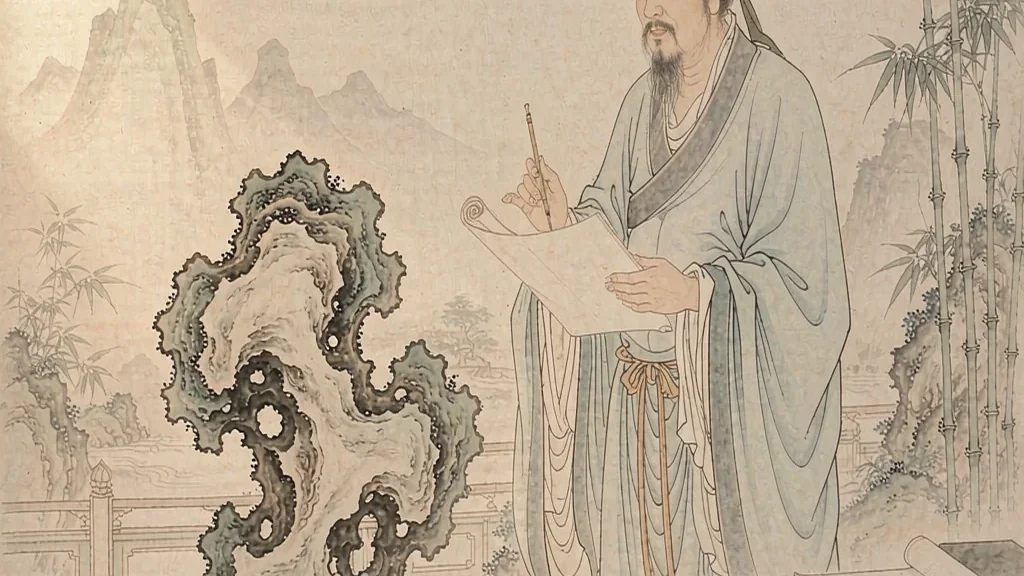
Mi Fu (1051–1107) was a Song dynasty calligrapher, painter, and eccentric whose restless genius made him one of the “Four Masters of the Song” and a perpetual favorite of connoisseurs. Famous for his odd behavior—he worshipped stones, ranted about rivals, and signed himself with a bizarre self-mockery—Mi Fu channeled his energy into running script of extraordinary liveliness. His writings on calligraphy, mixing sharp taste with playful arrogance, remain among the most quoted criticism in the Chinese tradition.
A Life of Eccentricity
Mi Fu was born into a family with ties to the court and received a gentleman’s education, but he is remembered as much for his personality as his art. Contemporaries described him as clean to the point of fussiness, given to archaic dress, and capable of sudden, theatrical gestures. The most famous story has him bowing reverently to an oddly shaped rock and addressing it as a brother, earning him the nickname “Mi the Mad.”
Despite the antics, he held official posts and moved in literary circles, befriending the statesman-artist Su Shi and the poet Huang Tingjian. His eccentricity was not mere clowning; it expressed a Romantic strain in Song literati culture that valued individual spirit over conformity, and Mi Fu became its most colorful embodiment.
The “Four Masters of the Song”
Mi Fu is grouped with Su Shi, Huang Tingjian, and Cai Xiang as the Four Masters of the Song, a designation that honors the four calligraphers who defined the dynasty’s literati style. Where Tang masters prized monument and rule, the Song four prized personal expression, learned reference, and a relaxed, learned hand.
Within this group Mi Fu stood out for technical brilliance and a near-obsessive devotion to the old masters. He copied Wang Xizhi and other Jin models until he could imitate them exactly, then turned that mastery into a freely personal running script. His leadership among the four helped shift calligraphy’s center of gravity from public monument to private self.
Running Script and the “Mi Dot”
Mi Fu’s preferred medium was running script (xingshu), the semi-cursive hand between regular and full cursive. His versions are marked by abrupt speed changes, jagged angles, and a distinctive dot—the “Mi dot”—that he pressed, turned, and released with a flick, giving his pages a nervous, electric life. The effect is witty and restless rather than calm.
He believed a stroke should show the whole body’s motion, and his lines often look as if written in a single held breath. Connoisseurs say his work “shouts and whispers” within a line, and that reading it feels like watching a quick-minded person think aloud. That quality made him a model for anyone who wanted calligraphy with personality.
Mi Fu as a Collector and Critic
Mi Fu was a passionate collector of calligraphy and painting, and a sharp, opinionated critic. His catalogue writings and essays rank famous works, attack forgeries, and state strong preferences—often dismissing Tang regular-script masters as too stiff while praising Jin dynasty freedom. His “History of Calligraphy” and various notes are still read as early examples of serious art criticism.
His judgments mattered because his eye was trained by handling originals. He advocated learning from the best models and warned against careless innovation, yet his own practice was bold. The tension between his conservative taste and his wild hand is part of what makes his criticism so lively and trustworthy.
Calligraphy Theory and “Eight Faces”
Mi Fu taught that the brush should be able to move in “eight faces,” meaning it must respond in every direction without being trapped by a fixed grip or stance. This idea opposed the heavy, centered pressure favored by some Tang masters and encouraged a lighter, more flexible wrist. His advice aimed at freedom within control.
He also stressed the importance of “stele and帖” study—learning from both carved stone inscriptions and ink manuscripts—and he distrusted copies that flattened the living quality of the original. Modern scholars value his theoretical remarks because they come from a working master who had solved the problems he describes.
The “Cloud Mountain” Painter
Besides calligraphy, Mi Fu was a pioneer of a misty, allusive style of landscape later called “Mi dot” or “Mi family clouds and mountains.” Using layered wet dots of ink, he suggested southern mountains wrapped in rain rather than drawing precise contours. This painterly manner influenced literati painting for centuries.
His son Mi Youren continued and systematized the style, and together the two are honored as founders of a poetic, suggestion-based approach to landscape. The link between his calligraphic dots and his painterly dots is often noted: the same flick of the wrist served both arts, and Mi Fu embodies the literati ideal of the versatile gentleman-artist.
Influence and Later Reputation
Mi Fu’s impact on later calligraphy was enormous. Yuan masters such as Zhao Mengfu studied him closely, and Ming and Qing literati returned to his running script whenever they wanted relief from rigid Tang models. His stress on personal voice helped make individual style the measure of a calligrapher’s worth.
In Japan his work was admired by Zen-linked painters and calligraphers who valued spontaneous, eccentric brushwork. Today he appears in every survey of Chinese art as the archetype of the gifted, difficult genius, and his few surviving works are counted among the supreme treasures of Song art.
Why Mi Fu Still Matters
Mi Fu matters because he shows calligraphy as personality made visible. His pages are not calm monuments but conversations—argumentative, witty, and alive. For students he is a warning and an inspiration: a warning that technique without spirit is dead, and an inspiration that disciplined study of the old masters can free, not trap, the hand.
His criticism, his collecting, his painting, and his writing together make him one of the most complete artistic personalities in Chinese history. Few figures bridge the gap between scholar and showman so successfully, and that is why, nine hundred years on, people still tell the story of the man who bowed to a rock.
❓ Frequently Asked Questions
Who was Mi Fu?
He was a Song dynasty calligrapher, painter, and notorious eccentric, counted among the Four Masters of the Song and famed for lively running script.
What is the “Mi dot”?
It is his distinctive way of writing a dot—pressed, turned, and flicked—that gives his work a restless, electric quality.
Why was Mi Fu called “the Mad”?
He behaved theatrically, most famously bowing to a rock and calling it brother, which made him a legend of artistic eccentricity.
What did he contribute to criticism?
He wrote sharp, opinionated rankings of famous works and warned against forgeries, helping establish calligraphy as a subject of serious criticism.
How did he influence painting?
He developed a misty “cloud mountains” landscape built from layered wet dots, a manner continued by his son and later literati painters.
What does “eight faces” mean?
It is his teaching that the brush must respond in every direction, encouraging a flexible wrist over a fixed, heavy grip.