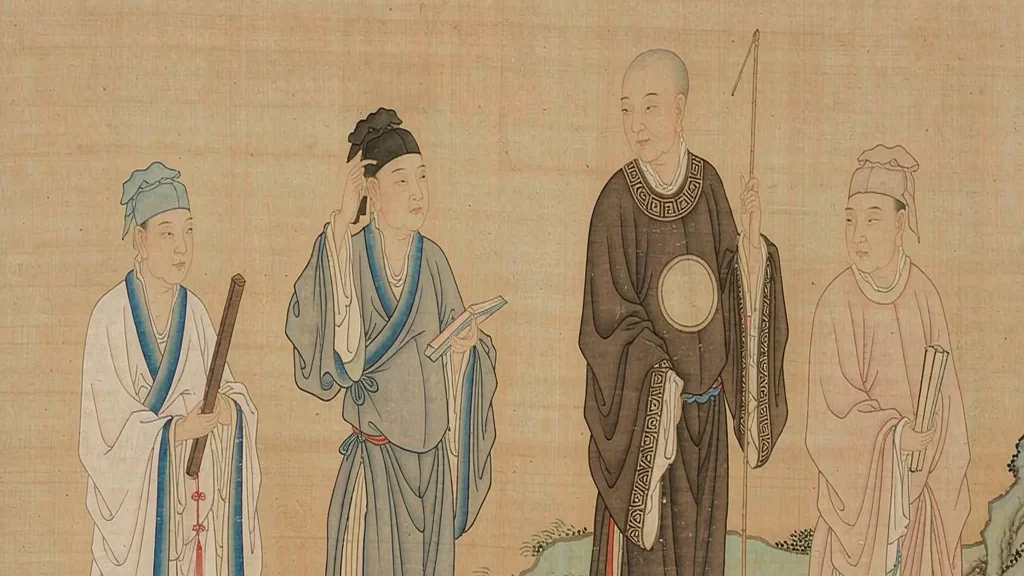
The Song Four Masters are the four calligraphers most celebrated from the Song dynasty: Su Shi, Huang Tingjian, Mi Fu, and Cai Xiang. Living in an era when literati culture flourished, they shifted the center of gravity from faithful imitation toward personal expression, a tendency summed up as the idea of valuing meaning or intent. Their letters, poems, and inscriptions made running script a vehicle for individual voice, and their example shaped Chinese calligraphy for centuries afterward.
Who the Four Were
The group pairs three bold literary personalities with one more conservative craftsman. Su Shi was a poet and statesman; Huang Tingjian his friend and a distinctive stylist; Mi Fu a connoisseur famous for eccentricity; Cai Xiang the senior, known for orderly regularity.
Together they represent a range rather than a single school. The list itself became canonical, taught as a compact introduction to Song-dynasty writing and its departure from the strict models of earlier courts.
The Shift to Personal Expression
Earlier periods had stressed correct structure and faithful copying. The Song masters argued that writing should carry the writer's meaning and temperament, not merely reproduce a model. This was a quiet revolution in what good calligraphy was for.
The result was freer, more varied running-script work, where a letter could be loose, intense, or playful according to mood. Technique remained essential, but it was now a means to a personal end rather than the end itself.
Su Shi and His Circle
Su Shi wrote with a relaxed, slightly flattened hand that matched his plainspoken literary voice. His occasional awkwardness was accepted, even loved, as sincerity rather than fault.
His friendships with Huang Tingjian and others turned calligraphy into conversation. They exchanged writings, teased each other's styles, and through such exchange cemented a community of literati who wrote for one another.
Huang Tingjian's Distinctive Stroke
Huang developed an elongated, vertically stretched manner with dramatic flicks, easy to recognize. His lines can look as if drawn upward by tension, giving his work a taut, questing energy.
He paired calligraphy with intense literary and philosophical study, and his boldness shows confidence that the personal mark matters. Later writers who wanted vigor often looked to him as a source.
Mi Fu the Eccentric Connoisseur
Mi Fu is famous both for brilliant running-script fluency and for an eccentric personality that became legend. As a collector and judge of art, he influenced what was valued, and his writings on connoisseurship mattered.
His brush manner is quick, clean, and full of changes of speed, suggesting a hand that thought as it moved. The liveliness of his work made him a favorite model for those who prized spontaneity.
Cai Xiang and Ordered Regularity
Cai Xiang, the senior figure, is often described as the most traditional of the four, with a steadier, more regular hand. He stands as a bridge between older discipline and the new freedom of his juniors.
His presence in the group reminds us that the Song shift was not a rejection of structure but a rebalancing. Good order was still admired; it was simply no longer the only virtue a work needed.
The "Valuing Meaning" Idea
A slogan of the age held that one should value the intent or meaning behind the writing. This framed calligraphy as an expression of the whole person, continuous with poetry and painting rather than separate from them.
The idea justified risk. If meaning came first, a slightly irregular stroke was acceptable if it served feeling. That permission loosened hands across the tradition and helped merge calligraphy with the broader literati arts.
Letters and Everyday Writing
Much of the four masters' surviving work is letters and notes, not formal pieces. This everyday corpus is precious because it shows the hand at its most natural, the very ground where personality appears.
Because letters were private, they escaped the pressure of public perfection. Later learners treasured them precisely for that candor, copying casual lines as if they were scripture.
Influence on Later Ages
The Song Four Masters became a permanent reference. Yuan and later masters returned to them constantly, and the emphasis on personal voice became a settled part of calligraphic theory.
Even critics who preferred other manners granted the four their place. Their combination of literacy, individuality, and skill set a standard that joined scholarship and art in a way the tradition still honors.
The Social World of the Literati
The four masters belonged to a wider circle of officials, poets, and monks who exchanged writings as a form of friendship. A gift of a handwritten poem could cement an alliance or soothe a rift, so calligraphy was social currency.
Their letters reveal a life of banquets, travels, and scholarly talk in which writing appeared naturally. The art was not performed on stage but woven into daily intercourse among the educated.
This setting explains their relaxed manner. Because the work was often addressed to a known friend, it could be candid and uneven, qualities the circle prized as signs of a real person rather than a polished mask.
Manuscripts and Their Afterlife
After the masters died, their letters and poems were copied, collected, and engraved as models, spreading their hands far beyond their own circles. A single casual note could seed hundreds of later imitations.
Collectors treasured original manuscripts and guarded them as relics of great minds. Loss and forgery were constant risks, and connoisseurs developed sharp eyes to tell the genuine from the made-up.
The printed and carved transmission also smoothed differences among the four, presenting them as a tidy group. Real distinctions remained, but the canon liked a clean list, and the four supplied one.
Calligraphy and Literati Painting
The Song masters practiced painting as well as writing, and they insisted the two shared the same brush logic. A line in ink was a line in ink, whether it formed a character or a branch.
This union deepened the idea that the scholar's hand expressed character across media. A person who wrote well was presumed able to paint well, and the same principles of rhythm and structure applied to both.
Later literati art built directly on this fusion, treating calligraphy as the foundation of painting. The four masters thus stand at the head of a long tradition that refused to separate the written word from the painted image.
❓ Frequently Asked Questions
Who were the Song Four Masters?
They were Su Shi, Huang Tingjian, Mi Fu, and Cai Xiang, the four calligraphers most celebrated from the Song dynasty.
What made them important?
They shifted emphasis from faithful imitation to personal expression, making running script a vehicle for individual voice.
What does "valuing meaning" mean?
It is the idea that calligraphy should carry the writer's intent and temperament, not just reproduce a model correctly.
Why is Mi Fu so well known?
For brilliantly fluent running-script work and a legendary eccentric personality, plus influential writings on connoisseurship.
What kind of works survive from them?
Largely letters and notes, prized because they show the hand at its most natural and candid.
How did they influence later calligraphy?
They became a permanent reference, and their emphasis on personal voice entered settled calligraphic theory for centuries.