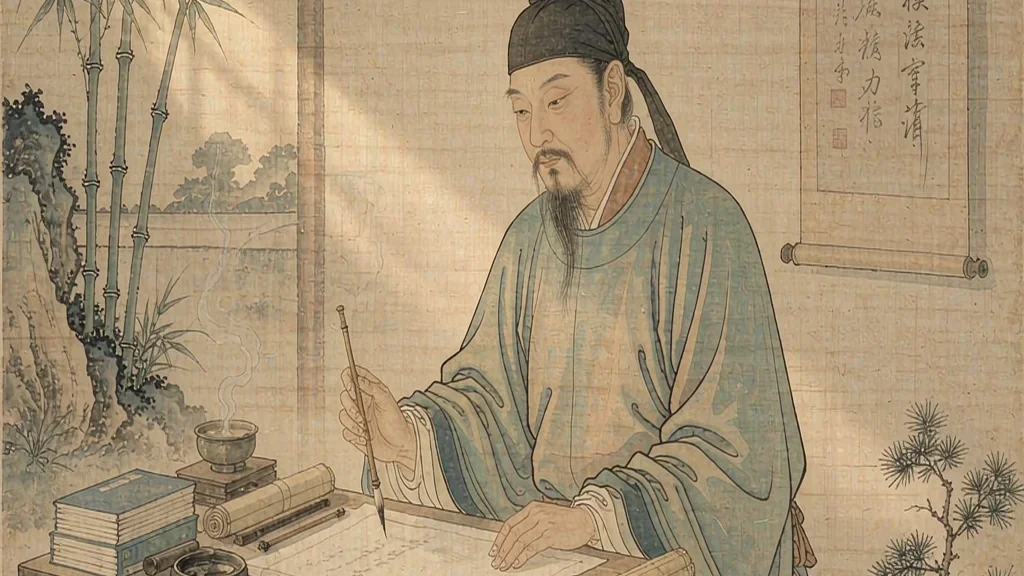
Ouyang Xun (557–641) was a Tang dynasty calligrapher whose regular script became one of the foundational models of the entire tradition. Living through the transition from the Chen and Sui to the Tang, he absorbed both southern elegance and northern strength and produced a style of taut, alert, and beautifully balanced characters. His “Jiucheng Palace” stele is perhaps the single most copied regular-script work in history, and his rules of structure remain teaching texts to this day.
Life Across Three Dynasties
Ouyang Xun was born near the end of the Southern Chen dynasty and lived through the Sui unification and into the early Tang. His long, unsettled life gave him exposure to the calligraphic currents of both the south and the newly reunited north. He served as an official and was admired at the Tang court for his learning as much as his brush.
He was known in life for an unusual appearance and a formidable memory, and he moved in the circle of early Tang literati who set the empire’s cultural tone. By the time of his fame he was already advanced in age, which may explain the settled, authoritative quality of his mature script.
The “Ou Style” of Regular Script
Ouyang Xun’s regular script, the “Ou style,” is famous for precise, suspenseful structure. His characters are tightly organized, with strokes that seem pulled toward a tense center, giving an impression of alertness and control. Connoisseurs describe his manner as “dangerous and rigorous,” meaning it looks almost perilously exact.
This tension comes from his handling of space: he leaves deliberate gaps and sets components at angles that create quiet drama without breaking balance. The result is regular script that is highly legible yet never flat, and it became a favorite for students who wanted to learn discipline and exact proportion above all.
The “Jiucheng Palace” Stele
Ouyang’s supreme monument is the “Stele of the Jiucheng Palace” (Jiuchenggong Liquan Ming), written in his old age and carved to record the repair of a palace and the discovery of a sweet spring. Its characters are the textbook example of his manner: small, dense, and impeccably ordered.
Because it was engraved and widely rubbed, the stele became the most studied regular-script model in East Asia for over a thousand years. Generations of children in China, Korea, and Japan first learned to write by copying its characters, and it remains in print as a copybook today. Few single objects have taught so many people to write.
Synthesis of North and South
Ouyang Xun stands at the reunion of the Northern and Southern traditions. His training carried southern fluency, but the Sui-Tang moment pushed him toward northern monumentality, and he fused the two into a personal synthesis. Later historians point to him as the calligrapher who first gave Tang regular script its classical authority.
This synthesis is why his style feels complete: it has the south’s refinement and the north’s strength, resolved into calm order. The Tang ideal of a single standard script reaches an early peak in his hand, and the masters who followed—Yan, Liu, Zhao—all built on the ground he helped prepare.
“Thirty-Six Strokes” and Structure Rules
Tradition attributes to Ouyang Xun a set of structural principles, often called the “Thirty-Six Strokes” or “Thirty-Six Methods,” that teach how to place components for balance and life. Whether or not he wrote them, the rules became a standard framework for analyzing character structure.
These methods discuss things like distributing space evenly, letting a component “look back” at another, and avoiding crowding—concrete advice that turns abstract taste into teachable rules. They show the Tang drive to codify calligraphy as a learnable discipline, and they are still quoted in manuals.
His Son and the Family Tradition
Ouyang Xun’s son, Ouyang Tong, also became a noted regular-script calligrapher who imitated and extended his father’s manner, though with a sharper, more deliberate edge. The father-son pair is sometimes mentioned together as evidence that the Ou style was a true school, passed within a family.
Ouyang Tong’s surviving stele works let us see how a closely trained follower varied the model while staying within it. Their example illustrates how Tang calligraphy was transmitted: not only through rubbings but through lineages of teachers and sons who carried a manner forward.
Standing Among the Tang Masters
Ouyang Xun is counted among the early Tang “four great masters” of regular script alongside Yu Shinan, Chu Suiliang, and Xue Ji. Of these, his manner is the most austere and structural, making him the natural first teacher for students before they attempt the fuller styles of Yan or the lean manner of Liu.
His reputation has never seriously declined. From the Tang onward, emperors collected his works and officials emulated his hand. The sheer number of rubbings taken from his steles across the centuries is itself proof of his unmatched role in basic instruction.
Influence Across East Asia
Ouyang Xun’s reach extended well beyond China. In Korea and Japan, where Chinese writing was adopted by the educated classes, his steles were among the models transmitted by envoys and monks. Japanese calligraphy of the early periods shows clear Ou-style discipline, and Korean neo-Confucian scholars prized his exactness.
The reason is practical: his style is the most teachable of the great manners because its logic is visible on the page. A learner who masters Ouyang Xun has learned the grammar of regular script and can move on to freer or fuller styles with confidence.
Why Ouyang Xun Matters
Ouyang Xun matters because he gave Chinese calligraphy its first fully codified regular script and a teaching method to match. His “Jiucheng Palace” stele is less a single artwork than a shared foundation on which countless writers built their hands, and his structural rules turned taste into instruction.
For any student of the brush, he is the natural starting point: demanding but clear, ancient but endlessly reprinted. To copy Ouyang Xun is to join a line of learners stretching back fourteen hundred years, all bending over the same dense, alert characters.
❓ Frequently Asked Questions
Who was Ouyang Xun?
He was a Tang dynasty calligrapher who lived through three dynasties and created a foundational, highly disciplined regular script known as the “Ou style.”
What is the “Jiucheng Palace” stele?
It is his late-life masterpiece recording a palace repair and a sweet spring; engraved and widely rubbed, it became the most studied regular-script model in East Asia.
What makes his style distinctive?
His characters are tightly structured with suspenseful tension and deliberate spacing, giving an impression of alertness and exact control.
What are the “Thirty-Six Methods”?
They are attributed structural rules teaching how to place components for balance and life, turning calligraphic taste into teachable instruction.
How did he unite north and south?
He combined southern fluency with northern monumentality during the Sui-Tang reunion, giving Tang regular script its early classical authority.
Why is he good for beginners?
His style’s logic is visible on the page, making it the most teachable of the great manners and a natural first model before freer styles.