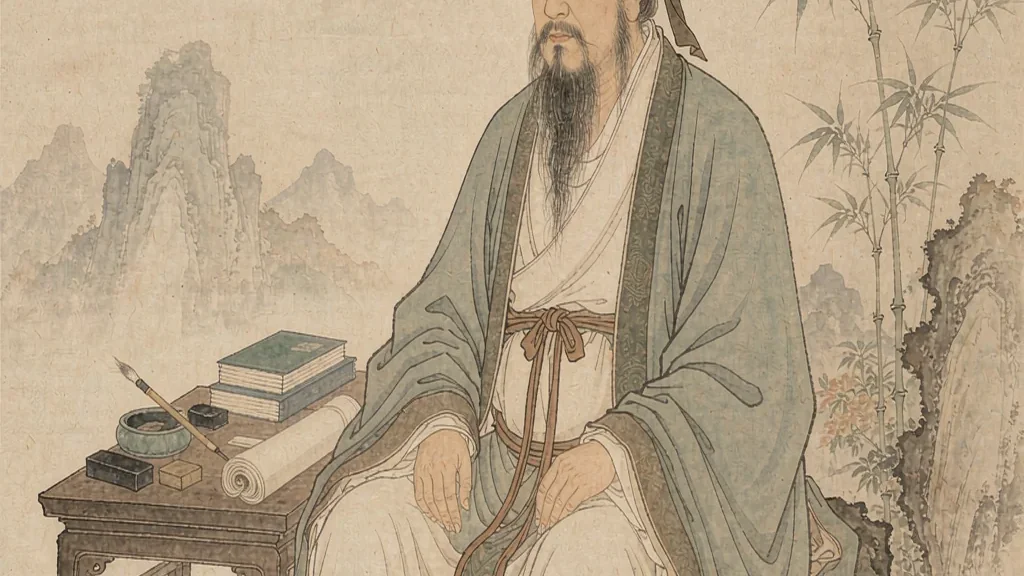
Yan Zhenqing (颜真卿, 709–785) was a Tang-dynasty statesman, loyal general, and one of the most influential calligraphers in Chinese history. He is revered above all for his regular script (kaishu), which broke from the slender elegance of earlier models to create a bold, full, and monumentally balanced style that later generations adopted as a standard for learning. His life was as dramatic as his art: he died a martyr defending the Tang court. This article surveys his career, his calligraphic innovations, and his lasting place in the canon.
A Life of Service and Loyalty
Yan Zhenqing came from a family of officials and rose through the examination system to high office. He is remembered as a man of integrity who opposed treason and corruption even at personal risk. During the An Lushan rebellion he organized local resistance and suffered the loss of family members killed in the fighting.
His death was itself an act of principle: in his seventies he was sent on a mission to persuade a rebellious warlord and was murdered for refusing to submit. Later rulers honored him as a model of loyalty, which added a moral halo to his artistic fame.
The Yan Style of Regular Script
Before Yan, regular script was often associated with the refined, slightly narrow manner of the early Tang masters such as Ou Yangxun. Yan developed a contrasting look: characters built on thick, straight strokes with a broad, square structure and generous internal space. The effect is weighty, calm, and public — suited to steles and inscriptions.
His manner is sometimes described as "muscular," with a strong central axis and strokes that seem to carry architectural force. Where earlier elegance aimed at grace, the Yan style aimed at dignity and presence.
Key Works
Among his best-known pieces is the stele inscription Duobao Pagoda (多宝塔碑), an early work showing a tighter, more disciplined hand, often used by beginners because of its clarity. Later works display the fuller, freer Yan manner that became his signature.
Another famous piece, the Memorial for a Nephew (祭侄文稿), is a running-script draft written in grief after his nephew died in battle. Though informal and splashed with corrections, it is treasured as a raw record of feeling and is ranked among the greatest running-script works.
Contrast with Wang Xizhi
The history of Chinese calligraphy is often told as a dialogue between the "Wang" lineage of elegant, flowing models and the "Yan" alternative of solemn, structured power. Where Wang Xizhi represents spontaneous grace, Yan Zhenqing represents moral weight made visible in strokes.
This contrast is not a rivalry of quality but of temperament. Later students typically learn both: Wang-derived models for fluidity, Yan models for structure and seriousness. Together they bracket the expressive range of the art.
Influence on Later Calligraphers
The Yan style became a foundation for regular-script learning for more than a thousand years. Song-dynasty scholars such as Su Shi admired him, and the "regular-script masters" of later eras routinely trained on Yan steles. His influence even reached Japan, where similar monumental styles took root.
Because his characters are clear and well-proportioned, they suited printing and teaching, which helped spread his forms widely. Many standard character shapes today still echo Yan's structural logic.
Yan and Liu: The "Yan-Liu" Pair
Calligraphy lore often pairs Yan Zhenqing with Liu Gongquan, another Tang master of regular script, as "Yan's muscles, Liu's bones" (颜筋柳骨). Yan's strokes feel fleshy and substantial; Liu's are tighter and more angular. Studying both gives a writer both mass and tension.
This pairing became a teaching shorthand: learn Yan for body and warmth, learn Liu for precision and edge. The two Tang masters thus jointly defined the regular-script curriculum that survived into modern times.
Why He Matters Today
Yan Zhenqing matters because he showed that calligraphy could carry character — that a public, upright hand could express integrity as surely as a private, lyrical one. His combination of statesmanship and art made him a cultural ideal: the scholar who writes as he lives.
For today's learners, his steles remain among the first serious models of regular script, a doorway into disciplined, confident brushwork. His story also reminds viewers that behind a calm line of characters may stand a life of conviction.
Yan Zhenqing in Popular Memory
Long after his death, Yan Zhenqing remained a cultural hero as much as an artistic one. Later dynasties promoted his loyalty as a model for officials, and local shrines kept his memory alive. His calligraphy was taught not only for its beauty but as a moral lesson: the steady, upright stroke was read as the outer sign of an upright man who would not bend.
In modern times his works are studied in schools and exhibited in museums, and his name is among the first that Chinese learners meet when they begin regular script. The rare combination of political courage and artistic greatness has made him a lasting ideal of the scholar who serves both brush and state with the same unwavering integrity.
Yan Style in Regular-Script Learning
Teachers often point beginners toward Yan Zhenqing because his characters are clearly built and generously spaced, making the underlying structure easy to see and copy. Where a more mannered style can hide faults, the Yan manner shows every wobble, so the student gets honest feedback from the page and learns discipline early.
The available Yan steles also form a natural progression. A learner may start with the tidy Duobao Pagilion stele to fix proportions, then move to his mature, heavier works to gain body and confidence. This graded path is one reason his name sits at the front of so many regular-script curricula, from old academies to modern weekend classes.
❓ Frequently Asked Questions
Who was Yan Zhenqing?
He was a Tang-dynasty official and calligrapher, famous for his monumental regular script and honored for his loyalty.
What is the Yan style?
It is a bold, full, square form of regular script with thick strokes and generous space, projecting dignity and weight.
What is his most famous work?
The Duobao Pagoda stele is a key regular-script model; the Memorial for a Nephew is his greatest running-script piece.
How does he compare to Wang Xizhi?
Wang stands for graceful flow; Yan for solemn structure. Students learn both to gain the full expressive range.
Who was Liu Gongquan?
A Tang contemporary paired with Yan as "Yan's muscles, Liu's bones," known for tighter, bonier strokes.
Why study Yan today?
His clear, well-built characters are ideal first models of regular script and show how brushwork can express character.