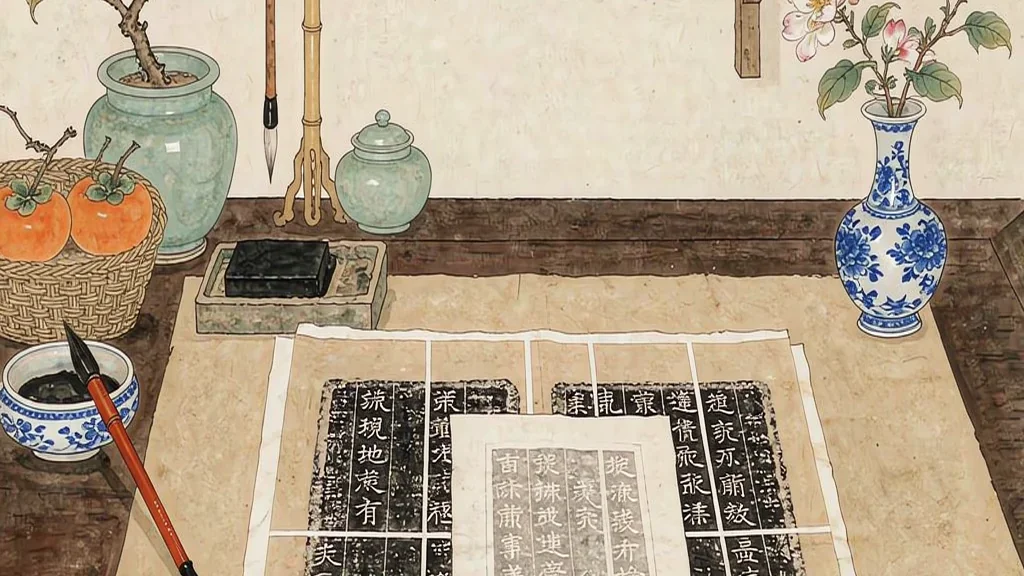
In Chinese calligraphy the word tie refers to model letters and transcribed writings, especially those of revered masters, that were carved into wood or stone and then reproduced as guides for learners. Distinct from monumental steles, tie were usually intimate works: letters, poems, and notes in running or cursive script. The tie tradition shaped how generations practiced the living, spontaneous side of brush writing, and the rivalry between stele study and tie study became one of the great debates in later calligraphy.
The Meaning of Tie
The term originally meant a tablet or a posted notice, but in calligraphy it came to mean a master's writing preserved as a model. A tie might be a short letter, a colophon, or a copied passage, valued precisely because it showed the hand at its most natural and personal.
Unlike the formal, public tone of many stone inscriptions, tie preserve the everyday voice of great writers. Scholars treasured them not only for style but for the glimpse they offered of a master's mind and friendships, which is why so many carried added notes by later collectors.
From Ink Trace to Carved Model
Because original ink writings were fragile, the safest way to share them was to carve the characters into wood or stone and then make rubbings. The carving aimed to capture the original brush feeling, though a skilled or careless cutter could soften or sharpen the lines.
This step from living ink to carved relief meant that a tie was already one remove from the master's hand. Connoisseurs therefore distinguished true ink-trace copies from carved versions, and the best collections tried to include both for comparison.
The Great Model Collections
Imperial workshops assembled large compiled tie sets, gathering the works of many masters into numbered volumes. These compilations became the standard references for court and academy alike, spreading a canon of models across the empire.
Such collections were expensive and prestige-laden, often produced for the emperor or high officials. Owning or even borrowing a complete set was a mark of serious standing, and scholars traveled long distances to study a famous compilation held by a collector.
Tie and the Running Script
Most tie are in running script or cursive script, the freer modes where personality shows most. A letter written in haste could become a cherished model, because its spontaneity was exactly what students wanted to absorb.
This gave tie study a different feel from stele study. Where steles taught structure and monumentality, tie taught flow, connection, and the rhythmic linking of strokes. A balanced education drew on both.
The Tie School versus the Stele School
From the later imperial period onward, a clear divide opened between those who learned mainly from tie and those who learned mainly from steles. The tie school prized elegance, literary grace, and the classical masters of the past; the stele school turned to blunt, archaic stone cuts for vigor.
The debate was partly about taste and partly about access, since different regions had different monuments available. It also reflected a broader question of whether calligraphy should aim at refinement or at raw expressive power.
Famous Masters in the Tie Canon
The tie corpus is dominated by a handful of names whose letters and poems became perpetual models. Wang Xizhi of the early period is the supreme figure, his casual notes elevated to objects of devotion by later emperors and collectors.
In later eras, Song dynasty literati and Yuan masters extended the tie tradition, each adding writings that were themselves copied and recopied. The result is a chain of models in which each generation both inherited and reinterpreted the last.
Copying and Personal Variation
Studying tie was never meant to produce clones. The ideal was to absorb a master's principles, then find one's own voice. Teachers warned that imitating too closely produced lifeless writing, while ignoring models entirely led to chaos.
Advanced students therefore copied a tie faithfully for a time, then deliberately broke from it, seeking the balance between discipline and freedom that defines mature brush work.
Tie in the Modern Collection
Today the great carved tie survive as both study tools and cultural treasures. Facsimile editions and photographic reproductions have made them widely available, so a learner no longer needs access to a rare rubbing to study a master's letter.
Yet the originals still command reverence. A genuine early impression of a famous tie, with its crisp lines and old paper, remains a prize for museums and private collectors, a direct link to the hands that wrote China's literary history.
The Craft of Carving a Tie
Turning an ink original into a carved tie was skilled work, demanding that the cutter read brush feeling and translate it into relief without killing it. A good cutter was part artist.
Carvers faced choices at every stroke: how deep, how round, where to let the knife follow the hair. Their decisions shaped what millions of later students would copy.
Poor carving flattened the life out of a masterpiece, which is why collectors prized early, careful impressions. The tie is thus a collaboration between writer and cutter, and the second hand is never invisible.
Tie and the Book Trade
Carved tie were printed and sold, making them among the first reproducible calligraphy teaching aids. A rubbing from a woodblock brought a master's letter into any study that could afford it.
Publishers competed with finer blocks and fuller collections, and the trade spread models faster than hand copying ever could. The tie was both art and commodity.
This commerce democratized learning, letting modest households study the same hands as the elite. It also standardized taste, since the available blocks decided what most people practiced.
Studying Tie in Practice
A serious learner works through a tie slowly, first tracing its flow, then copying it from memory until the rhythm enters the hand. The goal is not likeness but understanding.
Teachers pair one tie with others so the student hears a range of voices rather than mimicking one. Variety prevents the deadening imitation the tradition warned against.
Over time the models dissolve into method, and the student writes freely with the masters behind the shoulder. That quiet inheritance is the real product of tie study.
❓ Frequently Asked Questions
What is a tie in calligraphy?
It is a master's writing, usually a letter or poem, preserved as a model, often by carving it and making rubbings for students to copy.
How does tie differ from a stele?
Tie are usually intimate, freely written works in running or cursive script, while steles are formal public monuments with a more structured, monumental tone.
Why were tie carved and rubbed?
Because original ink writings were fragile and rare, carving and rubbing let many students share a single master model across distance and time.
Who is the central figure of the tie tradition?
Wang Xizhi, whose casual notes were elevated into canonical models by later emperors and collectors.
What was the tie versus stele debate?
It was a later dispute over whether to learn from elegant literary models or from blunt archaic stone cuts, reflecting different ideas of good writing.
Are tie still used for learning today?
Yes, both as reproduced study models and as treasured originals in museums and collections.