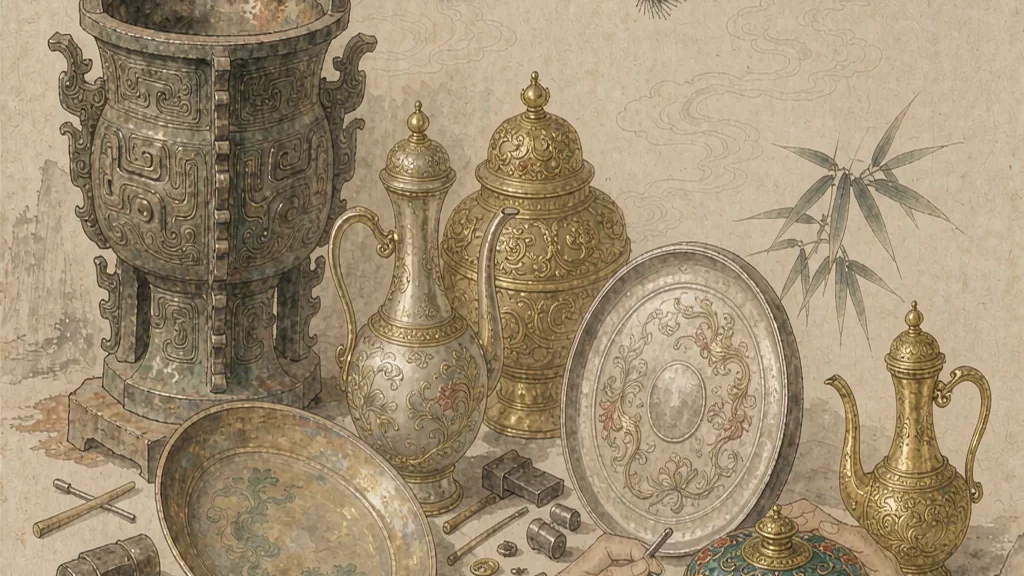
Jīnshǔ gōngyì (金属工艺), metalwork, spans forging, casting, filigree, and repoussé across bronze, gold, silver, and iron.
The Bronze Age Legacy
Chinese bronze casting reached its peak during the Shang and Zhou dynasties. The ritual vessels — ding tripods, zun wine vessels, and bell sets — were cast using sectional piece-mold techniques.
Gold and Silver Work
Chinese goldsmiths developed sophisticated techniques including hammering (repoussé), filigree (fine wire work), and granulation. Tang dynasty gold and silver work shows influence from Sasanian Persia.
The Lost-Wax Method
The lost-wax (cire perdue) casting method was used for complex bronze and metal pieces. A wax model is coated in clay, heated to melt the wax, and molten metal is poured into the cavity.
Inlay Techniques
Chinese metalworkers inlay gold, silver, and precious stones into bronze and iron bases. The cuo jin (错金) technique inlays gold into bronze.
Regional Centers
Beijing is famous for cloisonné. Guangdong excels at silver filigree. Yunnan works with copper.
Modern Metalwork
Traditional metalwork techniques continue in workshops across China.
The Artistic Process and Techniques
The creation of this craft requires years of dedicated practice and mastery of specialized techniques. Artisans begin by carefully selecting raw materials, considering factors like texture, color, and quality. The process involves multiple steps, each requiring precision and patience.
Traditional techniques have been passed down through generations of master craftsmen. While modern tools have been adopted in some steps, the core artistic methods remain unchanged. The finest pieces can take weeks or even months to complete.
Each artisan develops their own style while staying true to traditional forms. This balance between innovation and tradition keeps the craft alive and relevant in the modern world.
Preservation and Modern Revival
In recent years, there has been a renewed interest in traditional Chinese crafts. The government has recognized many crafts as Intangible Cultural Heritage, providing support for training programs and cultural exhibitions. Young people are increasingly drawn to these ancient arts.
Museums and cultural centers across China now feature dedicated galleries for this craft. International exhibitions have introduced these traditional arts to global audiences, creating new markets and appreciation for Chinese craftsmanship.
Master artisans have opened workshops to train the next generation, ensuring that these ancient skills are not lost to modernization. The fusion of traditional techniques with contemporary design has opened exciting new possibilities.
Historical Development
The history of this topic spans thousands of years of Chinese civilization. Early records from ancient texts provide glimpses into its origins. Over successive dynasties the subject evolved significantly absorbing influences from different regions.
During the Tang and Song dynasties this field experienced a golden age. Scholars and practitioners refined techniques established standards and created works that influenced generations. The imperial court often patronized this art elevating its status.
The Ming and Qing dynasties saw further refinement. Increased trade brought new ideas from beyond Asia. This cross-cultural fertilization enriched the tradition while maintaining its Chinese character.
In the modern era efforts have been made to preserve traditional practices. The government has designated many related crafts as Intangible Cultural Heritage ensuring their survival.
Regional Variations
Different regions of China have developed their own distinctive styles. Northern styles emphasize bold forms and practicality reflecting harsh climates. Southern styles are more refined and decorative.
Eastern coastal regions developed interpretations influenced by maritime trade with Japan and Korea. Western regions with diverse ethnic populations incorporated elements from minority traditions.
Central China as the historical heartland represents the most classical forms. Many standard techniques were established here and spread to other regions.
Modern Applications
Today this tradition continues to evolve. Contemporary practitioners experiment with modern materials while respecting traditional forms. This creative tension between innovation and tradition drives the field forward.
International interest in Chinese culture has created global markets. Exhibitions and workshops have introduced these traditions to worldwide audiences fostering cross-cultural appreciation.
Educational institutions offer programs training the next generation. These combine traditional apprenticeship with modern approaches ensuring effective knowledge transmission.
Cultural Significance
This subject embodies core Chinese values. Its symbolism draws from Confucian ethics Daoist cosmology and Buddhist spirituality creating layers of meaning that reward deeper study.
Materials colors and forms all carry specific meanings. Motifs represent longevity prosperity happiness or spiritual protection. These choices reflect deliberate artistic and cultural decisions.
Rituals and ceremonies associated with this subject connect practitioners to centuries of tradition serving as living links to the past.
Materials and Tools
This craft requires specific materials carefully selected for properties. Traditional artisans developed deep knowledge of how sources seasons and preparation methods affect the final product.
Tools have been refined over centuries each serving a specific purpose. Mastering their use requires years of practice. Many tools are handmade by artisans adapted to personal techniques.
Traditional materials are increasingly difficult to source. Some crafts have adapted with sustainable alternatives while others maintain strict traditional standards.
Master-Disciple Transmission
The traditional method of learning was through apprenticeship with a master. Students began with basic tasks and gradually learned advanced techniques as they proved dedication. This relationship often lasted many years.
Masters imparted techniques aesthetic sensibilities work ethics and cultural values. Transmission was holistic encompassing both technical skills and philosophical understanding.
Modern training models include vocational schools and university programs. However the master-disciple relationship remains valued for its depth and personal guidance.
❓ Frequently Asked Questions
📝 Chinese Vocabulary
金工 — : Metalwork; the craft of working with metals.
青铜 — : Bronze; the dominant metal of early Chinese civilization.
失蜡法 — : Lost-wax casting; a precision metal casting method.
鎏金 — : Gilding; the technique of applying gold to metal surfaces.
错金 — : Gold inlay; engraving fine lines in bronze or iron and hammering gold wire into them.
捶揲 — : Hammering or repoussé; shaping sheet metal by striking it from behind to raise a relief.
累丝 — : Gold filigree; twisting fine metal wires into openwork jewelry and ornaments.
錾刻 — : Chasing or engraving; cutting surface patterns into metal with a graver.
🎉 Fun Facts
- The earliest Chinese bronze vessels were cast using sectional piece molds — no other ancient civilization used this method.
- A single Shang dynasty bronze ding could weigh over 800 kilograms and required a team of dozens of workers to cast.
- Chinese gold filigree from the Tang dynasty is so fine that modern jewelers struggle to replicate it.
- The lost-wax method let Chinese founders cast hollow, intricate statues, including the celebrated gilt-bronze Buddhist figures of the Tang and Ming periods.
- Gold granulation on Chinese jewelry uses spheres no larger than a grain of sand, fused without visible solder for a speckled, jewel-like surface.
- The Tang Famen Temple hoard, sealed in 874 CE, preserved exquisitely repoussé gold and silver vessels that had been hidden for a thousand years.