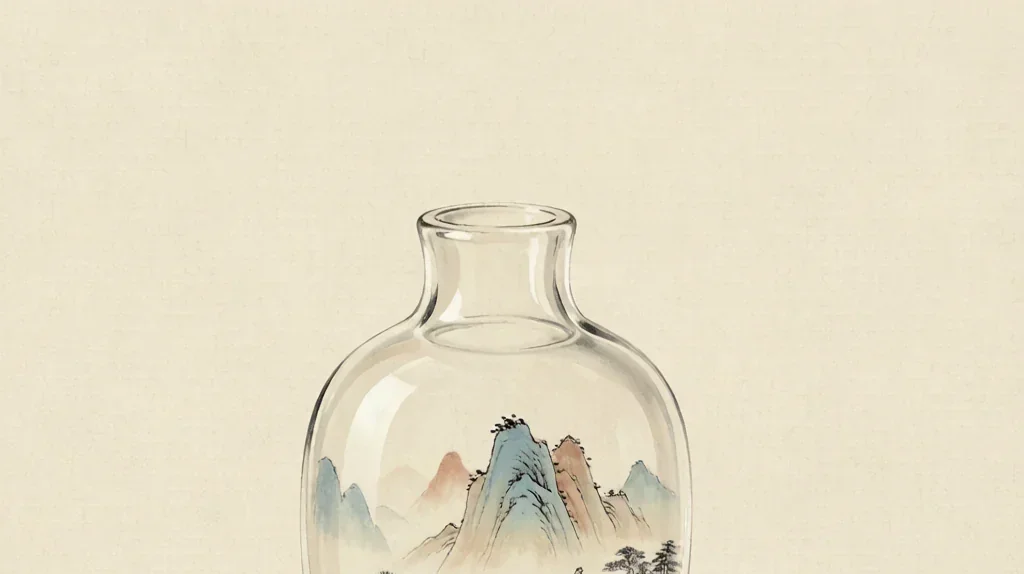
The snuff bottle (鼻烟壶, bí yān hú) is a small vessel, typically palm-sized, made to hold powdered tobacco (snuff) that was inhaled rather than smoked. Introduced to China from the West in the seventeenth century, snuff-taking was taken up at the Qing court and among the elite, and the humble container was transformed into one of the most exquisite miniature art forms in Chinese craft. Snuff bottles were carved, painted, inlaid, and enameled in a remarkable range of materials, and they became prized gifts, collectibles, and vehicles for virtuoso decoration. What began as a practical pocket flask thus became a stage for almost every decorative technique China possessed, and the bottle's tiny scale forced makers to a concentration of skill that larger objects never demanded. The result is a craft where the whole history of Chinese ornament — from jade to enamel, from landscape painting to calligraphy — is compressed into a object one can close in a fist, which is why collectors have long treated the snuff bottle as a pocket museum of the imperial arts.
Origins and the Arrival of Snuff
Snuff — finely ground tobacco mixed with aromatics — reached China via European contact in the late Ming and early Qing period. The Qing court, especially under emperors who enjoyed it, turned snuff-taking into a refined social ritual, and the habit spread from the palace outward through the ranks of officials.
Europeans carried snuff in box-like containers, but Chinese artisans adapted the idea into a narrow-necked bottle suited to keeping the moist powder and to being carried in a sleeve or pocket. The bottle shape was a Chinese solution to a foreign custom, and it proved far better suited to the powder than the Western box.
The sleeve pocket mattered. Qing dress lacked the deep pockets of European coats, so a small bottle that rode in the sleeve was practical, and the form answered a real need of dress as much as of taste, which helped the bottle spread beyond the court into everyday gentry life.
The Qing Court and Imperial Workshops
Qing emperors, notably Kangxi, Yongzheng, and Qianlong, patronized snuff-bottle making through the imperial workshops, encouraging technical experiment. The palace produced bottles in glass, enamel, and jade for the court and as diplomatic gifts, and the imperial mark became a guarantee of quality.
Because the bottles were small and personal, they invited astonishing detail, and court taste favored both opulent materials and witty, scholarly imagery. A bottle could carry a landscape on the inside and a poem on the outside, so the object was at once a toy, a painting, and a book.
The diplomatic role was significant. Bottles were given to envoys and officials as marks of favor, and the recipient's rank could be read in the material, so the bottle was also a token of the state's grace, carried home across Asia and Europe as a small embassy of Chinese taste.
Materials and Forms
Snuff bottles were made in glass, various jades and hardstones, ivory, lacquer, metal, porcelain, and organic materials like coconut shell. The standard shape has a flat or rounded body, a short neck, and a tiny mouth, and the variety of bodies is the first thing a collector learns to read.
A stopper of coral, jade, or metal usually caps the bottle and holds a small spoon — often of ivory or bone — attached beneath to lift the snuff. This spoon is a defining functional detail, and its presence or absence, and its material, tell the viewer something about the bottle's making and date.
The range of materials is the craft's encyclopedia. A single imperial collection might hold a bottle of translucent glass painted within, one of mottled agate, one of carved cinnabar lacquer, and one of painted enamel, each demonstrating a different workshop and a different idea of beauty in the same small form.
Inside-Painted Bottles
The most famous type is the nèi huà bottle, painted on the interior of clear or frosted glass or crystal. The artist reverses the image, working through the narrow neck with a bent brush, so the finished picture reads correctly from outside, and the reversal is the maker's supreme test.
Inside painting demands steady hands and planning, since corrections are impossible on glass. Centers such as Beijing, Shandong, and Guangdong developed distinctive schools of inside painting, each with its own preferred subjects and its own way of handling the reversed brush.
The subject matter of inside painting is remarkable for its ambition. A single bottle might carry a whole landscape with pavilions, figures, and inscription, or a set of bottles might illustrate a sequence of poems, so the miniature medium became a vehicle for the full repertoire of Chinese painting, shrunk to the palm.
Carved and Relief Bottles
Beyond painting, bottles were carved from a single piece of jade, agate, or rock crystal, sometimes exploiting the stone's natural colors to suggest a landscape. Layered agate could be carved so a brown skin framed a pale "scene," and the carver's eye for the stone's gifts was as important as the hand.
Other relief techniques included carved cinnabar lacquer and molded porcelain, each allowing dense, tactile decoration on the tiny surface. The relief bottle invites the thumb as much as the eye, because the carving can be felt, and the object is thus both seen and held in a way a flat painting is not.
The single-stone bottle is the carver's challenge. Cutting a hollow vessel from a solid, flawed stone without breaking it requires judgement of the material's hidden faults, and the best carvers could "read" a stone and plan the hollow so the natural color did the decorative work, a skill close to that of the jade carver.
Enamel and Painted Enamel
Qing workshops produced cloisonné and painted-enamel (falang) bottles with brilliant, durable color, often on metal or glass. Painted enamel from the palace is among the most collectible and technically demanding, because the enamel must be fired without cracking the thin ground.
These bottles display the same famille-rose and court patterns found on larger porcelain, miniaturized with great precision. The miniaturization is not mere copying; it is a rethinking of the design for a curved, tiny field, and the best enamel bottles feel composed for the bottle rather than shrunk from a plate.
Cloisonné bottles, with their wired cells of color, show the metalworker's hand, while painted enamel shows the painter's. The two enamel traditions thus bring different crafts into the same small object, and a collector can trace the whole imperial enamel workshop through its bottles alone.
Imagery and Symbolism
Decoration ranges from landscapes, scholars, and beauties to flowers, birds, and auspicious symbols like bats (good fortune) and peaches (longevity). Inside-painted bottles might even carry poems and seals, so the bottle could be a complete literary object in miniature.
As personal objects, bottles could express the owner's taste or carry a dedicatory inscription, making them intimate gifts between friends and officials. A bottle given by one poet to another might bear a verse, turning the gift into a small correspondence carved in glass or stone.
The symbolism followed the wider language of Chinese ornament. A bat and a peach together wished the owner fortune and long life; a pair of mandarin ducks wished harmony; and the choice of motif was a polite message from giver to receiver, so the bottle spoke even when silent.
Collecting and Connoisseurship
Snuff bottles became a serious collecting field in the West in the nineteenth and twentieth centuries, and today major museums hold study collections. Value depends on material, rarity, provenance, and the quality of decoration, and the small size makes the field approachable for new collectors.
Inside-painted bottles by named masters are especially sought, while imperial glass and enamel pieces command high prices at auction. The market rewards both the imperial and the personal: a bottle with a known maker or a known owner carries a story that multiplies its worth.
Connoisseurship is learned by handling. Because the bottles are small, a study collection can be held in two hands, and the experienced eye reads material, wear, and painting style by touch and closeness that a photograph cannot convey, so the field remains blessedly hands-on in an age of screens.
Modern Survival
Although snuff-taking declined in the twentieth century, the bottle survived as an art form and souvenir. Inside-painting remains a living craft, taught in family lines and demonstrated for visitors, and the skill passes as it always did, from elder to apprentice at the bench.
Contemporary makers continue the tradition while experimenting with new subjects, ensuring that this miniature medium still rewards close looking. Some now paint modern cityscapes inside the bottle, proving the reversed brush can carry the present as well as the past.
The souvenir trade cuts both ways. It keeps the form visible and the makers employed, but it also floods the market with weak work, so the serious collector must learn to separate the live, skilled bottle from the tourist trinket, a distinction that lies in the steadiness of a single reversed line.
❓ Frequently Asked Questions
What is a snuff bottle?
It is a small, palm-sized vessel for holding powdered tobacco (snuff), developed in China from the seventeenth century as both a functional container and a miniature art form.
How did snuff come to China?
Snuff arrived via European contact in the late Ming and early Qing, and was taken up at the Qing court as a refined social habit.
What is inside painting?
It is decoration painted on the interior of a clear or frosted bottle, done in reverse through the neck with a bent brush so it reads correctly from outside.
What materials were used?
Bottles were made in glass, jade, agate, rock crystal, ivory, lacquer, porcelain, enamel, and other materials, often with a tiny spoon under the stopper.
Why are snuff bottles collected?
Their miniature scale hosts extraordinary craft and imagery, and imperial and master-made examples are rare and historically significant.
Are snuff bottles still made?
Yes; inside painting especially continues as a living craft, and modern makers still produce bottles for art and souvenir markets.