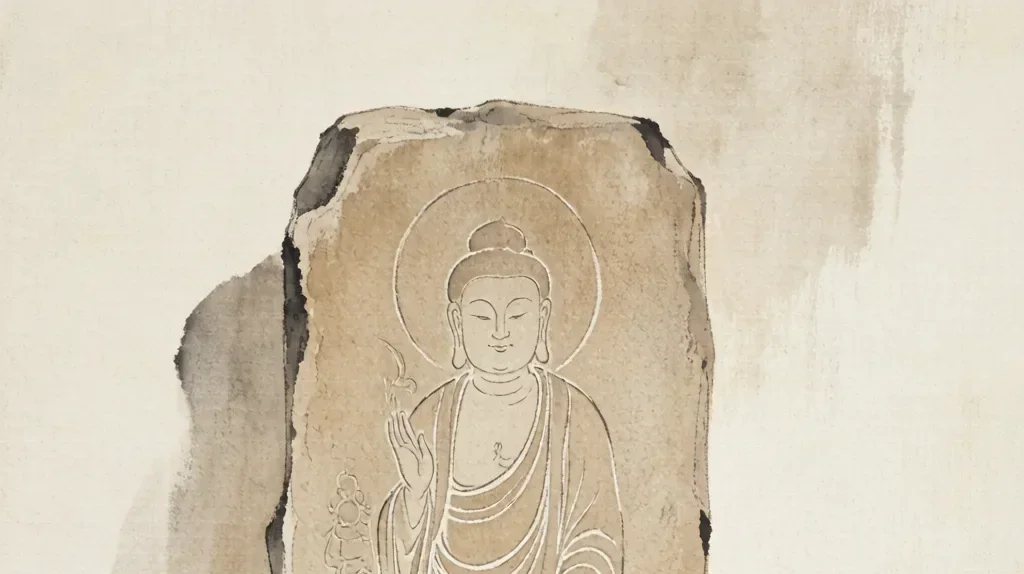
Shíkè (石刻), the art of stone engraving, is one of the oldest and most enduring forms of Chinese visual culture. For more than two thousand years, craftsmen and court artists have cut inscriptions, reliefs, and full statues into marble, limestone, and granite, turning cold rock into records of history, expressions of faith, and ornaments for bridges, tombs, and palaces. From the drum-shaped boulders of the Qin court to the towering Buddhas of the great cave-temples, stone engraving carries the memory of dynasties in a medium meant to outlast them.
The Earliest Stone Inscriptions
The earliest surviving Chinese stone inscriptions are traditionally attributed to the Qin dynasty (221–206 BCE), when the First Emperor had his achievements proclaimed on upright stones set up across the conquered lands. These imperial steles were both political statements and models of calligraphy, carved in the neat seal script of the age.
Even more famous are the stone drums (石鼓, shí gǔ): ten drum-shaped boulders, each inscribed with a poem in ancient seal script, probably produced in the Qin state before the empire was unified. Their rhymed hunting hymns are counted among the most treasured calligraphic works in Chinese history, and the stones themselves were treated as national treasures, carefully moved and preserved through later dynasties. They mark the moment when stone became a deliberate carrier of literature rather than merely a surface for images.
Han Dynasty Foundations
It was during the Han dynasty (206 BCE–220 CE) that stone engraving moved from scattered royal monuments into a broad, learned tradition. Confucian classics were cut into stone so that students could copy them accurately, and the deaths of officials and local worthies were marked by carved shrine tables and tomb doors.
The Wu family shrines (武氏祠, Wǔshì cí) in Shandong are the best-known survivors of this habit. Their walls are covered with low reliefs showing historical paragons, virtuous women, strange beasts, and processions of the afterlife. Carved in a confident, almost pictorial line, they give us a window onto Han beliefs about loyalty, filial piety, and the cosmic order. At the same time, stone funerary animals — winged lions, horses, and spirit-road guardians — began to stand before the tombs of the elite, a custom that would grow far grander in later centuries.
Stelae: The Stone Books of China
From the Han onward, the stele (石碑, shí bēi) became the standard way to publish an important text or record a great event "in stone that lasts forever." A typical stele is an upright slab crowned with a carved dragon or tortoise base, its face filled with finely engraved characters. Temples, academies, and government offices raised them to honor donors, fix land boundaries, or announce new laws.
The most scholarly use of the form was the engraving of the Confucian classics. In 837 CE, during the Tang, the Kaicheng Stone Classics were cut as 114 tablets bearing the approved texts of the Confucian canon, so that students copying them would not introduce errors. Today these and thousands of other tablets survive in the Forest of Stelae (碑林, Bēilín) in Xi'an, a museum holding more than 3,000 inscribed stones that together form a library in rock.
Cliff Inscriptions
Where a stele is a made object, a cliff inscription (摩崖石刻, mó yá shí kè) uses the mountain itself as the page. Carvers chose a smooth rock face on a sacred peak or a roadside cliff and cut large characters or whole poems straight into the living stone. Because the surface is uneven and the scale huge, these works read less as documents than as acts of devotion and display.
Mount Tai alone preserves over 2,200 surviving inscriptions, ranging from a single immense character carved by an emperor to long poems left by famous writers and pilgrims. Similar cliffs survive on Mount Hua, Mount Emei, and along old travel routes, turning whole landscapes into open-air galleries. The weathering of these inscriptions is now a serious concern, since once the stone flakes away the words cannot be restored.
Buddhist Cave Art: The Great Grottoes
The arrival of Buddhism from India transformed Chinese stone carving. Instead of flat tablets, artisans began to hollow temples out of cliff sides and fill them with carved images of the Buddha and the bodhisattvas. The great age of the grottoes runs from the Northern Dynasties (北朝, Běicháo, roughly the 4th–6th centuries) through the Tang.
At Yungang, near Datong, 5th-century carvers sponsored by the Northern Wei court cut vast Buddhas straight from the sandstone cliff, their faces bearing a mix of Central Asian and Chinese features. At Longmen, outside Luoyang, later Northern Wei and Tang emperors expanded a warren of niches into a mountain of serene, classically Chinese figures, including the famous giant Buddha of the Fengxian Cave. Centuries later, the Leshan Buddha in Sichuan — carved into a riverside cliff over the course of the Tang — became the largest stone Buddha in the world, its shoulders wide enough to shelter a crowd. These sites show stone engraving at its most ambitious, blending architecture, sculpture, and devotion.
Relief Carving and Funerary Art
Much of China's stone engraving is relief rather than free-standing statues: figures raised slightly above a flat ground, like drawings pressed into rock. Han tomb chambers used such reliefs to picture banquets, hunts, and mythical journeys. Later imperial tombs developed the "spirit way" (神道, shén dào), a long approach road lined with pairs of carved animals — lions, camels, horses, and horned beasts — together with human officials and tall ornamental pillars called huabiao (华表).
These guardian figures were never merely decorative. Each was placed by rule and ritual to protect the dead and to announce the rank of the person buried. The animals were idealized rather than natural, their muscles flattened and their postures frozen so that they would read clearly from a distance and survive centuries of weather. In this funerary world, stone engraving served both religion and state order.
Techniques and Tools
The basic toolkit of the stone carver is small but demanding: a hammer, a set of chisels of different widths, and a pointed punch for rough shaping. For fine lines and calligraphy the artisan works the chisel almost like a brush, controlling the depth so that each stroke has the same energy as ink on paper. Coarser rock is ground and smoothed with abrasive powders and water, then sometimes polished to a soft sheen.
To copy a finished inscription, craftsmen take a rubbing (拓片, tà piàn): damp paper is laid over the carved stone, pressed into every cut, and then inked so that the raised surface turns black and the incised characters stay white. Rubbings turned unique stones into portable texts and images, letting a stele in Xi'an be studied in Hangzhou or Kyoto. The skill of cutting and the skill of rubbing grew up together, two halves of one tradition of preserving words in stone.
Stone Statuary and Architectural Ornament
Beyond tombs and caves, stone carving dressed the everyday architecture of empire. The paired stone lion (石狮, shí shī) became the universal guardian of gates, bridges, and official compounds, often shown playing with a cub or resting a paw on a ball. Bridges gained marble rails and posts carved with lotus, clouds, and small crouching beasts; the Lugou Bridge (Marco Polo Bridge) near Beijing is famous for the hundreds of lively little lions crowded along its balustrades.
Palaces and gardens used engraved panels for screens, thresholds, and railings, while imperial workshops favored white marble (汉白玉, hàn bái yù) for its fine grain and pale, luminous color. Granite, harder and coarser, was chosen where strength mattered — sea walls, foundations, and outdoor steps meant to bear traffic for centuries. The right stone for the right place was a judgment passed from master to apprentice.
Cultural and Religious Meaning
Stone engraving in China is rarely "art for art's sake." A stele joins Confucian respect for recorded history; a cave Buddha joins Buddhist hope for merit and release; a spirit-way lion joins the Daoist and popular concern to ward off harm and keep order between the worlds of the living and the dead. The same craft thus served the court, the monastery, and the family altar.
The durability of stone also carried a philosophy. To carve a text in rock was to say that the truth it held should not fade with the paper it was written on. Emperors used this permanence to claim legitimacy; families used it to honor ancestors; pilgrims used it to fix a prayer where wind and rain would slowly, but not quickly, erase it. In every case, stone was chosen because it was the closest thing to forever.
Preservation and Modern Practice
Today many forms of stone engraving are listed as Intangible Cultural Heritage, and the great grottoes — Longmen, Yungang, and others — are protected as UNESCO World Heritage sites. Conservators battle air pollution, water seepage, and the simple slow cracking of age, using science to slow what they cannot reverse. Museums display rubbings and original fragments so that the public can meet the works without adding to their wear.
At the same time, the craft is alive in workshops from Quyang in Hebei — long famous for its marble carvers — to the temples still being maintained in the south. Young artisans learn both the old hand methods and modern power tools, and some blend traditional motifs with contemporary design for gardens and interiors. The stone lion still guards new gates, the stele still marks important occasions, and the chisel still answers the rock, much as it has for two thousand years.
📝 Chinese Vocabulary
🎉 Fun Facts
❓ Frequently Asked Questions
What is stone engraving (石刻) used for?
It serves many purposes: Buddhist statuary, funeral monuments and tomb guardians, inscribed steles that record history and texts, and the decorative lions and rails of bridges and palaces.
Which stones are traditionally used?
White marble (Hanbaiyu) for fine imperial and architectural work, limestone for steles and reliefs, and granite where outdoor durability is most important.
What are the most famous examples of Chinese stone carving?
The Leshan Buddha, the Longmen and Yungang grottoes, the Forest of Stelae in Xi'an, and the marble rails of the Lugou Bridge are among the best known.
How are stone rubbings (拓片) made?
Damp paper is laid over the carved stone and pressed into the cuts, then ink is applied so the raised surface turns black and the incised characters remain white, reproducing the inscription.
When did the great Buddhist cave-temples appear?
The major grottoes were cut from the Northern Dynasties (北朝) through the Tang dynasty, with Yungang and Longmen being the best-known early and mature examples.
Is stone engraving still practiced today?
Yes. Many forms are protected as Intangible Cultural Heritage, the great sites are conserved as World Heritage, and workshops from Quyang to the south still train new carvers.