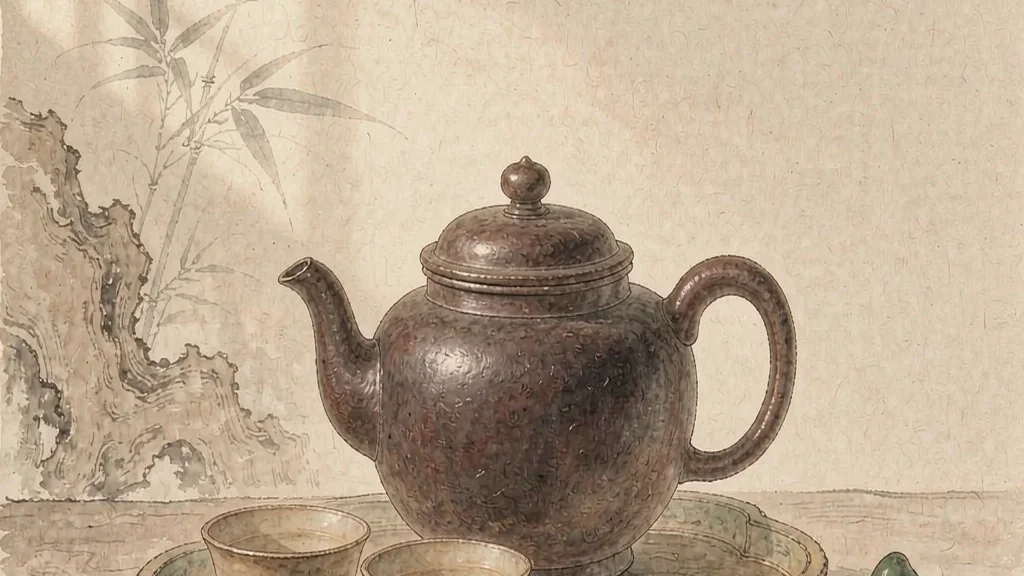
Yíxīng zǐshā (宜兴紫砂), Yixing purple-clay teapots, are unglazed stoneware whose porous body is said to improve tea with use.
The Zisha Clay: Purple, Red, and Yellow Sands
Yixing clay is not a single material but a family of three primary clays: zisha (紫砂, purple sand), hongni (红泥, red clay), and duanni (缎泥, yellow clay). These clays are composed primarily of kaolin, quartz, and mica, with significant iron content that gives them their distinctive colors. All three come from local deposits around Yixing.
The Art of the Yixing Teapot
Yixing teapots are traditionally made entirely by hand using the 'slab-building' technique or 'coiling' method, never on a potter's wheel. The potter works the clay into thin slabs that are cut, shaped, and assembled into the teapot form. The handle, spout, and lid are crafted separately.
Seasoning: The Soul of a Yixing Teapot
A Yixing teapot must be 'seasoned' (养壶, yǎng hú) through dedicated use with a single type of tea. As the pot is used, its unglazed interior absorbs tea oils and polyphenols, gradually developing a patina that enriches the flavor of the brew.
The Ming Dynasty Origins
Yixing teapots were first developed during the Ming dynasty. The shift from powdered tea to whole-leaf steeping created demand for a new type of teapot.
Famous Yixing Masters
The Ming dynasty potter Gong Chun (供春) is traditionally considered the first great Yixing master. The Qing dynasty saw the rise of Chen Mingyuan (陈鸣远).
Collecting Yixing Teapots
Antique Yixing teapots by renowned masters can command prices exceeding one million yuan at auction.
The Artistic Process and Techniques
The creation of this craft requires years of dedicated practice and mastery of specialized techniques. Artisans begin by carefully selecting raw materials, considering factors like texture, color, and quality. The process involves multiple steps, each requiring precision and patience.
Traditional techniques have been passed down through generations of master craftsmen. While modern tools have been adopted in some steps, the core artistic methods remain unchanged. The finest pieces can take weeks or even months to complete.
Each artisan develops their own style while staying true to traditional forms. This balance between innovation and tradition keeps the craft alive and relevant in the modern world.
Preservation and Modern Revival
In recent years, there has been a renewed interest in traditional Chinese crafts. The government has recognized many crafts as Intangible Cultural Heritage, providing support for training programs and cultural exhibitions. Young people are increasingly drawn to these ancient arts.
Museums and cultural centers across China now feature dedicated galleries for this craft. International exhibitions have introduced these traditional arts to global audiences, creating new markets and appreciation for Chinese craftsmanship.
Master artisans have opened workshops to train the next generation, ensuring that these ancient skills are not lost to modernization. The fusion of traditional techniques with contemporary design has opened exciting new possibilities.
Historical Development
The history of this topic spans thousands of years of Chinese civilization. Early records from ancient texts provide glimpses into its origins. Over successive dynasties the subject evolved significantly absorbing influences from different regions.
During the Tang and Song dynasties this field experienced a golden age. Scholars and practitioners refined techniques established standards and created works that influenced generations. The imperial court often patronized this art elevating its status.
The Ming and Qing dynasties saw further refinement. Increased trade brought new ideas from beyond Asia. This cross-cultural fertilization enriched the tradition while maintaining its Chinese character.
In the modern era efforts have been made to preserve traditional practices. The government has designated many related crafts as Intangible Cultural Heritage ensuring their survival.
Regional Variations
Different regions of China have developed their own distinctive styles. Northern styles emphasize bold forms and practicality reflecting harsh climates. Southern styles are more refined and decorative.
Eastern coastal regions developed interpretations influenced by maritime trade with Japan and Korea. Western regions with diverse ethnic populations incorporated elements from minority traditions.
Central China as the historical heartland represents the most classical forms. Many standard techniques were established here and spread to other regions.
Modern Applications
Today this tradition continues to evolve. Contemporary practitioners experiment with modern materials while respecting traditional forms. This creative tension between innovation and tradition drives the field forward.
International interest in Chinese culture has created global markets. Exhibitions and workshops have introduced these traditions to worldwide audiences fostering cross-cultural appreciation.
Educational institutions offer programs training the next generation. These combine traditional apprenticeship with modern approaches ensuring effective knowledge transmission.
Cultural Significance
This subject embodies core Chinese values. Its symbolism draws from Confucian ethics Daoist cosmology and Buddhist spirituality creating layers of meaning that reward deeper study.
Materials colors and forms all carry specific meanings. Motifs represent longevity prosperity happiness or spiritual protection. These choices reflect deliberate artistic and cultural decisions.
Rituals and ceremonies associated with this subject connect practitioners to centuries of tradition serving as living links to the past.
Materials and Tools
This craft requires specific materials carefully selected for properties. Traditional artisans developed deep knowledge of how sources seasons and preparation methods affect the final product.
Tools have been refined over centuries each serving a specific purpose. Mastering their use requires years of practice. Many tools are handmade by artisans adapted to personal techniques.
Traditional materials are increasingly difficult to source. Some crafts have adapted with sustainable alternatives while others maintain strict traditional standards.
Master-Disciple Transmission
The traditional method of learning was through apprenticeship with a master. Students began with basic tasks and gradually learned advanced techniques as they proved dedication. This relationship often lasted many years.
Masters imparted techniques aesthetic sensibilities work ethics and cultural values. Transmission was holistic encompassing both technical skills and philosophical understanding.
Modern training models include vocational schools and university programs. However the master-disciple relationship remains valued for its depth and personal guidance.
❓ Frequently Asked Questions
📝 Chinese Vocabulary
宜兴紫砂 — : Yixing purple sand; the signature clay of Yixing teapots.
养壶 — : Seasoning the pot; the process of developing a tea patina.
供春 — : Gong Chun; the first known Yixing master.
紫砂壶 — : Purple sand teapot; a Yixing teapot.
朱泥 — : Zhuni, a fine, dense red Yixing clay prized for small, warm-toned pots.
西施壶 — : Xishi pot, a classic teardrop-shaped Yixing form named for the beauty Xi Shi.
顾景舟 — : Gu Jingzhou, a twentieth-century master whose signed pots set modern auction records.
开壶 — : Kai hu, the ritual of boiling a new pot to clean and prepare it before first use.
🎉 Fun Facts
- Yixing clay contains 7–12% iron, which gives it its distinctive colors and tea-enhancing properties.
- A well-seasoned Yixing teapot can brew a flavorful cup of tea even with just hot water — the tea essence absorbed in the clay is enough.
- The most expensive Yixing teapot ever sold fetched over 17 million yuan at auction.
- A new Yixing pot is traditionally dedicated to a single type of tea, because the porous clay absorbs aromas that mixing different leaves would blur.
- The natural clay beds around Yixing are strikingly small, confined to a few low hills near the town rather than a broad region.
- Many contemporary makers press their own name chop into the soft clay of the lid and base as a personal signature.